February 26 News: The U.S. Senate Democrats recently held a meeting focused on advancing legislation for the cryptocurrency market structure, with key attention on the CLARITY Act and its feasibility for implementation in 2026. The bill aims to clarify the regulatory roles of the U.S. Securities and Exchange Commission (SEC) and the Commodity Futures Trading Commission (CFTC), establishing a clearer compliance framework for digital asset platforms, stablecoin issuers, and the DeFi ecosystem. It is seen as a significant milestone in U.S. crypto regulation policy.
Currently, the White House’s policy coordination deadline of March 1 is approaching. The rules on stablecoin yields have become a major point of contention between the two parties. Democrats favor strengthening investor protection, limiting potential financial risks, and emphasizing anti-money laundering and banking regulation compatibility; Republicans and the crypto industry, on the other hand, support a regulatory environment that encourages technological innovation to maintain U.S. leadership in blockchain and artificial intelligence.
Meanwhile, senior executives from venture capital firm a16z, Marc Andreessen and Chris Dixon, briefed Senate Republicans on policies, highlighting the importance of the U.S. Senate crypto bill in maintaining America’s leadership in crypto asset regulation, AI innovation, and digital financial infrastructure. Collin McCune, head of government affairs at a16z, noted that the meeting focused on the future direction of crypto market structure legislation and AI strategic coordination.
At the industry level, whether stablecoins should be allowed to offer interest or yields remains a contentious issue. Industry representatives like Brian Armstrong questioned proposals to restrict yields, arguing that such restrictions could weaken the market competitiveness of USD stablecoins and impact the development pace of the U.S. digital asset ecosystem. Meanwhile, the Office of the Comptroller of the Currency (OCC) proposed a framework that allows stablecoin issuance but limits yield distribution, further intensifying policy disagreements between banks and crypto firms.
Additionally, the Senate is coordinating key provisions on tokenized asset regulation, DeFi compliance frameworks, and CFTC spot market rules, causing legislative progress to stall temporarily. Although the Agriculture Committee’s push for related regulatory details is seen as a positive sign, the bill still requires broader support from Democrats to proceed to a full vote.
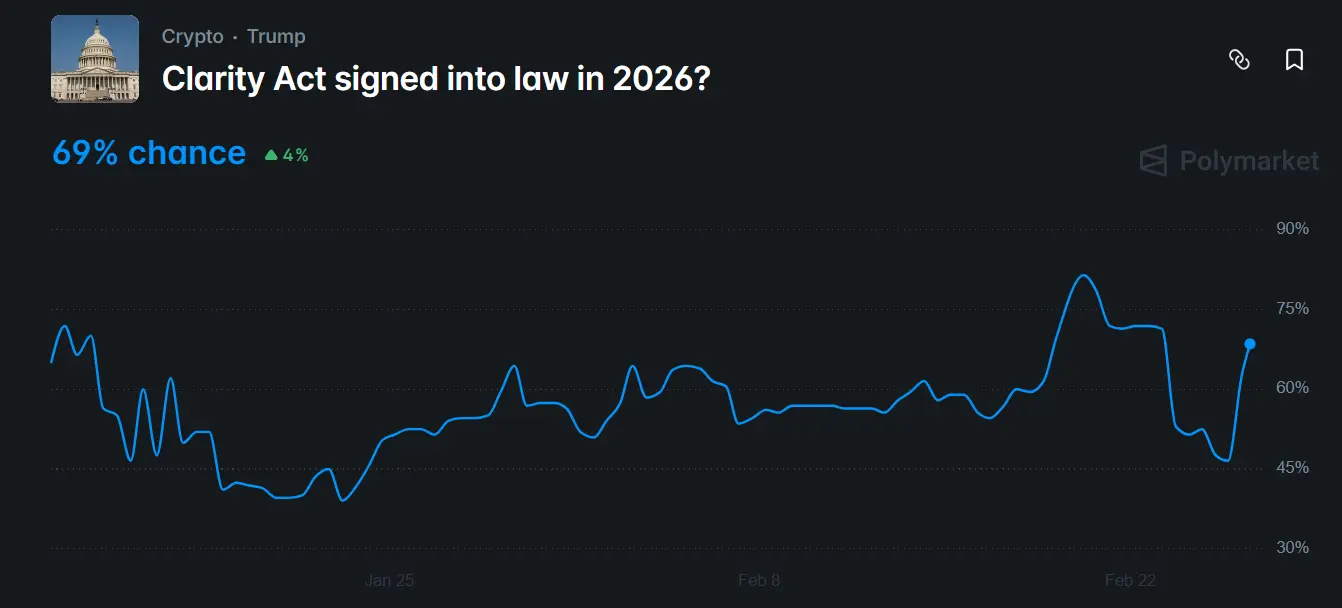 (Source: Polymarket)
Market prediction platforms show that after Trump’s speech on national issues, the probability of the CLARITY Act being signed into law by 2026 dropped to 47%. However, with the progress of Democratic meetings and increased policy lobbying, this probability has rebounded to 69%. This change reflects growing market expectations that U.S. crypto regulation will become clearer, stablecoin policies will be implemented, and the digital asset compliance framework will accelerate formation.
Disclaimer: The information on this page may come from third parties and does not represent the views or opinions of Gate. The content displayed on this page is for reference only and does not constitute any financial, investment, or legal advice. Gate does not guarantee the accuracy or completeness of the information and shall not be liable for any losses arising from the use of this information. Virtual asset investments carry high risks and are subject to significant price volatility. You may lose all of your invested principal. Please fully understand the relevant risks and make prudent decisions based on your own financial situation and risk tolerance. For details, please refer to
Disclaimer.
Related Articles
NFT Buyers This Week Doubled, Ethereum Sales Remain Top Position
This week, the NFT market showed active trading with buyer numbers growing 100.75% to reach 236,771 people, and seller numbers increasing 141.83% to 295,021 people, but total transaction volume declined 31.63% to 903,279 transactions. Ethereum and Polygon performed outstandingly, particularly with Polygon's Courtyard series experiencing significant sales growth. Analysis indicates that despite the increase in buyers, the average purchase quantity per person has declined, resulting in limited overall sales growth.
GateNews5m ago
Robinhood Launches $1.5 Billion Stock Buyback Program as Stock Price Falls 39% by 2026
Robinhood Markets approved a $1.5 billion stock buyback program on March 24, aimed at enhancing shareholder confidence and optimizing capital returns. The plan will be implemented starting in the first quarter of 2026, with a timeline of approximately three years. This move reflects management's confidence in the company's long-term development and may help alleviate market pressure from stock price declines.
GateNews41m ago
Pump.fun Allows Creator Fees to Be Adjusted Only Once After Launch, Trading Volume Drops Significantly
Memecoin token issuance platform Pump.fun has updated its fee distribution mechanism, allowing token issuers to change the fee recipient only once, in order to prevent malicious manipulation. Community reactions are mixed; some users believe the change has limited impact. Platform activity and revenue have declined, with income and trading volume in 2026 dropping sharply, highlighting the need to optimize the incentive balance between creators and traders.
GateNews43m ago
South Korea's Cryptocurrency Outflows Reach $60 Billion in Second Half of 2025, Exchange Profits Plummet
The South Korean Financial Services Commission report indicates that cryptocurrency outflows will reach $60 billion in the second half of 2025, primarily flowing to overseas platforms, while local exchange user numbers are growing but profits are declining. The total market capitalization and trading volume of the crypto market are expected to decline, with investors focusing on the impact of international markets and geopolitical factors on prices.
GateNews1h ago
South Korea's Crypto Asset Outflows of $60 Billion in H2 2025, Exchange Profits Decline Sharply by 38%
The Korea Financial Services Commission report shows that in the second half of 2025, cryptocurrency asset flows to overseas platforms and self-custody wallets are projected to reach $60 billion, with a 14% increase. Despite growth in local exchange users and deposits, operating profits have declined significantly, primarily due to price volatility affecting market trading volume and profitability.
GateNews1h ago
Hyperliquid Launches PURR Stock Options Trading
Hyperliquid Strategies Inc has launched options trading for PURR on Nasdaq to enhance liquidity and price discovery. CEO David Schamis highlights improved risk management for investors. The company reported significant growth, but incurred a net loss due to HYPE price volatility.
TapChiBitcoin1h ago


