Karik254

vip
Age 2.5 Yıl
Peak Tier 0
No content yet
I do business, I deal on deals if you have a good deal you get it to me if I like it i buy your deal if you have money to buy my own i give you my deal you pay that's business 😂
post-image
  • Reward
  • Comment
  • Repost
  • Share
I do business, I deal on deals if you have a good deal you get it to me if I like it i buy your deal if you have money to buy my own i give you my deal you pay that's business 😂
KevinLeevip
"From Pair Programming to Full Team Empowerment: How Gate Embraces the AI Development Paradigm"
And Gate's attitude towards this matter is very clear: we do not treat AI as a decorative toy, but as the foundation of next-generation productivity. Based on this irreversible trend and in line with the internal mainstream consensus, we choose to fully embrace AI and various vibe coding tools, encouraging colleagues to continuously push boundaries and drive innovation, so that AI truly becomes an integral part of daily development and business iteration.
repost-content-media
  • Reward
  • 1
  • Repost
  • Share
Karik254vip:
I do business, I deal on deals if you have a good deal you get it to me if I like it i buy your deal if you have money to buy my own i give you my deal you pay that's business 😂
  • Reward
  • Comment
  • Repost
  • Share
I do business, I deal on deals if you have a good deal you get it to me if I like it i buy your deal if you have money to buy my own i give you my deal you pay that's business 😂
CoinFixedProfitTradevip
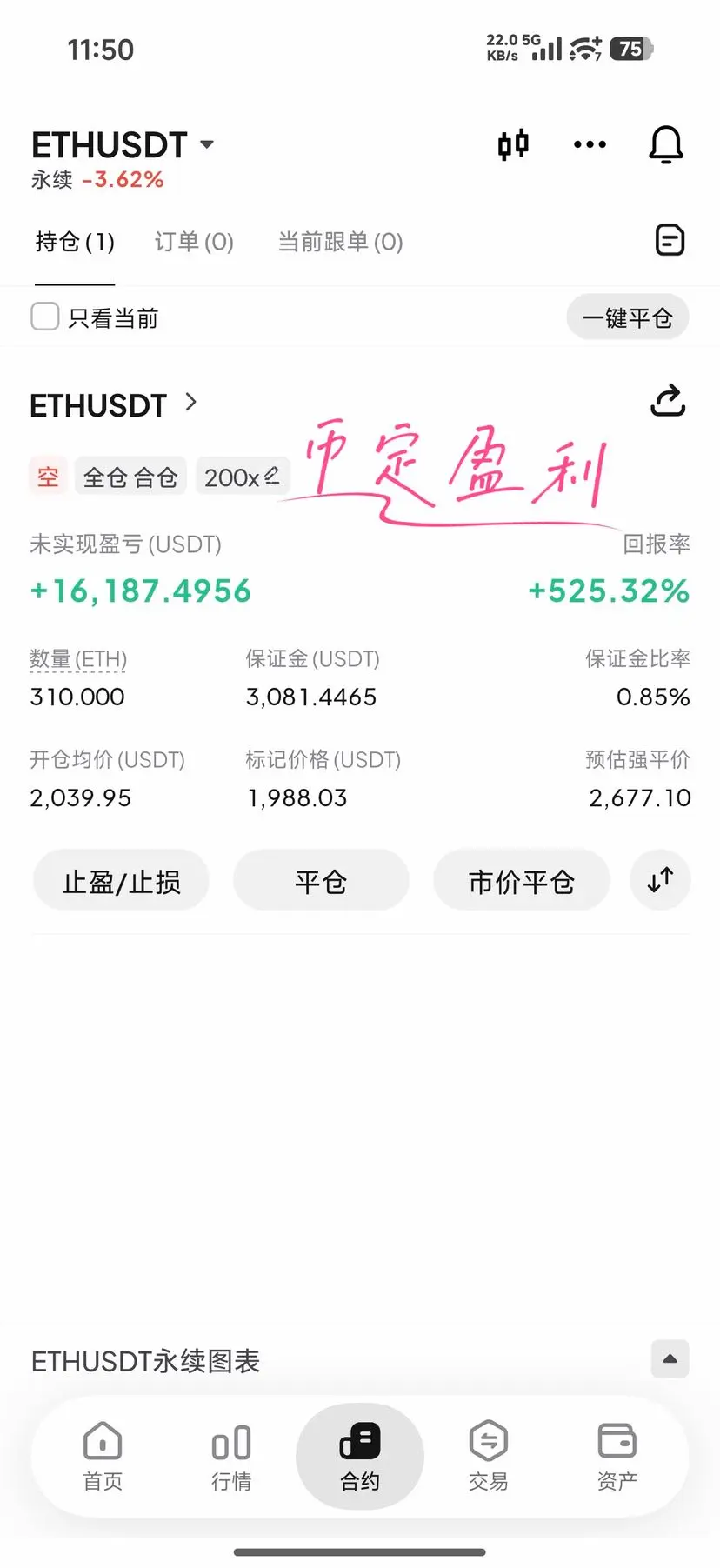
$ETH
BTC is eating meat, ETH can't fall behind 📈
Yesterday's bearish strategy also achieved great success on the second-largest coin!
A short position of 310 ETH is floating with a profit of over 16,000 USDT, with a return rate exceeding 525%.
The market's consistent decline tells us: respect the trend, profits will follow.
repost-content-media
  • Reward
  • 1
  • Repost
  • Share
Karik254vip:
I do business, I deal on deals if you have a good deal you get it to me if I like it i buy your deal if you have money to buy my own i give you my deal you pay that's business 😂
Yusfirahvip
#USHouseAdvancesTokenizedSecurities
The U.S. House of Representatives has just delivered what may be the most consequential week in American digital asset policy history, and most people are still not paying attention to what actually happened.
On March 26 2026, the House Financial Services Committee convened a formal hearing titled "Tokenization and the Future of Securities: Modernizing Our Capital Markets." This was not a preliminary discussion or an exploratory roundtable. It was a structured legislative proceeding designed to build the congressional record necessary to pass binding law governing how tokenized securities operate within the United States financial system. The timing was not accidental. It was the product of months of regulatory groundwork, cross-agency coordination, and bipartisan negotiation converging in a single legislative window.
To understand why this hearing matters, you have to understand what led up to it.
On March 17, one week before the hearing, the Securities and Exchange Commission and the Commodity Futures Trading Commission jointly published a 68-page interpretive release that formally entered the Federal Register on March 23. This document established, for the first time in U.S. regulatory history, a five-category taxonomy for crypto assets. The five categories are digital commodities, digital securities, stablecoins, digital collectibles, and digital tools. Sixteen crypto assets were explicitly named as digital commodities not subject to securities law, including Bitcoin, Ethereum, Solana, XRP, Cardano, Chainlink, and even Dogecoin. More importantly for the tokenization story, real-world assets tokenized on-chain — bonds, equities, treasuries — were formally classified as digital securities, giving institutions a clear regulatory footing to build on for the first time.
Both SEC Chairman Paul Atkins and CFTC Chairman Michael Selig were explicit: this interpretive release carries persuasive authority but not the binding force of statute. Only Congress can provide that. And Congress is now moving to do exactly that.
Four days before the hearing, the SEC approved Nasdaq's proposal to allow tokenized securities to trade alongside traditional shares on the same order book. This was structural, not symbolic. A tokenized share and a conventionally issued share of the same company can now coexist within the same trading venue, settling on entirely different technical rails. The fact that this approval preceded the hearing by less than a week was not coincidental. Regulators and legislators were coordinating signal and action.
At the hearing itself, two witnesses defined the full scope of the challenge. Kenneth Bentsen Jr., President and CEO of SIFMA, the Securities Industry and Financial Markets Association, represented the custodians, clearing houses, broker-dealers, and investment banks that form the operational backbone of U.S. capital markets. His presence at the table confirmed something important: this is no longer a conversation happening between crypto-native companies and skeptical regulators. Traditional finance has entered the room as an active participant, not a reluctant observer. The institutions that would need to integrate tokenized settlement into infrastructure built over decades for a different technical reality are now asking Congress to give them the legal framework to do it.
Summer Mersinger, CEO of the Blockchain Association and a central figure in the CLARITY Act negotiations, testified from the digital asset industry side. Her argument was direct: the absence of a clear statutory architecture for tokenized securities is not just a policy inconvenience. It is a structural constraint on the pace at which production-grade financial infrastructure can be built and deployed. Every institution that launches a tokenized product today is making its own private legal determination about what that product is and which regulator governs it. That is not a sustainable model at the scale this market is approaching.
Two new bills were introduced in connection with the hearing: the Modernizing Markets Through Tokenization Act of 2026 and the Capital Markets Technology Modernization Act of 2026. Both are aimed at closing the legal gaps that currently force institutional participants to operate without statutory backing.
The broader legislative context here is the CLARITY Act, which passed the House on July 17, 2025 with a bipartisan 294-134 vote. The Senate Agriculture Committee advanced its portion in January 2026. The Senate Banking Committee markup, which is the final required legislative step before a full Senate floor vote, is now targeted for the second half of April 2026. This timeline was unlocked this week when Senators Thom Tillis of North Carolina and Angela Alsobrooks of Maryland reached a stablecoin yield agreement in principle, resolving what had been the most contentious outstanding dispute in the bill — whether platforms can pay interest to users holding stablecoins. Capitol Hill review sessions for the compromise text began on March 23.
The CLARITY Act, once enacted, will be the first statute in U.S. history to draw a hard legal boundary between digital commodities under CFTC jurisdiction and digital securities under SEC jurisdiction. Every subsequent legal question about a tokenized asset — which registration requirements apply, which exchanges can list it, which investor protections attach to it, which enforcement mechanism governs any violation — flows from that single statutory determination.
The market being regulated is not hypothetical. As of March 23, 2026, the on-chain tokenized real-world asset market stood at $26.48 billion, up 5.25% in the previous 30 days alone. Total represented asset value including platform-locked tokens reached $387.35 billion. BlackRock, JPMorgan, Franklin Templeton, and Circle have all deployed institutional-grade tokenized products. Bank of Montreal announced this week a tokenized cash platform built in collaboration with CME Group and Google Cloud, targeting a second-half 2026 launch subject to regulatory approval. The infrastructure buildout is already underway. What has been missing is the legal architecture to govern it at scale.
The NASAA, the North American Securities Administrators Association, submitted a letter for the hearing record calling for any follow-up legislation to preserve regulatory parity between tokenized and non-tokenized securities, maintain state oversight powers, and protect comprehensive enforcement authority regardless of the underlying technology. This represents the cautionary voice in the room: move fast, but do not hollow out the investor protections that took decades to build.
What makes this moment different from every previous attempt at U.S. crypto legislation is the convergence. In the span of roughly 60 days, the United States has produced a joint SEC-CFTC taxonomy with Federal Register authority, SEC approval of Nasdaq's tokenized securities integration, two new House bills, a dedicated committee hearing, a resolved stablecoin dispute, and a Senate markup timeline locked in for April. These are not parallel tracks. They are sequential steps in a single coordinated process. The March 25 testimony will directly inform how the Senate Banking Committee finalizes the securities provisions of the CLARITY Act in the weeks immediately following.
The price of Bitcoin today is around $70,000 and under short-term pressure. That is the noise. The signal is that the regulatory infrastructure enabling the next decade of institutional crypto adoption is being assembled piece by piece, this week, in real time. Regulatory clarity is the single largest unlocking mechanism for institutional capital. Every major asset manager that has spoken publicly on the subject has said exactly this. The capital is not absent. It has been waiting for the legal foundation to stand on.
When the CLARITY Act clears Senate markup and the two new tokenization bills advance through committee, the real-world asset sector and the protocols powering compliant on-chain settlement, tokenized custody, and programmable financial instruments will be positioned to absorb flows that the current market structure simply cannot yet accommodate. The projects building that infrastructure quietly, without the speculative premium that accompanies trending narratives, are the ones whose positioning will matter most when the door fully opens.
The regulation is not coming. It is here, being written, and the people writing it are moving faster than the market has given them credit for.
repost-content-media
  • Reward
  • 1
  • Repost
  • Share
Karik254vip:
I do business, I deal on deals if you have a good deal you get it to me if I like it i buy your deal if you have money to buy my own i give you my deal you pay that's business 😂
The only legit guys in town are "Rwandans" njugu za 20bob ni envelope ya 1kg sugar size, then kukupea he has to bend abit as sign of humility, once these civilians will get their own properties I will buy from them.
Yusfirahvip
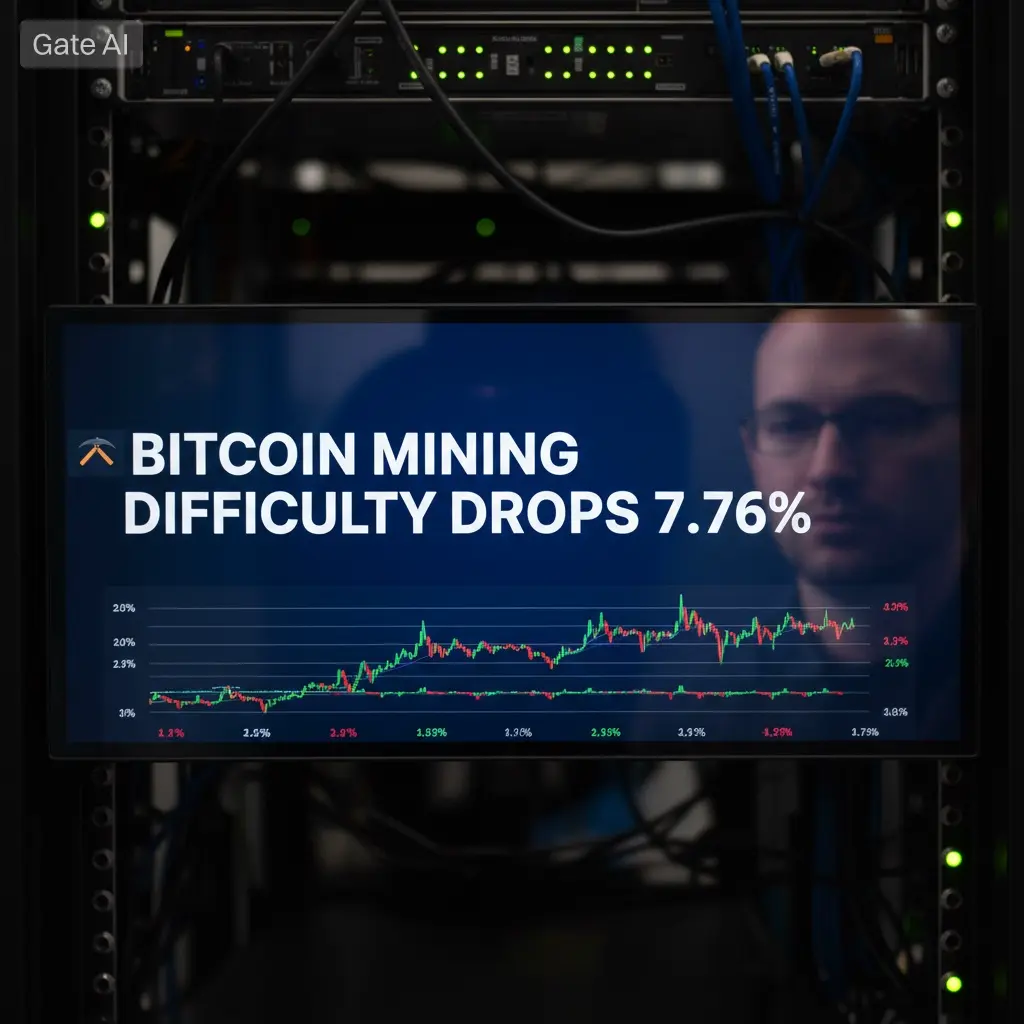
#BitcoinMiningDifficultyDrops7.76%
The latest adjustment in Bitcoin mining difficulty a sharp 7.76% decline is more than just a technical recalibration; it is a signal that the underlying economics of the Bitcoin network are undergoing a meaningful shift. For a system designed to self-regulate through code, such a significant drop reflects changes in miner behavior, hash rate distribution, and broader macro pressures that are reshaping the mining landscape in real time.
At its core, mining difficulty adjusts approximately every two weeks to ensure that Bitcoin blocks continue to be produced roughly every 10 minutes, regardless of how much computational power (hash rate) is participating in the network. When difficulty drops at this scale, it typically indicates that a substantial portion of miners have either reduced operations or temporarily exited the network. This can be driven by several converging factors, including rising energy costs, reduced profitability due to lower BTC prices, and increasing operational pressures following recent halvings and margin compression across the mining sector.
One of the most important dynamics behind this drop is the relationship between Bitcoin price and miner profitability. As BTC trades below certain cost thresholds, less efficient miners particularly those operating with higher electricity costs or outdated hardware are forced offline. This creates a natural “cleansing” effect within the network, where only the most efficient and well-capitalized operations survive. While this may appear bearish on the surface, it actually strengthens the network over time by redistributing hash power toward more sustainable and resilient participants.
At the same time, there is a growing structural shift occurring within the mining industry: the migration of hash power toward alternative high-performance computing use cases, particularly artificial intelligence (AI). As AI demand surges globally, some mining firms are reallocating infrastructure including GPUs, data centers, and energy contracts toward AI workloads that offer more stable and predictable revenue streams compared to the volatility of Bitcoin mining. This transition is subtly reshaping the competitive landscape, reducing total hash rate growth and contributing to downward pressure on mining difficulty.
From a market perspective, a drop in mining difficulty often carries mixed implications. On one hand, it can be interpreted as a sign of stress within the network, reflecting declining miner participation and potential short-term bearish sentiment. On the other hand, it can also signal a potential bottoming phase, where forced selling from struggling miners begins to ease, reducing sell pressure on the market. Historically, periods of declining difficulty have sometimes preceded price stabilization or recovery, as weaker hands exit and the market resets.
Another key factor to consider is miner behavior following such adjustments. With lower difficulty, remaining miners can produce blocks more easily, increasing their BTC rewards relative to their computational input. This improves profitability margins for those still active, potentially reducing the need to immediately sell mined BTC to cover operational costs. As a result, selling pressure from miners may decrease in the short term, creating a more balanced supply-demand dynamic in the market.
From a strategic standpoint, this development aligns with broader trends in the crypto ecosystem, where efficiency, scale, and capital access are becoming increasingly critical. Large, institutional-grade mining operations with access to cheap energy and advanced infrastructure are gaining dominance, while smaller players struggle to compete. This consolidation is gradually transforming Bitcoin mining from a fragmented industry into a more structured and capital-intensive sector.
In my view, this 7.76% difficulty drop should not be seen in isolation. It is part of a larger narrative involving macroeconomic tightening, evolving energy markets, and the growing intersection between blockchain infrastructure and emerging technologies like AI. While short-term sentiment may interpret this as a sign of weakness, the long-term implications point toward a more efficient, resilient, and professionally managed mining ecosystem.
Ultimately, Bitcoin’s design ensures that it adapts to changing conditions. Difficulty drops are not failures — they are proof that the system is functioning exactly as intended. As weaker participants exit and stronger ones consolidate, the network continues to evolve, maintaining its core promise of decentralization and security while adjusting to the realities of a rapidly changing global economy.
The key question now is not whether difficulty will rise again — it inevitably will — but who will be in control of the hash power when it does.
repost-content-media
  • Reward
  • Comment
  • Repost
  • Share
  • Reward
  • Comment
  • Repost
  • Share
The only legit guys in town are "Rwandans" njugu za 20bob ni envelope ya 1kg sugar size, then kukupea he has to bend abit as sign of humility, once these civilians will get their own properties I will buy from them.
LighthouseSaysvip
Trump is just a damn loudmouth
They should shut his mouth for good
I missed my crude oil 103 short position
Got stopped out too early on my Bitcoin long
But it has nothing to do with Trump
I just think his attitude is too disruptive
repost-content-media
  • Reward
  • 1
  • Repost
  • Share
HighAmbitionvip:
good information with us
I do business, I deal on deals if you have a good deal you get it to me if I like it i buy your deal if you have money to buy my own i give you my deal you pay that's business 😂
CryptoThrovip
Bull run💹 will start with 👇
🐱 Wikicat ($WKC)
🐱 Billicat ($BCAT)
🥞 Crepe
🐶 Drover
🚀 JETO
🐱 Ocicat
🐸 Pepe
🐶 Shiba Inu
👑 The Kingdom Coin ($TKC)
Am I missing anyone?
repost-content-media
  • Reward
  • 1
  • Repost
  • Share
HighAmbitionvip:
thnxx for sharing information with us
I do business, I deal on deals if you have a good deal you get it to me if I like it i buy your deal if you have money to buy my own i give you my deal you pay that's business 😂
CryptoThrovip
Bull run💹 will start with 👇
🐱 Wikicat ($WKC)
🐱 Billicat ($BCAT)
🥞 Crepe
🐶 Drover
🚀 JETO
🐱 Ocicat
🐸 Pepe
🐶 Shiba Inu
👑 The Kingdom Coin ($TKC)
Am I missing anyone?
repost-content-media
  • Reward
  • 2
  • Repost
  • Share
HighAmbitionvip:
thnxx for the update information
View More
I do business, I deal on deals if you have a good deal you get it to me if I like it i buy your deal if you have money to buy my own i give you my deal you pay that's business 😂
asiftahsinvip
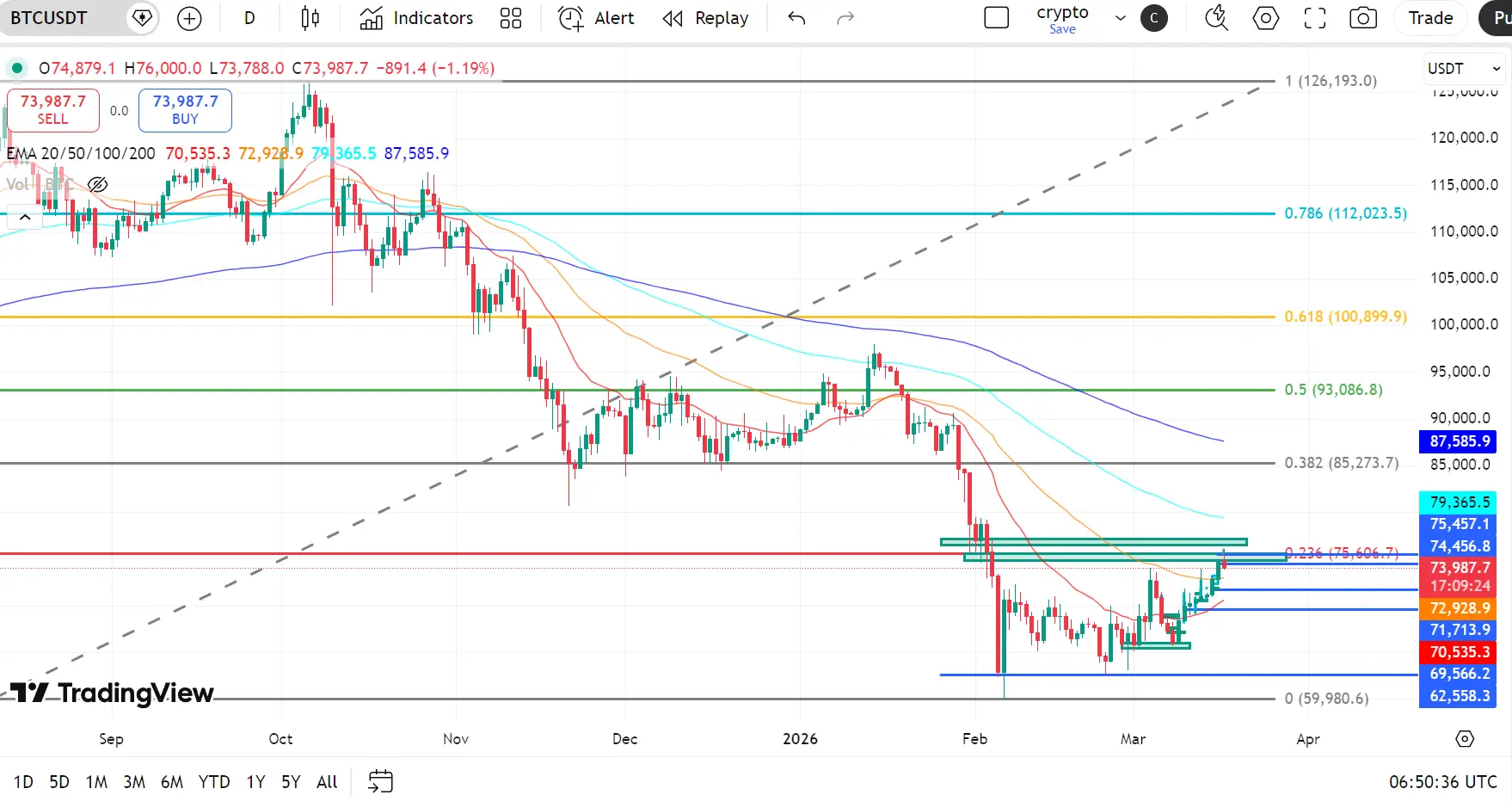
BTC Technical Outlook: Bitcoin Tests Key Resistance After Relief Rally from Cycle Lows
Bitcoin remains within a broader corrective structure despite showing short-term recovery strength following its rebound from the $59,980 macro base. The recent move higher reflects a relief rally after an extended decline, with price now approaching a critical resistance cluster.
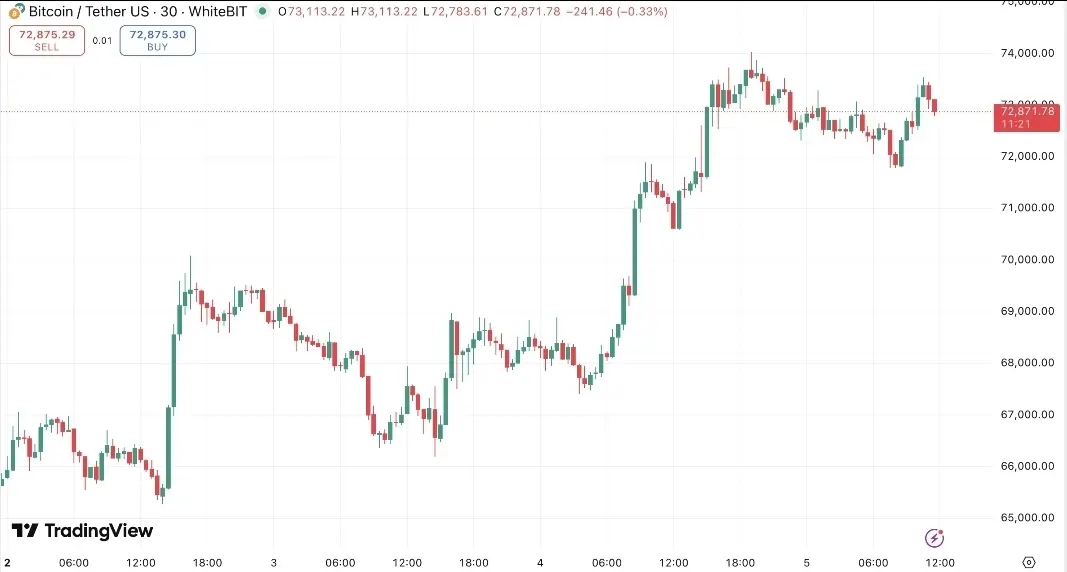
Currently, BTC is trading around $73,500–$75,000, testing the $75,600 resistance (0.236 Fibonacci level) — a key pivot zone that will determine whether the market transitions into a deeper recovery or resumes its bearish trend.
EMA Structure (Bearish with Early Recovery Signals)
20 EMA: $70,535
50 EMA: $72,928
100 EMA: $79,365
200 EMA: $87,585
Bitcoin has reclaimed the 20 and 50 EMAs, signaling improving short-term momentum.
However, price remains below the 100 and 200 EMAs, indicating that the broader trend is still bearish. The $79K–$87K region continues to act as a strong macro resistance zone.
The 50 EMA ($72,900) is now acting as short-term dynamic support, confirming a shift in immediate market structure.
Fibonacci & Price Structure
0.786 Fib: $112,023
0.618 Fib: $100,899
0.5 Fib: $93,086
0.382 Fib: $85,273
0.236 Fib: $75,606
Fib 0: $59,980
Bitcoin is currently testing the 0.236 Fib level ($75,600) — a critical resistance that has historically acted as a rejection zone during corrective rallies.
A clean breakout and hold above $75,600 would open upside potential toward $85,000 (0.382 Fib).
Failure to break this level could result in rejection and continuation of the broader downtrend.
RSI Momentum
RSI is currently around 59, indicating bullish momentum building.
The move above the 50 level confirms increasing buying pressure, though the indicator is approaching levels where short-term consolidation or minor pullbacks may occur before continuation.
📊 Key Levels
Resistance
$75,600 (0.236 Fib)
$79,300 (100 EMA)
$85,200 (0.382 Fib)
Support
$72,900 (50 EMA)
$70,500 (20 EMA)
$65,000–$68,000 (demand zone)
RSI: 59 — bullish momentum
📌 Summary
Bitcoin is attempting a short-term bullish recovery, reclaiming key moving averages and testing the $75,600 resistance level.
A confirmed breakout above this zone could shift momentum toward a broader corrective rally targeting $85K–$93K. However, failure to break and hold above resistance would likely lead to renewed selling pressure, with a potential move back toward the $65K–$68K demand zone.
The market now sits at a decision point, where price action around $75K will define the next directional move.
$BTC #BitcoinBoomsAbove$75K
repost-content-media
  • Reward
  • Comment
  • Repost
  • Share
I do business, I deal on deals if you have a good deal you get it to me if I like it i buy your deal if you have money to buy my own i give you my deal you pay that's business 😂
Bit_ardizorvip
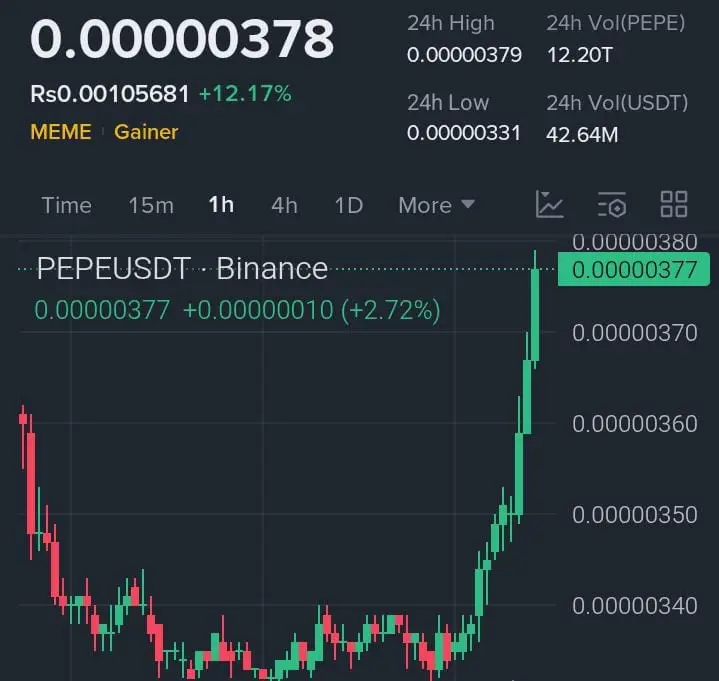
$PEPE Momentum Ignition → Meme Breakout Setup
EntryZone: 0.00000345–0.00000375
BullishAbove: 0.00000395
TP1: 0.00000440
TP2: 0.00000510
TP3: 0.00000620
SL: 0.00000320
repost-content-media
  • Reward
  • Comment
  • Repost
  • Share
I do business, I deal on deals if you have a good deal you get it to me if I like it i buy your deal if you have money to buy my own i give you my deal you pay that's business 😂
Bit_ardizorvip
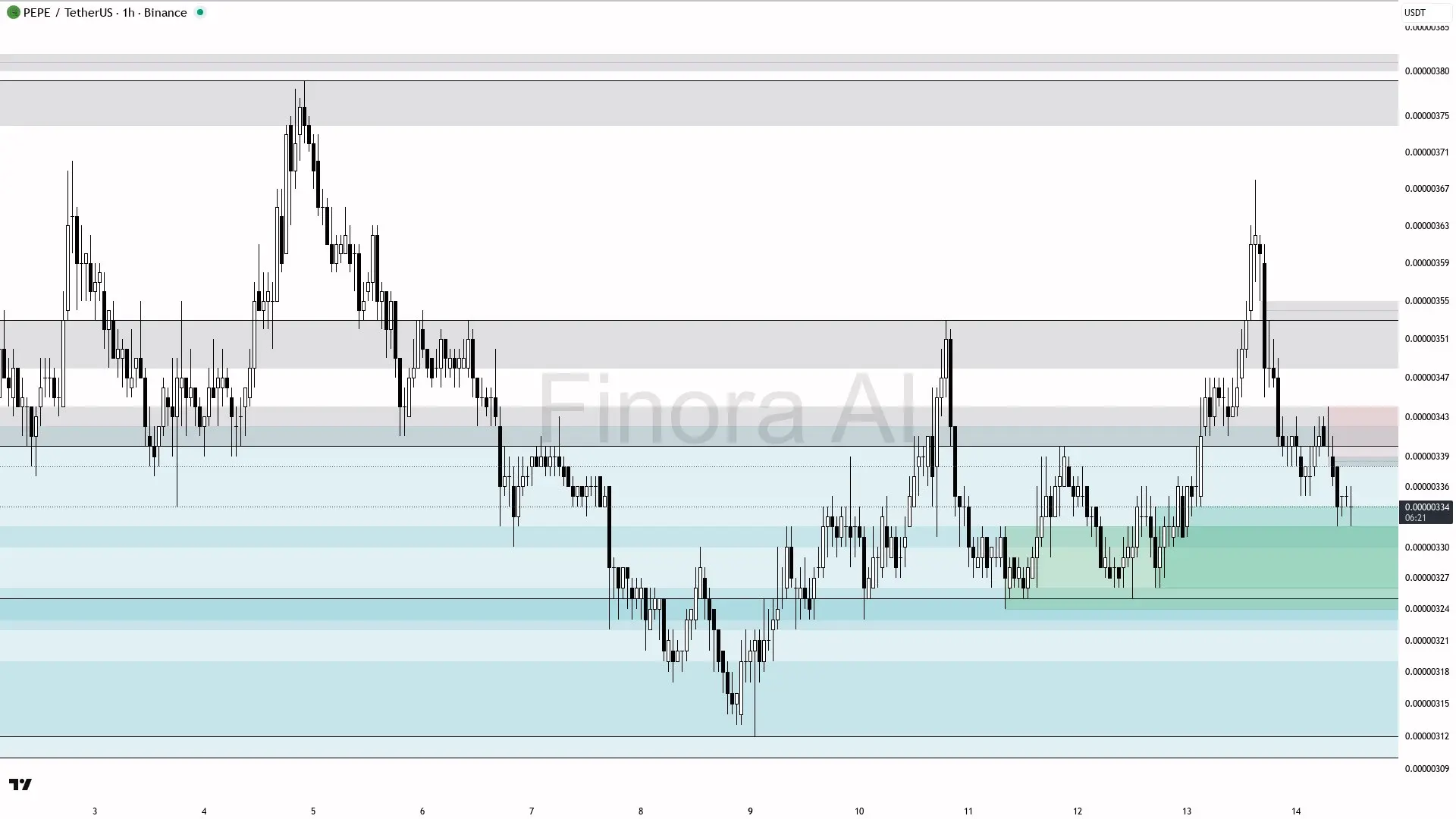
$PEPE 1h | Technical Outlook
- Bearish bias dominates across all major indicators except a faint short-term bullish hint
- Key resistance zone sits tight between 0.00000335 and 0.00000344, pressure mounting
- A drop towards 0.00000325 support could unlock a -7% move from current levels
- Low volume and volatility now set the stage for a sharp move soon
- Watch closely for a critical test near the recent low that could change everything...
repost-content-media
  • Reward
  • 1
  • Repost
  • Share
Karik254vip:
I do business, I deal on deals if you have a good deal you get it to me if I like it i buy your deal if you have money to buy my own i give you my deal you pay that's business 😂
Falcon_Officialvip
#CryptoMarketBouncesBack
As of March 13, 2026, Bitcoin (BTC) is trading in a range near $71,500–$71,600, showing signs of stabilization after a period of consolidation around the $70,000 mark. Recent data indicates that market participants are reacting to macroeconomic triggers and geopolitical influences, with price action oscillating around key psychological levels. Multiple market reports affirm that this range‑bound behavior reflects both bounce attempts and continued volatility as traders digest broader global trends.
Analysts note that Bitcoin’s movement near $70K has been influenced by ongoing easing in Middle East tensions and changing investor sentiment, which has helped lift BTC back toward major levels after earlier declines. This range‑based price action signals that the market is attempting to form a base before a potential directional move.
📈 #CryptoMarketBouncesBack What’s Driving BTC’s Recovery
The narrative of a crypto market rebound is supported by several factors:
Macro sentiment shifting: Recent geopolitical developments have bolstered risk appetite as traders assess commodities, equities, and digital assets in a new light. Bitcoin recently outperformed several traditional markets, indicating that investors may be favoring crypto as an alternative hedge amid instability.
Renewed capital inflows: Spot and ETF flows into Bitcoin products have seen uplifts in recent sessions, showing renewed interest from institutional and retail players.
Market psychology improving: Fear gauges like the Fear & Greed Index have shown slight improvement, reflecting cautious optimism and reduced panic selling pressure across crypto markets.
These combined forces contribute to the current bounce narrative, where BTC is attempting to reclaim key resistance and confirm support on lower timeframes.
📉 Key Technical Indicators Momentum, Support & Resistance
Technical analysis paints a nuanced picture of Bitcoin’s bounce:
RSI (Relative Strength Index):
Available market data suggests momentum oscillators were recently in buoyant territory reflecting strengthening buy interest on short timeframes. This shows that relief rallies are underway, though longer‑term RSI trends remain cautious until sustained breakouts occur above major resistance levels.
Support Zones:
$70,000 has acted as a critical pivot level serving as support during recent consolidation phases;
Below that, zones around $68,600–$68,050 have been important structural support, where buyers have historically stepped in. These zones are currently being monitored as foundational levels that confirm the bounce if defended successfully.
Resistance Levels:
Immediate resistance is noted near $70,800‑$71,000.
Further upside barriers cluster around $72,000 and above, which must be breached decisively for the market to confirm a bullish continuation.
Overall, the technical pattern suggests bounce attempts are genuine, but market direction depends on sustained support at higher levels and validation of breakout momentum.
📊 Market Structure & Price Action Bounce or Relief Rally?
Recent BTC price action shows that short squeezes and mechanical buying drives have played a role in the rebound. These moves can lift prices quickly but often lack strong spot demand fundamentals supporting long‑term growth. This dynamic suggests the bounce may partly reflect traders capitulating shorts and rapid tactical positioning rather than purely fundamental inflows.
At the same time, on‑chain and exchange data shows that selling pressure from long‑term holders has eased, and institutional flows have been more stable recently — both phenomena typically align with pre‑bounce market behavior historically.
Thus, while short‑term volatility remains high, BTC’s technical and on‑chain environment supports the bounce narrative in the near term, provided price holds above structural support zones.
📌 Sentiment & Broader Crypto Market Context
From the wider crypto ecosystem perspective:
Crypto market cap rebounding: Broader crypto indices and altcoin segments have also shown bounce signals, with DeFi total value locked and NFT activity climbing alongside Bitcoin’s recovery, indicating participation beyond just the flagship asset.
Investor confidence improving: Metrics such as improved trading volumes and market cap recoveries illustrate that sentiment is repairing after prior drawdowns.
Macro influences: Global market volatility and shifts in investor behavior toward risk assets have made BTC more attractive as diversification.
Together, these factors have contributed to Bitcoin’s ability to bounce back into higher trading ranges and stabilize after prior corrections.
📊 What Traders Are Watching Next
As traders and analysts assess Bitcoin’s trajectory in this bounce phase:
🔹 Bullish scenario: Sustained closes above $72,000 and defense of support near $70,000 could signal a larger trend reversal and renewed upside exploration toward higher resistance zones on the weekly timeframe.
🔹 Bearish risk: Failure to hold support levels could expose BTC to further range contraction or deeper pulls toward $68,000 or lower, especially if macro pressure re‑intensifies.
In either scenario, volume confirmation, macro data releases, and on‑chain insights will be key signals that help validate Bitcoin’s bounce or warn of renewed weakness.
⭐ Conclusion: BTC’s Bounce Real But Still Fragile
At current levels near $71,500–$71,600, Bitcoin is demonstrating a meaningful rebound after prior consolidation and volatility. The technical setup shows bounce behavior, with supportive momentum on short to medium timeframes and renewed interest from key market participants.
However, the recovery remains fragile until major resistance breaks decisively and broader indicators confirm long‑term strength. For now, BTC is bouncing back in the short run and the market will be watching the next few sessions closely to determine whether this marks a sustainable recovery or a temporary relief rally.
repost-content-media
  • Reward
  • 1
  • Repost
  • Share
Karik254vip:
I do business, I deal on deals if you have a good deal you get it to me if I like it i buy your deal if you have money to buy my own i give you my deal you pay that's business 😂
HighAmbitionvip
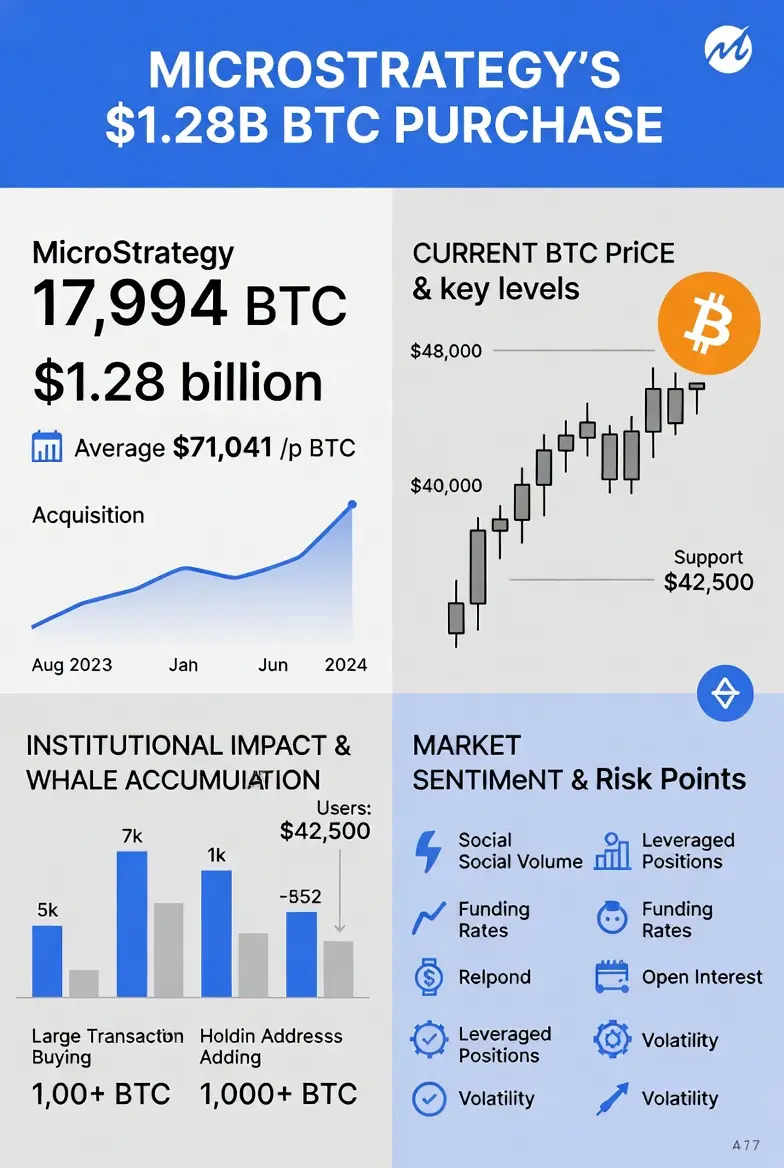
#MicroStrategyAddsBTCFor1.28B
On March 9, 2026, MicroStrategy, the prominent business intelligence firm led by Bitcoin advocate Michael Saylor, announced a massive Bitcoin acquisition totaling 17,994 BTC for approximately $1.28 billion, purchased between March 2 and March 8, at an average price of $70,946 per BTC. This move has immediate and broader implications for the cryptocurrency market, investor sentiment, and Bitcoin’s technical positioning.
1. Immediate Market Signals
Institutional Confidence Boost: MicroStrategy’s purchase signals continued institutional conviction in Bitcoin as a long-term store of value. When a public company invests over $1B in BTC, it reinforces the narrative that Bitcoin is a hedge against macro risks and fiat devaluation.
Market Liquidity: The purchase absorbed significant liquidity from the market, temporarily reducing available supply in the $68K–$72K range, supporting upward price pressure.
Psychological Impact: Retail and smaller institutional investors often interpret such high-profile acquisitions as bullish signals, encouraging additional buying.
2. Current Bitcoin Market Position
Price Range: BTC is currently trading between $68,000 and $70,500, with MicroStrategy’s average purchase price at $70,946 acting as a psychological resistance/support benchmark.
Market Cap Influence: BTC’s market cap hovers near $1.4–1.5 trillion, representing over half of the total crypto market cap (~$2.4–$2.5 trillion). This dominant position amplifies the impact of large institutional purchases.
Technical Levels:
Support: $68K, $66K
Resistance: $70.5K–$71K (short-term), $75K (medium-term target if bullish momentum continues)
Indicators: Funding rates positive, whale accumulation visible on-chain, Fear & Greed Index improving
3. Why MicroStrategy’s Move Matters
Reinforces BTC as “Digital Gold”: Companies allocating billions to Bitcoin demonstrate trust in BTC’s ability to store value against inflation, geopolitical instability, and fiat risk.
Institutional Adoption Momentum: Other publicly traded firms and hedge funds may follow, leading to cascading inflows into BTC and related ETFs.
Market Signaling: MicroStrategy often acts as a trendsetter; their move can stabilize sentiment during geopolitical tensions (like US-Iran-Hormuz risks) and support ongoing crypto rebounds.
4. Macro and Geopolitical Implications
Hedge Against Risk: With oil prices elevated and geopolitical risks high, BTC benefits from its non-sovereign nature. MicroStrategy’s accumulation reflects confidence in BTC as a hedge against global uncertainty.
Liquidity Considerations: Large purchases absorb sell-side liquidity, potentially reducing volatility from short-term panic moves.
Comparison to Past Moves: This mirrors prior strategies in 2020–2022, when MicroStrategy’s purchases preceded BTC rallies toward $75K–$80K, suggesting potential medium-term upside.
5. Market Psychology & Investor Sentiment
Retail Investors: Often follow high-profile purchases, increasing buying momentum and reducing fear-driven selling.
Institutional Investors: May view BTC as undervalued or ripe for accumulation after conflict-driven dips.
On-Chain Insights: Whale wallets show consolidation; BTC outflows to exchanges remain moderate, suggesting accumulation rather than imminent sell-offs.
6. Risks & Considerations
Market Volatility: Large purchases can temporarily support prices, but BTC remains sensitive to macro shocks, oil prices, and geopolitical events.
Short-Term Corrections: Even with institutional buying, short-term dips toward $66K–$65K remain possible, particularly if broader markets react to unexpected events.
Regulatory Factors: US SEC, global regulations, or ETF approvals/disapprovals could influence institutional appetite and market stability.
7. Historical Parallels
2020–2022 MicroStrategy Purchases: Each accumulation phase preceded strong BTC rallies, reinforcing the “institutional catalyst” theory.
Conflict Hedge Dynamics: During Ukraine 2022 and similar geopolitical risks, BTC outperformed equities and traditional hedges, validating large corporate accumulation strategies.
8. Full Market Takeaways
BTC Momentum: Currently bullish in the $68K–$70K zone, supported by institutional accumulation and macro tailwinds.
Psychological Levels: $70.9K (MicroStrategy average), $71K–$72K (short-term resistance), $75K+ medium-term target if momentum continues.
Institutional Flows: Strong driver of confidence, reducing panic selling and encouraging follow-on buying.
Geopolitical Hedge: BTC continues to benefit from tensions, oil risks, and macroeconomic uncertainties.
Technical Indicators: Positive funding rates, whale accumulation, and recovering Fear & Greed Index indicate potential continuation of upward trend.
Caution: Monitor oil prices, geopolitical updates, and regulatory news; large institutional purchases stabilize but do not eliminate volatility.
9. Conclusion
MicroStrategy’s $1.28B BTC purchase sends a powerful bullish signal. It highlights confidence in Bitcoin’s long-term hedge status, reinforces institutional adoption, and stabilizes the market amidst geopolitical uncertainty. While short-term volatility persists, BTC’s current momentum (~$70K zone) and accumulation trends suggest a medium-term bullish outlook, with $75K+ a realistic target if institutional and retail momentum continues.
Micro strategy add BTC for 1.28B is more than just a corporate acquisition—it’s a signal that Bitcoin is solidifying its position as a primary store of value for institutions, a hedge for global uncertainty, and a resilient market driver in 2026.
repost-content-media
  • Reward
  • Comment
  • Repost
  • Share
I do business, I deal on deals if you have a good deal you get it to me if I like it i buy your deal if you have money to buy my own i give you my deal you pay that's business 😂
HighAmbitionvip
#MicroStrategyAddsBTCFor1.28B
On March 9, 2026, MicroStrategy, the prominent business intelligence firm led by Bitcoin advocate Michael Saylor, announced a massive Bitcoin acquisition totaling 17,994 BTC for approximately $1.28 billion, purchased between March 2 and March 8, at an average price of $70,946 per BTC. This move has immediate and broader implications for the cryptocurrency market, investor sentiment, and Bitcoin’s technical positioning.
1. Immediate Market Signals
Institutional Confidence Boost: MicroStrategy’s purchase signals continued institutional conviction in Bitcoin as a long-term store of value. When a public company invests over $1B in BTC, it reinforces the narrative that Bitcoin is a hedge against macro risks and fiat devaluation.
Market Liquidity: The purchase absorbed significant liquidity from the market, temporarily reducing available supply in the $68K–$72K range, supporting upward price pressure.
Psychological Impact: Retail and smaller institutional investors often interpret such high-profile acquisitions as bullish signals, encouraging additional buying.
2. Current Bitcoin Market Position
Price Range: BTC is currently trading between $68,000 and $70,500, with MicroStrategy’s average purchase price at $70,946 acting as a psychological resistance/support benchmark.
Market Cap Influence: BTC’s market cap hovers near $1.4–1.5 trillion, representing over half of the total crypto market cap (~$2.4–$2.5 trillion). This dominant position amplifies the impact of large institutional purchases.
Technical Levels:
Support: $68K, $66K
Resistance: $70.5K–$71K (short-term), $75K (medium-term target if bullish momentum continues)
Indicators: Funding rates positive, whale accumulation visible on-chain, Fear & Greed Index improving
3. Why MicroStrategy’s Move Matters
Reinforces BTC as “Digital Gold”: Companies allocating billions to Bitcoin demonstrate trust in BTC’s ability to store value against inflation, geopolitical instability, and fiat risk.
Institutional Adoption Momentum: Other publicly traded firms and hedge funds may follow, leading to cascading inflows into BTC and related ETFs.
Market Signaling: MicroStrategy often acts as a trendsetter; their move can stabilize sentiment during geopolitical tensions (like US-Iran-Hormuz risks) and support ongoing crypto rebounds.
4. Macro and Geopolitical Implications
Hedge Against Risk: With oil prices elevated and geopolitical risks high, BTC benefits from its non-sovereign nature. MicroStrategy’s accumulation reflects confidence in BTC as a hedge against global uncertainty.
Liquidity Considerations: Large purchases absorb sell-side liquidity, potentially reducing volatility from short-term panic moves.
Comparison to Past Moves: This mirrors prior strategies in 2020–2022, when MicroStrategy’s purchases preceded BTC rallies toward $75K–$80K, suggesting potential medium-term upside.
5. Market Psychology & Investor Sentiment
Retail Investors: Often follow high-profile purchases, increasing buying momentum and reducing fear-driven selling.
Institutional Investors: May view BTC as undervalued or ripe for accumulation after conflict-driven dips.
On-Chain Insights: Whale wallets show consolidation; BTC outflows to exchanges remain moderate, suggesting accumulation rather than imminent sell-offs.
6. Risks & Considerations
Market Volatility: Large purchases can temporarily support prices, but BTC remains sensitive to macro shocks, oil prices, and geopolitical events.
Short-Term Corrections: Even with institutional buying, short-term dips toward $66K–$65K remain possible, particularly if broader markets react to unexpected events.
Regulatory Factors: US SEC, global regulations, or ETF approvals/disapprovals could influence institutional appetite and market stability.
7. Historical Parallels
2020–2022 MicroStrategy Purchases: Each accumulation phase preceded strong BTC rallies, reinforcing the “institutional catalyst” theory.
Conflict Hedge Dynamics: During Ukraine 2022 and similar geopolitical risks, BTC outperformed equities and traditional hedges, validating large corporate accumulation strategies.
8. Full Market Takeaways
BTC Momentum: Currently bullish in the $68K–$70K zone, supported by institutional accumulation and macro tailwinds.
Psychological Levels: $70.9K (MicroStrategy average), $71K–$72K (short-term resistance), $75K+ medium-term target if momentum continues.
Institutional Flows: Strong driver of confidence, reducing panic selling and encouraging follow-on buying.
Geopolitical Hedge: BTC continues to benefit from tensions, oil risks, and macroeconomic uncertainties.
Technical Indicators: Positive funding rates, whale accumulation, and recovering Fear & Greed Index indicate potential continuation of upward trend.
Caution: Monitor oil prices, geopolitical updates, and regulatory news; large institutional purchases stabilize but do not eliminate volatility.
9. Conclusion
MicroStrategy’s $1.28B BTC purchase sends a powerful bullish signal. It highlights confidence in Bitcoin’s long-term hedge status, reinforces institutional adoption, and stabilizes the market amidst geopolitical uncertainty. While short-term volatility persists, BTC’s current momentum (~$70K zone) and accumulation trends suggest a medium-term bullish outlook, with $75K+ a realistic target if institutional and retail momentum continues.
Micro strategy add BTC for 1.28B is more than just a corporate acquisition—it’s a signal that Bitcoin is solidifying its position as a primary store of value for institutions, a hedge for global uncertainty, and a resilient market driver in 2026.
repost-content-media
  • Reward
  • 1
  • Repost
  • Share
Karik254vip:
I do business, I deal on deals if you have a good deal you get it to me if I like it i buy your deal if you have money to buy my own i give you my deal you pay that's business 😂
TheBuzzingBeevip
🌟💥💫 BITCOIN (BTC) MARKET ANALYSIS: CONSOLIDATION AFTER $71K BREAKOUT - WHAT COMES NEXT?
Bitcoin (BTC) is currently trading around
$67,202 on the spot market, showing a -0.89%
decline over the past 24 hours with
approximately $277.30 million in USDT trading
volume. The recent price movement reflects a short-term pullback after Bitcoin experienced a strong rally earlier in the week.
Earlier in the week, BTC surged past several key technical levels, including the 200-week Exponential Moving Average (EMA) and the important $69,000 resistance zone, which previously marked the peak during the 2021 cycle. This breakout helped push Bitcoin toward a monthly high of approximately $71,893, marking one of the strongest upward moves seen in recent weeks.
The rally was partly driven by improving global risk sentiment. Easing geopolitical tensions, particularly surrounding Iran, contributed to renewed investor confidence across financial markets, including cryptocurrencies.
As a result, Bitcoin and several altcoins experienced strong buying momentum. Another important factor during the rally was the large amount of liquidations in the derivatives market. Within a 24-hour period, approximately $452 million in crypto positions were liquidated, with around $285 million coming from short positions. This indicates that many traders betting against the market were forced to close their positions, adding further buying pressure and accelerating Bitcoin's upward movement.
Despite this bullish breakout, Bitcoin has since retraced slightly to around the $67,000 level, suggesting the market may be entering a consolidation phase. Traders are now closely monitoring whether BTC can maintain strength above key support zones while preparing for the next potential move.
Market Sentiment and Key Metrics Recent sentiment indicators show that investors remain cautious despite the recent rally. The Crypto Fear & Greed Index recently dropped into the extreme fear zone around 10-12, reflecting lingering uncertainty among market participants.
At the same time, Bitcoin dominance remains
strong near 58.5%, indicating that BTC
continues to lead the broader crypto market. This dominance suggests that investors may still prefer Bitcoin over altcoins during periods
of uncertainty.
The total cryptocurrency market capitalization
currently fluctuates around $2.3 trillion, highlighting the significant scale of the digital asset market despite ongoing volatility. What Traders Are Watching Next Market participants are closely monitoring several upcoming macroeconomic developments that could influence Bitcoin's
direction . In particular, U.S. economic data such as the ADP employment report may affect expectations regarding Federal Reserve interest rate policy.
Changes in interest rate outlooks often impact risk assets like cryptocurrencies because they influence global liquidity conditions.
In addition, geopolitical developments remain an important factor for financial markets. Any
changes in international tensions could
quickly shift market sentiment and impact capital flows into crypto assets.
Market Outlook
Although Bitcoin has pulled back slightly from its recent highs, the broader structure still suggests a potential bottoming phase. Some analysts believe the market is showing stronger resilience than expected, which could support gradual recovery in the coming months.
For now, Bitcoin appears to be balancing between bullish technical signals and macroeconomic uncertainty. If BTC manages to stabilize above current support levels and regain momentum, another attempt toward the $70,000-$72,000 region could occur. However, traders should remain cautious in the short term as market volatility may continue while investors react to economic data and global developments. Overall, Bitcoin remains the dominant force in
the cryptocurrency market, and its next
directional move will likely set the tone for the broader digital asset ecosystem.
$BTC
repost-content-media
  • Reward
  • Comment
  • Repost
  • Share
I do business, I deal on deals if you have a good deal you get it to me if I like it i buy your deal if you have money to buy my own i give you my deal you pay that's business 😂
TheBuzzingBeevip
📊 𝐐𝐮𝐢𝐜𝐤 𝐂𝐫𝐲𝐩𝐭𝐨 𝐌𝐚𝐫𝐤𝐞𝐭 𝐃𝐢𝐠𝐞𝐬𝐭
BTC : Holding strong at $73,000 thanks to heavy institutional demand. In the last 24 hours, liquidations hit $472.88M. Bitcoin ETFs saw $155.2M inflows, signaling that big players are still buying.
ETH : Trading above $2,138, with ETH ETFs adding $130M inflows. Analysts note ETH is near a historically strong support zone, which could mean it’s undervalued right now.
Altcoins:
 • SOL is at $92.71, with $115 marked as the next big resistance if it breaks above $85.55.
 • XRP at $1.44 - needs to reclaim $1.466 to confirm bullish momentum.
 • Dogecoin broke out of a symmetrical triangle, possibly signaling the start of a stronger upward move.
 • Shiba Inu is steady at $0.0557, small gains but mostly sideways.
Market Trends:
 • Meme coins overall grew 0.9% to $32.8B.
 • Some traders warn Bitcoin is still following patterns from the 2022 bear market, so one more dip before a real recovery is possible.
 • Overall, the market is cautiously bullish, but confirmation is needed for a full trend reversal.
Institutions are back in, Bitcoin and Ethereum ETFs are seeing big inflows, and altcoins are following the trend. Watch key levels – BTC $76K, ETH $2,200, and XRP $1.466 - for signals of stronger bullish momentum.
$SOL $DOGE $XRP
repost-content-media
  • Reward
  • Comment
  • Repost
  • Share
I do business, I deal on deals if you have a good deal you get it to me if I like it i buy your deal if you have money to buy my own i give you my deal you pay that's business 😂
Yunnavip
Such an incredible post! I found it very helpful and interesting. It’s not easy to create content that connects with people, but you’ve done it perfectly. 👏
  • Reward
  • Comment
  • Repost
  • Share
  • Reward
  • Comment
  • Repost
  • Share
  • Pin