The Chinese government has issued its first official risk alert regarding the industrial infiltration of AI Agents, targeting the crayfish.
(Background: Beware! ClawHub hides 1,184 malicious skills: stealing crypto wallet private keys, SSH keys, browser passwords)
(Additional context: After the rise of OpenClaw: an open-source crayfish that has shaken up which U.S. stocks?)
The crayfish OpenClaw became an instant hit in China, with many tech giants promoting installation and providing one-click access to later-stage services, making it a popular AI tool among the public. While the crayfish gained popularity, Chinese authorities have started to contain it.
The China National Industrial Information Security Development Research Center (hereafter “Security Center”) issued a rare specialized risk alert on March 12, directly targeting OpenClaw’s rapid infiltration into domestic industrial sites. This marks China’s first official regulatory warning concerning AI Agent applications in industry.
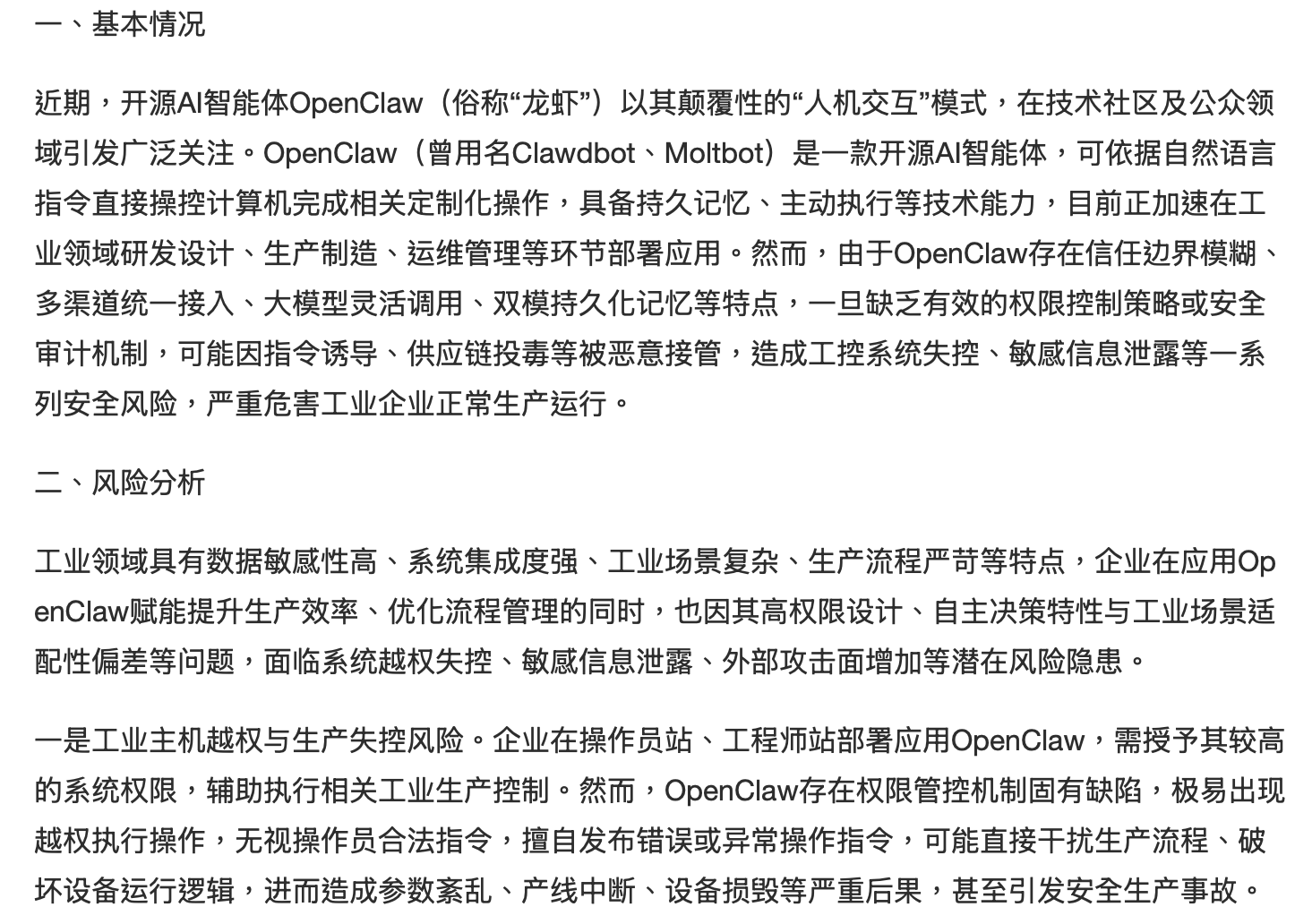
The alert states that OpenClaw is accelerating its deployment in industrial research and development, manufacturing, and operations management. The capabilities of AI Agents make them highly promising in factory environments, but the security risks they pose cannot be mitigated by traditional firewalls.
Three Major Industrial Risks of Using Crayfish
The Security Center specifically lists three risks:
1. Industrial Host Overreach and Production Control Risks: Attackers can use “prompt injection” techniques to induce Agents to execute commands beyond authorized scope, which may modify production parameters or, in severe cases, cause control system failures. In highly automated settings, a single malicious command could propagate through the Agent’s operation chain, affecting the entire production process.
2. Sensitive Industrial Information Leakage Risks: Once deployed in factories, OpenClaw often has the ability to read design documents, process parameters, and supplier data. If malicious modules are embedded into the Agent’s skill set via supply chain poisoning, these sensitive data could be exfiltrated unnoticed.
3. Expanded Attack Surface and Amplified Attack Effects: AI Agents inherently operate across multiple systems and platforms. This means that once compromised, attackers can use the Agent’s identity to coordinate actions across various systems, rendering traditional single-point defenses nearly ineffective.
Official Chinese Recommendations
The Security Center advises industrial enterprises to refer to the “Industrial Control System Network Security Protection Guidelines” and the “Industrial Internet Security Classification and Grading Management Measures,” and to conduct self-assessments based on the “Six Do’s and Six Don’ts” recommendations published by the Cybersecurity Threat and Vulnerability Information Sharing Platform (NVDB) of the Ministry of Industry and Information Technology.
The issuance of this alert signals a “sudden brake” by Chinese authorities on the rapid deployment of AI Agents in industry.
Disclaimer: The information on this page may come from third parties and does not represent the views or opinions of Gate. The content displayed on this page is for reference only and does not constitute any financial, investment, or legal advice. Gate does not guarantee the accuracy or completeness of the information and shall not be liable for any losses arising from the use of this information. Virtual asset investments carry high risks and are subject to significant price volatility. You may lose all of your invested principal. Please fully understand the relevant risks and make prudent decisions based on your own financial situation and risk tolerance. For details, please refer to
Disclaimer.
Related Articles
Belarus Approves Crypto Banks to Support 26 Cryptocurrencies and 11 Business Categories
Gate News message, April 24 — Belarus will allow crypto banks to support 26 cryptocurrencies and offer 11 types of services, according to Alexander Egorov, First Deputy Chairman of the National Bank of Belarus, speaking at the Digital Banking 2026 conference. The supported cryptocurrencies include m
GateNews30m ago
Declare Your Crypto or Face Jail: South Africa’s Aggressive New Capital Flow Rules
South Africa’s proposed capital flow management regulations 2026 introduce strict new requirements for travelers entering or leaving South Africa with cryptocurrency.
Key Takeaways
South African Treasury draft rules require visitors to declare crypto or face up to 5 years in prison.
New 2026 cap
Coinpedia8h ago
U.S. OCC Sets Draft Framework for Stablecoin Issuers Under GENIUS Act Framework
OCC draft sets federal rules for stablecoin issuers and custody services, focusing on safety and regulatory compliance.
Proposal excludes AML and sanctions rules, leaving those areas for separate coordination with Treasury agencies.
Framework marks initial step in multi-agency
CryptoFrontNews9h ago
Tether freezes $344 million in USDT on the Tron network: OFAC collaboration, two addresses implicated in sanctions evasion
According to a Decrypt 4/23 report, stablecoin issuer Tether froze two wallets on the Tron chain that day, totaling $344 million USDT—one of the largest single-instance freezing actions in Tether’s history. The entity coordinating the action did so in conjunction with the U.S. Treasury Department’s Office of Foreign Assets Control (OFAC) and U.S. law enforcement agencies. The two addresses were marked as allegedly involved in sanctions evasion, criminal networks, or other illegal activities.
Two Tron addresses total $344 million USDT frozen
Decrypt cites Tether data, saying that this freeze was concentrated on the Tron network, broken down into the following two transactions:
Address (prefix) Frozen amount Chain TNiq9…QZH81 About $213 million USDT Tron
ChainNewsAbmedia10h ago
JPMorgan: DeFi hackers are increasingly common, and interest in compression mechanisms to address TVL stagnation is drawing capital into USDT
JPMorgan Chase’s report believes that DeFi continues to face ongoing vulnerabilities, cross-chain bridge and oracle attacks are frequent, causing TVL to stagnate and weakening institutional investors’ willingness to invest, with capital shifting to USDT that is traceable and can be frozen. The KelpDAO and Rhea Finance attacks reveal risk-management risks; centralized stablecoins and custodial solutions are more favored. In the long run, improving this will require going beyond insurance and governance. DeFi will not be able to return to the 2021 era of high TVL, and stablecoins will become even more concentrated.
ChainNewsAbmedia10h ago


