Author: HIBIKI, Crypto City
FATF: Stablecoins the Top Choice for Illegal Transactions
According to the latest 42-page report from the Financial Action Task Force (FATF), stablecoins are currently the most popular virtual assets used in illegal transactions (including sanctions evasion). Participants include countries like Iran and North Korea, prompting calls for stricter regulation of stablecoin issuers.
FATF previously stated in January that stablecoins account for the majority of on-chain illegal activity transaction volume. The organization estimates that in 2024, illegal stablecoin activities related to scams and fraud will total approximately $51 billion.
North Korea and Iran Love Using Stablecoins
FATF further explained that North Korea’s Lazarus Group and other organizations use stablecoins to purchase military equipment; Iran’s Islamic Revolutionary Guard Corps also relies on stablecoins to acquire drone parts. Terrorist groups and drug trafficking organizations heavily depend on Tether ($USDT) and USDC for transferring funds and money laundering.
On July 2, 2025, Tether, the issuer of USDT, conducted the largest-ever freeze of Iran-related funds, freezing 42 cryptocurrency wallet addresses, over half of which are heavily linked to the local exchange Nobitex.
As a global standard-setting body focused on anti-money laundering, FATF points out that stablecoins, with features like price stability and high liquidity, are attractive tools for criminals to transfer funds.
Unsecured Wallets Become Vulnerabilities, Illegal Stablecoin Receipts Hit Record Highs
FATF’s latest report in March 2026 again warns that dollar-pegged stablecoins have become key tools in illegal financial activities.
The organization cites a report from blockchain analysis firm Chainalysis, stating that in 2025, illegal virtual asset transactions totaled $154 billion, with stablecoins accounting for 84%, a stark contrast to the Bitcoin-dominated illegal transactions of 2020.
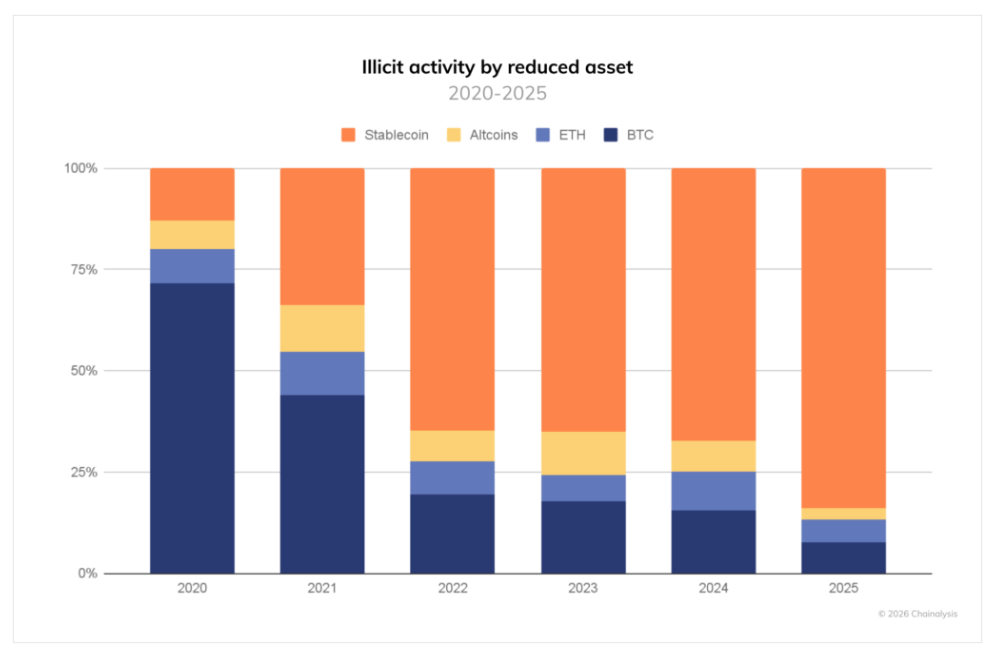
Source: Chainalysis | In 2025, illegal virtual asset transactions reached $154 billion, with stablecoins accounting for 84%
Additionally, according to a report released in mid-February by blockchain analysis firm TRM Labs, illegal entities received a total of $141 billion in stablecoins in 2025, setting a five-year high. The report notes that last year, overall stablecoin activity repeatedly exceeded $1 trillion per month, with activities related to sanctions accounting for 86% of illegal virtual asset flows.
The report emphasizes that malicious actors often hide their funds using cross-chain technology, decentralized exchanges, and OTC brokers. FATF points out that peer-to-peer transfers through non-custodial wallets are a critical vulnerability. These transactions occur in environments lacking anti-money laundering controls, making it difficult for regulators to track geographic locations and actual beneficiaries.
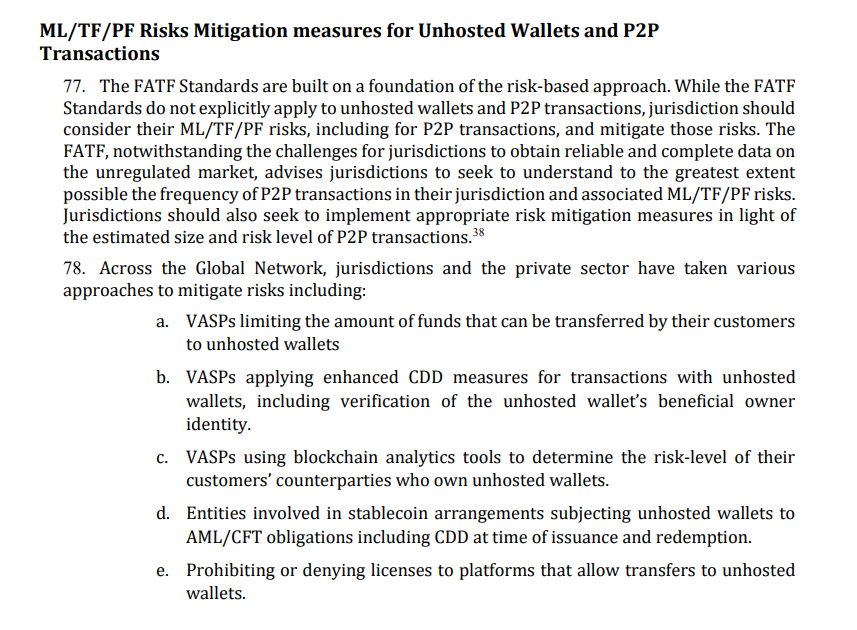
Source: FATF Report | FATF report states that peer-to-peer virtual asset transfers via non-custodial wallets are a key vulnerability
Stablecoin Market Cap Surpasses $300 Billion, Urgent Need for Regulation
It’s important to note that FATF does not call for a complete ban on stablecoins but strongly urges countries to impose anti-money laundering obligations on stablecoin issuers and intermediaries.
FATF recommends that stablecoin issuers utilize smart contract control features to establish whitelists and blacklists to restrict specific wallet transactions. Issuers should have the technical capability to intercept, freeze, and destroy suspicious stablecoins in secondary markets at any time. To address cross-border operational challenges, FATF encourages countries to establish transnational regulatory bodies to enhance information sharing and joint oversight.
Currently, the global stablecoin market value has exceeded $300 billion. As adoption accelerates and integration with traditional finance deepens, FATF believes that regulators worldwide must act swiftly and implement blockchain analysis tools to close regulatory and compliance gaps.
Disclaimer: The information on this page may come from third parties and does not represent the views or opinions of Gate. The content displayed on this page is for reference only and does not constitute any financial, investment, or legal advice. Gate does not guarantee the accuracy or completeness of the information and shall not be liable for any losses arising from the use of this information. Virtual asset investments carry high risks and are subject to significant price volatility. You may lose all of your invested principal. Please fully understand the relevant risks and make prudent decisions based on your own financial situation and risk tolerance. For details, please refer to
Disclaimer.
Related Articles
S&P 500 Index Futures Fall 0.3% as Trump Pledges to Extend US-Iran Ceasefire
S&P 500 futures fell 0.3%, recovering from earlier losses as Trump signaled extending the U.S.-Iran ceasefire.
Abstract: U.S. stock-index futures dipped before rebounding on news that President Trump intends to extend the U.S.-Iran ceasefire, signaling a potential easing of tensions and support for equities.
GateNews1h ago
Trump's Crypto Backing Reaches Historic $1.2B, Sparking National Security Concerns
Gate News message, April 21 — Federal filings reveal that Trump and the Republican Party have accumulated a historic $1.2 billion cash stockpile for the November midterms, with cryptocurrency executives playing a major role in funding the GOP war chest. Democrats currently hold only $261 million in
GateNews5h ago
U.S. Representatives Introduce PACE Act to Modernize Payment and Settlement System
Gate News message, April 21 — U.S. representatives introduced the Payments and Collections Enhancement (PACE) Act, legislation aimed at modernizing the American payment system.
The bill would allow eligible companies to directly access the Federal Reserve's payment infrastructure, reducing
GateNews5h ago
Crypto Hack Draining $300M May Slow Wall Street's Blockchain Ambitions
Gate News message, April 21 — A weekend hack that drained nearly $300 million from a small crypto project and triggered a $10 billion run on the largest decentralized lending platform may slow Wall Street's growing interest in blockchain technology, according to a report from Jefferies LLC released
GateNews5h ago
Poland's Crypto Legislation Stalled as MiCA Alignment Deadline Approaches, Triggering Business Exodus
Poland fails to override Nawrocki's veto on crypto regulation, delaying MiCA alignment by the July 1 deadline as firms relocate to Latvia, Czech Republic, Lithuania, and Malta amid regulatory uncertainty.
Poland's parliament again blocks the crypto regulation by Nawrocki's veto, leaving MiCA alignment to a future date and spurring domestic firms to move operations to other EU member states. The dispute centers on concerns about overregulation and broad KNF powers, intensifying political tensions and accelerating crypto outflows before MiCA's transition ends.
GateNews5h ago
U.S. Negotiators Arrive in Pakistan Over Past Two Days
Gate News message, April 21 — According to the Xinhua News Agency, Pakistani sources said on April 21 that U.S. negotiators have been arriving in Pakistan over the past two days.
GateNews5h ago


