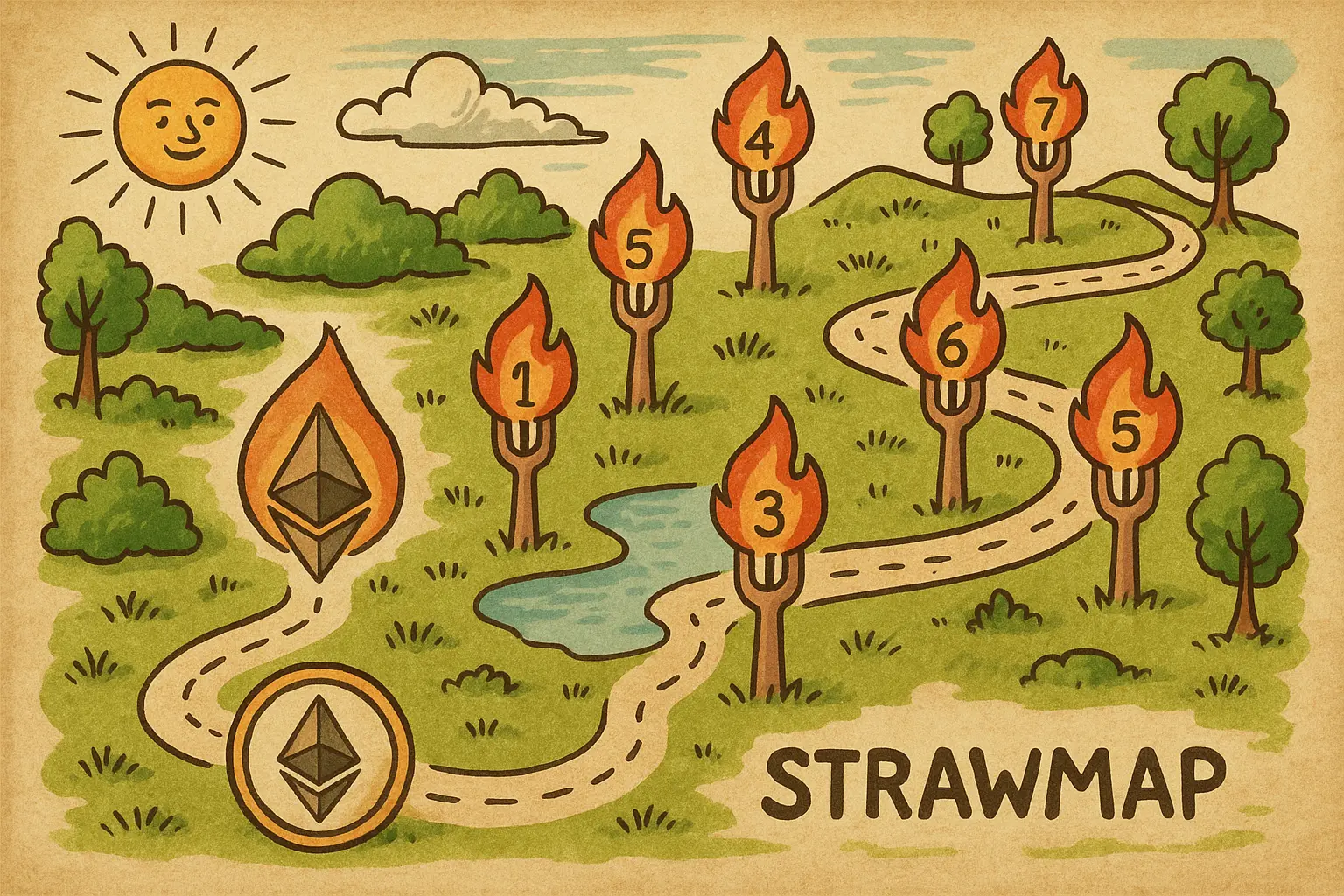
Ethereum Foundation researcher Justin Drake officially released the “Strawmap” roadmap on February 18, outlining plans to complete seven protocol forks by the end of 2029, with upgrades scheduled every six months. The roadmap focuses on L1 finality, Gigagas L1 scaling, Teragas L2 data processing, post-quantum cryptography security upgrades, and native L1 privacy protection.
Analysis of the Five Core Goals of Strawmap
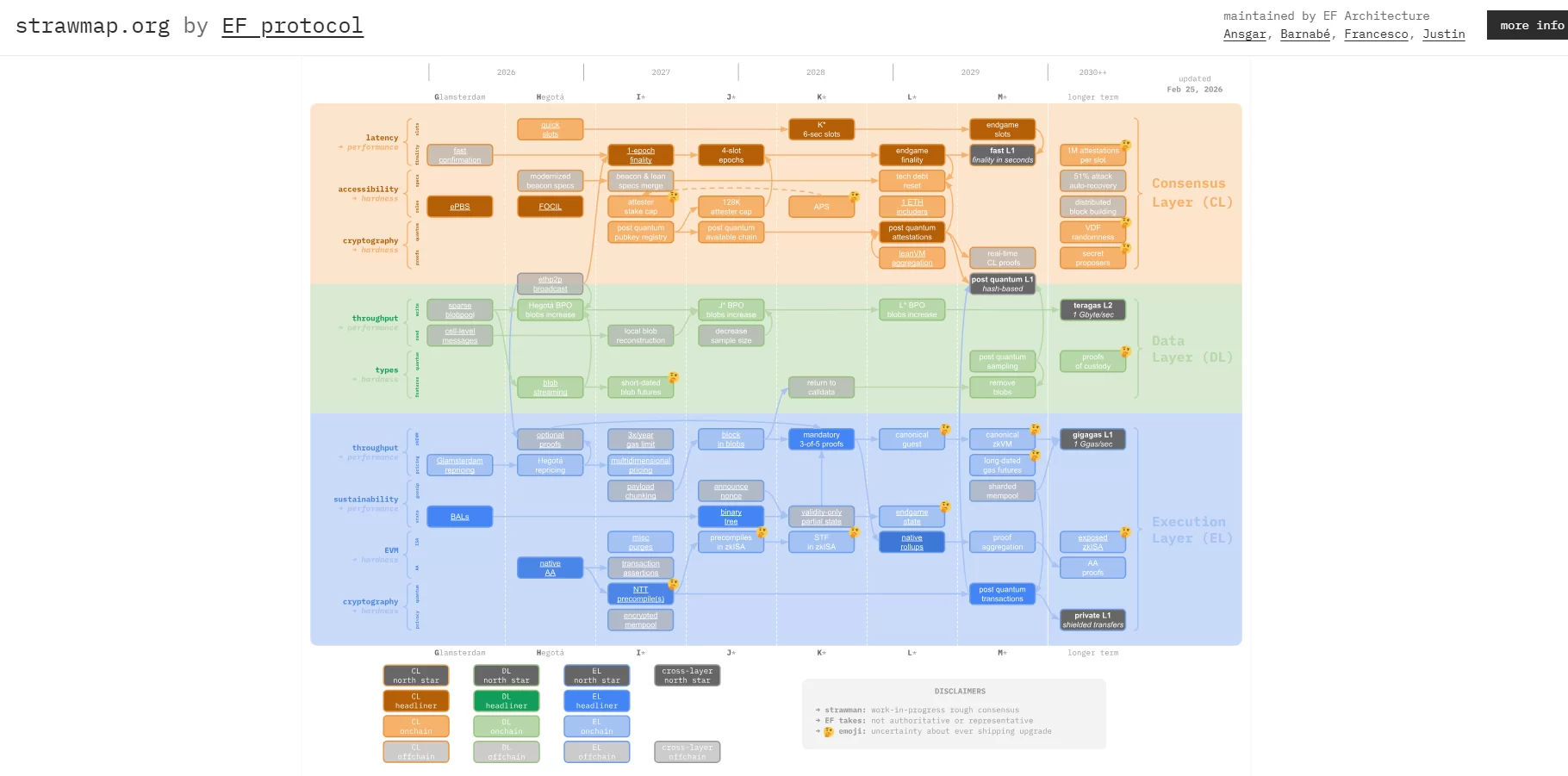
The five main objectives of Strawmap correspond to key technical bottlenecks currently faced by Ethereum, each with clear technical pathways.
Achieving rapid L1 finality centers on implementing Single Slot Finality (SSF), reducing block slot times from the current 12 seconds to 8 seconds or less, enabling near-instant transaction confirmation and significantly improving the mainnet user experience.
Gigagas L1 aims for the mainnet to reach a processing capacity of 1 billion gas per second (1 Gigagas/sec), equivalent to about 10,000 TPS, achieved through built-in zero-knowledge proof systems (zkEVM) at the protocol level, without requiring users to purchase additional hardware.
Teragas L2 targets the entire Ethereum Layer 2 ecosystem, utilizing PeerDAS (Peer-to-Peer Data Availability Sampling) technology to allow Layer 2 networks to access the mainnet data layer at near-zero cost, achieving an overall data throughput of approximately 10 million TPS.
Summary of the Five Goals of Strawmap
Rapid L1 Finality: Single Slot Finality (SSF), reducing slot time to under 8 seconds, eliminating transaction delays.
Gigagas L1: Built-in zkEVM, mainnet reaching 10,000 TPS, no additional hardware needed for users.
Teragas L2: Using PeerDAS, Layer 2 ecosystem achieving about 10 million TPS data processing capacity.
Post-Quantum Cryptography: Transitioning from ECDSA signatures to quantum-resistant schemes based on hash functions or lattice cryptography.
Native L1 Privacy: Integrating ETH transfers as a built-in protocol feature, not optional modules.
Upgrade Schedule: Seven Forks and Key Milestones by 2026
The Strawmap roadmap reorganizes Ethereum’s development phases. The original phases like “The Surge,” “The Scourge,” and “The Verge” are consolidated into three core workflows: Scale (scalability improvements), Improve UX (user experience optimization), and Harden L1 (mainnet security upgrades), making the overall development focus clearer.
In the near-term plan for 2026, Ethereum aims to achieve two key technical milestones: the Glamsterdam upgrade in the first half of the year and the Hegotá upgrade in the second half. These two forks mark the beginning of the entire seven-upgrade plan, laying the foundation for larger-scale Gigagas scaling and post-quantum security migration.
Ethereum co-founder Vitalik Buterin has recently emphasized that strengthening the Ethereum mainnet (L1) is the core strategy to ensure long-term blockchain competitiveness, noting that some early promises of Layer 2 solutions have not been fully realized, which further elevates the priority of enhancing the mainnet’s own technology.
Frequently Asked Questions
What is the core of the Ethereum Foundation Strawmap roadmap?
Strawmap is a protocol upgrade roadmap released by the Ethereum Foundation on February 18, 2026, planning to complete seven protocol forks by the end of 2029, with upgrades every six months. Its five main goals cover L1 scaling, post-quantum security, and native privacy protection.
What is the difference between Gigagas L1 and Teragas L2?
Gigagas L1 targets the Ethereum mainnet layer, achieving 10,000 TPS through built-in zkEVM. Teragas L2 focuses on the Layer 2 ecosystem, using PeerDAS data availability technology to reach about 10 million TPS across Layer 2. They differ fundamentally in architecture and technical approach.
Why is post-quantum cryptography upgrade listed as a core goal for Ethereum?
Advances in quantum computing pose a future risk of breaking current ECDSA elliptic curve signatures. The Ethereum Foundation plans to migrate to quantum-resistant signature schemes based on hash functions or lattice cryptography to ensure long-term security of the Ethereum network in the era of quantum computing.
Disclaimer: The information on this page may come from third parties and does not represent the views or opinions of Gate. The content displayed on this page is for reference only and does not constitute any financial, investment, or legal advice. Gate does not guarantee the accuracy or completeness of the information and shall not be liable for any losses arising from the use of this information. Virtual asset investments carry high risks and are subject to significant price volatility. You may lose all of your invested principal. Please fully understand the relevant risks and make prudent decisions based on your own financial situation and risk tolerance. For details, please refer to
Disclaimer.
Related Articles
Bitcoin ETFs See $213M Daily Inflow, Ethereum ETFs Record $83M Outflow on April 24
Gate News message, according to the April 24 update, Bitcoin ETFs recorded a single-day net inflow of 2,733 BTC (approximately $213.15 million), with a 7-day net inflow of 18,232 BTC (approximately $1.42 billion). Ethereum ETFs showed a single-day net outflow of 35,713 ETH (approximately $82.93 mill
GateNews17m ago
Kelp DAO 漏洞救援:Mantle 擬貸 Aave 3 萬 ETH、DeFi 聯盟承諾逾 43,500 ETH
After the Kelp DAO cross-chain bridge was hacked, DeFi United mobilized agreements from protocols including Aave to commit 43,500 ETH (about $101 million) to provide relief for bad debts. Mantle proposed MIP-34, offering to lend up to 30,000 ETH to the Aave DAO and granting 130,000 AAVE voting rights; Stani Kulechov personally injected 5,000 ETH, and Lido and others also contributed. This move is seen as an experiment in “exchanging loans for governance rights” during a crisis, pending a vote.
ChainNewsAbmedia1h ago
Ethereum Developer Proposes EIP-8182 to Add Native Privacy Transfers at Protocol Level
Gate News message, April 24 — Ethereum developer Tom Lehman has published a draft proposal for EIP-8182, aimed at introducing native privacy transfers to Ethereum by implementing shared privacy pools, fixed address system contracts, and zero-knowledge proof verification precompiles at the protocol l
GateNews1h ago
Arthur Hayes: Ethereum Could Exit Top 3 by 2030, AI Altcoins May Replace ETH
Arthur Hayes Predicts Ethereum's Market Decline
Arthur Hayes, co-founder of BitMEX, claimed in a recent interview that Ethereum (ETH) will fall out of the top three cryptocurrencies by market capitalization by 2030. According to Hayes, AI-focused altcoins could replace Ethereum in this
CryptoFrontier1h ago
Lighter Launches Multi-Asset Margin With ETH Collateral
Decentralized perpetuals exchange Lighter has launched Multi-Asset Margin today, enabling traders to post non-USDC assets as collateral for perpetual trading, according to Lighter's documentation. ETH is the first supported collateral asset. Users deposit a supported asset into their margin
CryptoFrontier1h ago
Ethereum Foundation Sells 10,000 ETH Worth $24M to Major Digital Asset Treasury
Gate News message, April 24 — The Ethereum Foundation sold 10,000 ETH at an average price of $2,387 per token in an over-the-counter deal with a major digital asset treasury on Friday, generating approximately $23.87 million to fund core operations and development.
The foundation said the proceeds
GateNews1h ago


