Losses at CrossCurve underline the high risk of cross-chain bridges during periods of rising crypto attacks.
CrossCurve halted user activity after an attack targeted its cross-chain bridge. The incident forced developers to investigate a smart contract flaw. Partner protocols and and security firms issued warnings as funds were traced on-chain.
User Interactions Halted as CrossCurve Examines Contract Weakness
CrossCurve confirmed on Sunday that its cross-chain bridge was targeted by attackers. The team linked the incident to a flaw in one of the bridge’s smart contracts. Users were asked to pause all activity while developers began reviewing the issue.
Because assets are held across multiple smart contracts, moving them between networks increases risk when a single component fails.
⚠️ URGENT Security Notice
Dear users,
Our bridge is currently under attack, involving the exploitation of a vulnerability in one of the smart contracts used.
Please pause all interactions with CrossCurve while the investigation is ongoing.
We appreciate your patience and… pic.twitter.com/yfo1KvWoDd
— CrossCurve (@crosscurvefi) February 1, 2026
Curve Finance addressed its community shortly after the incident. Users with exposure to CrossCurve pools were advised to reassess their positions and decide whether to withdraw voting support. The statement urged careful judgment when interacting with external protocols during unstable conditions.
Early checks found damage limited to the bridge, with no issues detected across other protocol components. Alerts went out quickly, while the team kept access paused and tracked the movement of stolen funds.
Protocol Calls for Asset Returns After On-Chain Review
After tracing on-chain activity, the team found that funds from the exploit had moved into 10 wallet addresses. CrossCurve said it could not confirm whether those wallets belonged to the attackers and saw no clear hostile behavior at that point. Even so, the protocol acknowledged that users lost funds due to the exploit.
In response, project officials appealed directly to recipients to return the assets. The team described the transfers as improper and asked for cooperation. To support recovery efforts, CrossCurve activated its SafeHarbor WhiteHat policy, offering a reward of up to 10% of recovered funds if the rest is returned.
Details included a direct contact email for coordination. An alternative option allows anonymous returns through a designated wallet address. The team said recovered funds would be returned to affected users after review.
Moreover, CrossCurve shared a contact email to help coordinate the return of funds. A separate wallet address was also provided for those who prefer to send assets back without revealing their identity. After verification, the team said it plans to distribute recovered funds to affected users.
Recent Breaches Expose Ongoing Risks in Decentralized Finance
Crypto attacks have increased across the industry, with the CrossCurve incident adding to a growing list of breaches. Security firm CertiK recorded nearly $400 million in losses in January 2026, with more than 40 major incidents reported.
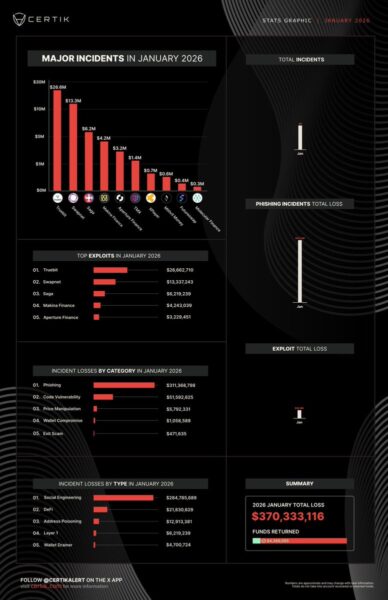
_Image Source: _X/CertiK
Cross-chain systems face a higher risk because they handle large amounts of funds and rely on complex structures. Recent incidents show how fast damage can spread once an exploit begins.
Other victims during the same period included Swapnet, which lost $13 million. Saga and Makina Finance reported losses of $6.2 million and $4.2 million. Step Finance also suffered a breach that drained several treasury and fee wallets, moving more than 261,000 SOL.
Losses across 2025 passed $1 billion, marking the worst year on record for crypto theft. The CrossCurve case adds another reminder of ongoing security gaps within decentralized finance.
Disclaimer: The information on this page may come from third parties and does not represent the views or opinions of Gate. The content displayed on this page is for reference only and does not constitute any financial, investment, or legal advice. Gate does not guarantee the accuracy or completeness of the information and shall not be liable for any losses arising from the use of this information. Virtual asset investments carry high risks and are subject to significant price volatility. You may lose all of your invested principal. Please fully understand the relevant risks and make prudent decisions based on your own financial situation and risk tolerance. For details, please refer to
Disclaimer.
Related Articles
Kelp DAO refutes LayerZero criticism; Aave bad debt reaches up to $230 million
Kelp DAO issued a statement on April 21 rebutting LayerZero’s criticism of its 1/1 DVN configuration, pointing the root responsibility for the $292 million vulnerability in this incident to LayerZero’s infrastructure. Aave released an event impact assessment report: under a scenario where losses are evenly distributed, about $124 million; under a scenario where losses are concentrated on L2, they reach up to $230 million.
MarketWhisper29m ago
DefiLlama denies exaggerated claims about the metrics, saying that Aave data has been excluded from the circulating liquidity calculation
KelpDAO’s vulnerability caused Aave’s total value locked (TVL) to fall from $26.4 billion on April 18, 2026, to about $17 billion on April 21, and after DefiLlama founder 0xngmi officially responded on the X platform to accusations that its Aave TVL figures were inflated by circular liquidity, he said that the amount of borrowed tokens has been deducted from the TVL.
MarketWhisper1h ago
Dune Analysis: 47% of LayerZero OApps Use Minimum 1-of-1 DVN Security Configuration
Analysis of LayerZero OApps post-KelpDAO hack reveals significant security issues, with 47% using the least secure 1-of-1 DVN tier. KelpDAO’s rsETH token also operates at this vulnerable level, exposing risks in single-validator architectures.
GateNews2h ago
Claude Desktop Installation Reportedly Writes Backdoor File to Chromium-Based Browsers
The Claude Desktop application by Anthropic installs a backdoor file in Chromium-based browsers without user consent, posing serious security and privacy risks by potentially allowing attackers to control users' browsers.
GateNews3h ago
Chinese National Arrested at Buenos Aires Airport for $49.4M Crypto Fraud Scheme
A Chinese national was arrested in Argentina for carrying a forged Paraguayan passport. He is wanted for orchestrating a $49.4 million cryptocurrency fraud in Nigeria, and extradition proceedings are being initiated.
GateNews3h ago
Lido EarnETH Vault Exposed to $21.6M rsETH Following Kelp Bridge Exploit, DAO Sets $3M Loss Protection
On April 18, a Kelp cross-chain bridge exploit led to the theft of $292 million in rsETH. Lido reported $21.6 million in exposure via its EarnETH vault, prompting Aave to freeze relevant markets. EarnETH has paused transactions and is deleveraging, while Lido's DAO treasury implemented a $3 million protection mechanism to cover potential losses. The core staking protocol remains unaffected.
GateNews4h ago


