
BitGo went public on Thursday in New York under the ticker BTGO, experiencing a rollercoaster trading session. The stock opened at $18 and surged to $24.50, a 36% increase, but then rapidly declined in the afternoon. It closed at $18.49, up only 2.7%, and after-hours trading pushed it down to $18.35. The IPO raised $212.8 million, with a valuation exceeding $2 billion, becoming the first major crypto company to go public in 2026.
Market Battles Behind the Rollercoaster on Day One
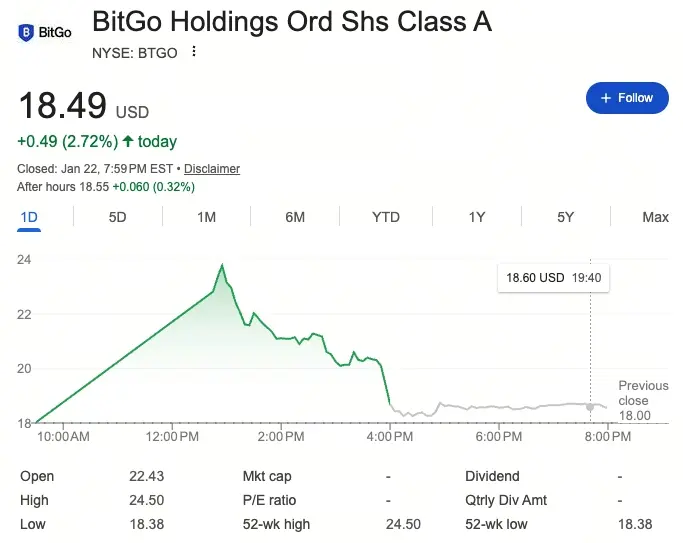
(Source: Google Finance)
BitGo’s Class A shares began trading on the New York Stock Exchange under the ticker BTGO. Previously, the company conducted an IPO at $18 per share, raising approximately $212.8 million, with a valuation over $2 billion. The stock quickly climbed to a high of $24.50 during the day but retreated in the afternoon. According to Google Finance, BTGO closed at $18.49 during regular trading, up about 2.7%, with after-hours trading around $18.35.
Such volatility on IPO day is not uncommon, but the pattern of a 36% intraday gain followed by a complete retracement warrants in-depth analysis. The rise from open to the high indicates strong market interest in crypto custody services. Early buyers likely included institutional investors optimistic about the long-term prospects of the crypto industry, as well as retail investors eager to participate in the “first crypto stock” milestone.
The $24.50 high implied that the market was willing to assign BitGo a valuation of over $2.7 billion, about a 35% premium over the IPO valuation. This valuation expansion reflects investor optimism about BitGo’s growth potential. However, the sharp afternoon decline shows that this optimism was not supported by sufficient buying interest. Profit-taking, exit of IPO arbitrage traders, and concerns over overvaluation may have driven the price down.
The modest 2.7% gain at close could be seen as bittersweet for BitGo and its underwriters. On one hand, the stock ultimately closed above the offering price, indicating a relatively fair IPO valuation without a “break” or failure. On the other hand, the complete retracement of intraday gains suggests that market consensus on BitGo’s valuation has yet to be formed, and subsequent trading days may continue to be volatile.
After-hours trading falling to $18.35, even below the closing price, indicates selling pressure has not fully abated. Although extended session volume was low, the directional signals remain noteworthy. If on the second trading day BitGo cannot hold the $18 offering price, it could trigger a deeper technical correction.
Industry Position with $100 Billion Asset Custody Scale
Founded in 2013, BitGo is one of the largest crypto custody providers in the US, with assets under custody exceeding $100 billion. The company offers custody, wallet infrastructure, staking, and settlement services for institutional clients. This $100 billion custody scale is highly significant in the crypto industry, making BitGo the second-largest crypto custodian after Coinbase.
The core value of crypto custody lies in security and compliance. Institutional investors’ main concerns when allocating crypto assets are safeguarding private keys and meeting regulatory requirements. BitGo provides bank-grade security through multi-signature technology, cold/hot wallet separation, insurance coverage, and strict internal controls. This expertise attracts hedge funds, family offices, and traditional financial institutions with high net worth.
Wallet infrastructure services are another revenue stream. BitGo supplies white-label wallet solutions for exchanges, payment firms, and DeFi protocols, enabling these clients to quickly deploy branded wallet services without developing complex key management systems from scratch. This B2B model is highly scalable, with a large potential market as crypto applications expand.
Staking services have become a key focus recently. With Ethereum’s transition to proof-of-stake (PoS) and the rise of other PoS blockchains, demand for staking yields from institutional investors has surged. BitGo offers secure staking services, allowing clients to earn staking rewards without transferring control of their assets. This service is popular among institutional clients for its combination of security and yield.
Settlement services serve as a bridge connecting traditional finance and crypto markets. The company provides net settlement solutions for exchanges and brokers, reducing on-chain transactions, lowering fees, and increasing efficiency. This service is critical for institutions handling large volumes of trades.
Regulatory Warming and the Strategic Significance of Trust Bank Licenses
This IPO marks the first major crypto-related company to go public in 2026, amid signs of a stabilizing US regulatory environment. In December last year, BitGo, along with Circle and Ripple, received conditional approval for a trust bank license in the US. This regulatory milestone is crucial for BitGo’s business development and investor confidence.
A trust bank license in the US is a high-level financial regulation permit, requiring strict capital adequacy, internal controls, and compliance standards. Obtaining this license indicates that BitGo has passed comprehensive regulatory review, with its operations, risk management, and financial health meeting traditional banking standards. Such regulatory recognition is vital for attracting institutional clients and traditional financial capital.
“Conditional approval” means BitGo still needs to fulfill additional requirements to obtain the full license, but this progress removes major hurdles for expansion. The simultaneous approval with Circle and Ripple shows US regulators are systematically establishing a compliant framework for the crypto industry rather than solely cracking down.
A stable regulatory environment has far-reaching implications for the IPO wave in crypto. Custody competitors like Anchorage Digital, Kraken, and Bitpanda, as well as several infrastructure firms, are also considering IPOs later this year. BitGo’s first-day performance will serve as an important reference for these subsequent offerings. If BitGo’s stock can stabilize and strengthen in the following days, it will boost market confidence in crypto IPOs. Conversely, continued weakness could cause other companies to reassess their timing.
The Beginning of the 2026 Crypto IPO Wave
BitGo’s listing is symbolic; it is the first major crypto company to go public in 2026, paving the way for a potential wave of crypto IPOs. From a fundraising perspective, the $212.8 million IPO is modest compared to tech giants, but significant for the crypto industry. This capital will support BitGo’s expansion, technological upgrades, and competitive positioning.
Valuation-wise, a $2 billion market cap relative to over $100 billion in assets under custody implies a 2% ratio. This ratio is reasonable within the custody sector, neither undervalued nor overly inflated. Investors’ valuation judgments mainly depend on expectations of future growth and profitability.
Disclaimer: The information on this page may come from third parties and does not represent the views or opinions of Gate. The content displayed on this page is for reference only and does not constitute any financial, investment, or legal advice. Gate does not guarantee the accuracy or completeness of the information and shall not be liable for any losses arising from the use of this information. Virtual asset investments carry high risks and are subject to significant price volatility. You may lose all of your invested principal. Please fully understand the relevant risks and make prudent decisions based on your own financial situation and risk tolerance. For details, please refer to
Disclaimer.
Related Articles
Trader "Maji" Holds $58.78M in BTC, ETH, HYPE Positions With $2.597M Unrealized Gains
On April 17, analyst Ai姨 reported that trader "Maji" holds $58.78 million in long positions in BTC, ETH, and HYPE, with $2.597 million in unrealized gains. Maji's largest position is ETH, leveraged at 25x, and has set specific take-profit targets for each asset.
GateNews12m ago
ETH breaks through 2400 USDT
Gate News bot message, Gate market shows, ETH breaks through 2400 USDT, current price 2402.82 USDT.
CryptoRadar59m ago
ETH up 0.65% in 15 minutes: amplified net exchange outflows, short-term buy pressure, and on-chain activity plus a surge of new users driving the rebound
During the period from 12:45 to 13:00 (UTC) on 2026-04-17, the ETH price recorded a +0.65% return, closing in the 2355.76 - 2382.28 USDT range, with a 15-minute amplitude of 1.13%. During this time, market attention rose rapidly, on-chain and derivatives trading activity increased significantly, and short-term volatility intensified.
The main driving force behind this unusual move is that the net exchange fund inflow-outflow phenomenon has been amplified. On-chain data show that within 10 minutes, approximately $420,000 worth of ETH was continuously transferred out of trading platforms, reflecting a significantly stronger investor willingness to hold tokens,
GateNews1h ago
Intchains Group Discloses 8,040 ETH Staked, Accelerates AI-Powered Operations Transformation
Intchains Group reported a cumulative staking of 8,040 ETH, with a strategy that includes the FalconX platform and its own Goldshell Stake. The company is also enhancing operations through AI automation to boost efficiency and decision-making.
GateNews2h ago
ETH rises 0.65% in 15 minutes: ETF fund inflows and leverage long accumulation resonate to lift spot prices
Between 2026-04-17 09:15 and 2026-04-17 09:30 (UTC), ETH fluctuated within the 2351.53 to 2376.99 USDT range. The 15-minute return recorded +0.65%, with a swing of 1.08%. Within this range, buying pressure significantly strengthened, with trades dominated by medium-sized orders, which increased market attention and amplified short-term volatility.
The main drivers behind this anomaly are continued inflows of institutional capital into ETH spot ETFs, especially with cumulative net inflows over the past 4 days exceeding $212 million. On April 17 alone, the ETF added an additional $9.5 million in inflows, and spot buy orders expanded in sync within 15 minutes. Leveraged long positions in the derivatives market are the second-largest catalyst. From April 14 to 17, ETH futures open interest grew 26% week over week, indicating that capital via multiple paths is simultaneously betting on an upside move. The funding rate being neutral suggests the leveraged structure is temporarily healthy.
In addition, global macro market risk appetite has rebounded (geopolitical tensions easing, and the Federal Reserve keeping rates unchanged), driving a broad rebound across mainstream risk assets, and the crypto market has attracted liquidity accordingly. At the industry level, major financial institutions are advancing filings for ETFs and trust products. Mining companies have increased their ETH holdings and also maintained active staking activity, further reinforcing medium- to long-term market expectations. Multiple factors overlap and resonate, amplifying volatility. On-chain transfers remain generally stable, and there is no abnormal concentration of fund flows migrating between exchanges.
What needs attention is that although the current market is lifted by the resonance of institutional capital and leverage, the continuous growth of futures positions combined with the spot price failing to rise above the 2400 USDT area will bring the risk of forced liquidation. Meanwhile, if ETF subscription inflows slow down or macro liquidity reverses, ETH spot support could weaken. Please focus on tracking ETF net inflows, changes in futures open interest, the macro news backdrop, and nearby support and resistance levels, and stay alert to short-term volatility and potential abrupt adjustments. For more real-time market information, please keep watching.
GateNews4h ago


