Source: Future Bro
This article will focus on the four halving events of Bitcoin from 2012 to April 2024, systematically sorting out the halving mechanism of Bitcoin, the trend of changes in inflation rates, and deeply exploring the impact of these events on price movements in conjunction with the market performance before and after each halving. Through historical data analysis and macro comparisons, this article points out that Bitcoin has currently entered a period where the inflation rate is lower than that of gold, and its scarcity is becoming increasingly prominent, gradually establishing a long-term value logic that can compete with traditional assets. Meanwhile, from the perspective of the cyclical rhythm of the four halvings, although the price increase since the 2024 halving has been moderate, it is still in a stage of accumulation, with the real window potentially gradually opening between 2025 and 2026. The article concludes by discussing the core value foundation of Bitcoin, including scarcity, decentralized mechanisms, and deflationary models, pointing out that its logic as “digital gold” is maturing.
1. Bitcoin Halving Cycle Basic Rewards and Inflation Rate:
Bitcoin was designed by Satoshi Nakamoto in 2009, with a total supply capped at 21 million coins. In the early days, miners received 50 BTC as a reward for successfully mining a block. This reward is halved approximately every 210,000 blocks (about every four years), gradually reducing the rate of new issuance.
The Bitcoin halving cycle officially began in 2012, occurring every four years, with the next halving in 2024. Each block reward is 3.125 BTC, resulting in an annual inflation amount of: 52560 x 3.125 = 164,250 coins, which accounts for approximately 0.782% of the total supply. An inflation rate of around 0.78% is already lower than the annual inflation rates of the vast majority of developed countries, while the inflation rate from increased gold mining production is approximately between 1.5% and 2%. Currently, BTC has entered a phase where its inflation rate is lower than that of gold.
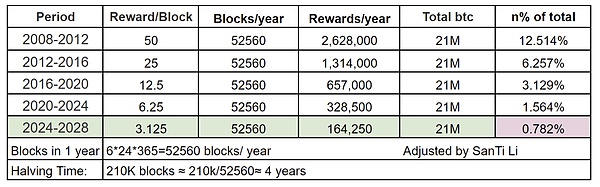
Fig.1 Bitcoin Halving Cycle Rewards and Inflation Graph
As shown in the chart: when each block has a reward of 50, the annual increase is approximately: 52560x50=2.628 million coins, accounting for about 12.5% of the total supply of 21 million. In 2025, when each block has a reward of 6.25, the annual increase will be: 52560x6.25=328.5 thousand, accounting for about 1.564% of the total supply of 21 million.
As of May 7, 2025, around 14:00, a total of approximately 19,861,268 BTC has been mined, accounting for about 94.58%, with a total market value of approximately $2 trillion ($2034,300,009,004). Compared to the last halving cycle in 2020, when about 18,385,031 BTC was mined, accounting for about 87.5%, the total market value at that time was approximately $161.8 billion. After about 5 years, the total market value has increased by approximately 1236%.
The inflation rate for the next 4 years is only 0.782% per year,
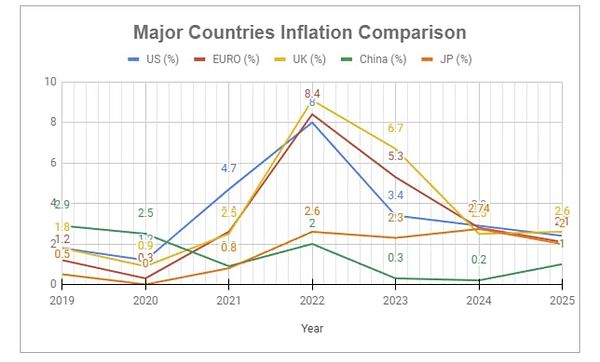
Fig.2 Comparison of the inflation rates of major countries worldwide from 2019 to 2025
China’s inflation rate was about 2.9% in 2019 and 2.3% in the United States, and at that time, due to the new crown epidemic subsidies in 2020, we predict that the large increase in subsidies in the US dollar is expected to cause a significant increase in the inflation rate from 2020 to 2022. And the inflation rate in the United States has indeed reached a high of 8%, and then it has been declining year by year due to the Fed’s interest rate hike policy. It has fallen to around 2.2% so far in 2024, and China’s annual inflation rate is about 0.2%, which is the best in major countries to limit inflation (2019–2024: data from official statistical agencies. 2025: The data is the IMF report and the actual updated forecast. In most developed countries, the statistics are around 2.5%, but the experience of actual shopping and currency depreciation should be significantly greater than the statistics.
At this time, this Bitcoin halving will reduce the inflation rate of BTC by half again, entering a new historical low inflation level of 0.782%. A decrease in inflation rate is generally not a bad thing for any asset, as it further increases scarcity. However, this does not necessarily mean that the asset’s value will rise 100% in a short period of time, but it is considered a relatively important factor against depreciation.
II. Comparative Analysis of Bitcoin Market Performance after 4 Halvings:
Since the advent of Bitcoin, each halving of the block reward has had a profound impact on the market price of BTC. From 2012 to 2024, the four rounds of halving events have shown some relatively consistent cyclical characteristics. This article provides a detailed comparison of the market price trends before and after each halving, also distilling some valuable patterns for readers’ reference. History never repeats itself exactly, but there are always similar patterns before reaching a peak or nearing destruction.
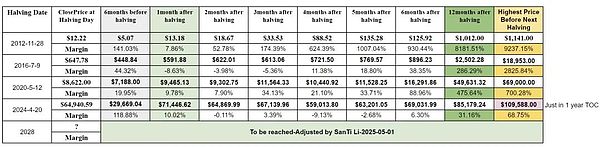
Fig.3 Value change data chart of BTC four halving cycles
As shown in Figure 3, the trend data for Bitcoin’s four halving events is summarized, including the first six months before the halving, the trend data for one year after the halving, and the situation of the highest point during the corresponding cycle. From the figure, it can be seen that the price of Bitcoin has experienced significant increases after each halving. Based on the closing price on the day of the halving, the increase within one year after the 2012 halving exceeded 8000%, about 286% for the 2016 halving, approximately 475% for the 2020 halving, while the increase for the 2024 halving within one year is only around 31% (up to now, the highest was 68.75% - $109588).
Significant price increases have generally been observed in the 6 months prior to the halving.
Looking back at the four halving events, Bitcoin usually begins to enter an uptrend about six months before the halving. For example:
- During the halving in 2012, the price increased by 141.03% compared to 6 months prior.
- The 2024 halving has increased by 118.88% compared to six months ago.
This stage often corresponds to the process of the market gradually pricing in the “halving expectations,” which has a strong value as a preparatory signal.
2. The core explosion period is 6 to 12 months after the halving, but it is not necessarily the highest point.
Historical experience from the past three halvings shows that the 6 to 12 months after the halving is the main upward phase for Bitcoin.
- 2012: One year later, the increase reached 8181.51%
- 2016: One year later, the increase was 286.29%
- 2020: One year later, an increase of 475.64%
- 2024: Not yet a year, currently at 31.18%, highest at 68.75% ($100.9k)
Especially in 2012 and 2020, a typical structure of “consolidation for half a year, followed by an explosion” was exhibited. One year later, it entered the maximum explosion period, reaching a historical new high at that stage. Currently, with the 2024 halving just a year away, if history repeats, the real explosion window may open between 2025 and Q1 of 2026.
The trend in the first year after the halving has preliminary reference significance for judgment.
After the halving in 2024, Bitcoin increased by 10.02% within a month, but then experienced fluctuations and corrections over the next two months, remaining in a consolidation phase overall. As of October 2024 (six months after the halving), the price has only slightly risen by 6.30% compared to the halving day, far from entering a major bullish phase. However, this is not uncommon in history, as both 2016 and 2020 saw the market officially start its rally only six months after the halving.
4. The peak of each bull market mainly occurs within 6-12 months after the halving, one year later.
According to the data from the previous three rounds, the closing price and highest price relative to the halving day during the halving cycle occurred in the mid-term before the next halving.
- 2012: Highest increase 9237.15%
- 2016: Increase of 2825.84%
- 2020: Increase of 700.28%
After the halving in 2024, a peak of $109,588 has already been reached, which is a 68.75% increase compared to the halving day, and it has not yet entered an exponential growth phase. This pattern only applies to this round, because after this round ends, if BTC can reach values as high as 300,000 to 500,000 or even around 1,000,000, its valuation will be extremely large. In the next halving, unless it is based on the depreciation of reference anchor assets or further application exploration, such as interstellar exploration, it will be difficult to see several times growth again.
Chart Summary:
The historical halving cycles of Bitcoin exhibit a highly consistent three-phase rhythm:
Momentum rises (6 months before the halving)→ Stable shock (6 months after the halving)→ The main rising wave erupts (6~18 months after the halving) The current halving in 2024 is about to complete a year, which means that the market may still be accumulating energy for the later outbreak. Similar to the eve of 2017, coincidentally, it was also the early days of Trump’s presidency. At the same time, the Stock-to-Flow diagram also indirectly assists us in the reference values that are still in the thick and thin: but the historical data and laws only have reference value, and we cannot blindly follow the guidance of the data, but also have enough self-judgment to study DYOR.
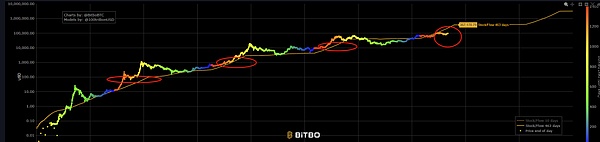
Fig.4 Bitcoin Price Stock-to-Flow Chart
3. The Scientific Attributes of BTC’s Long-term Value:
The value of an asset derives from consensus and its intrinsic value, while long-term consensus must come from its inherent advanced nature, scientific attributes, and irreplaceable pioneering status. Bitcoin (BTC) is not just a cryptocurrency asset; it is an innovative result at the intersection of multiple disciplines including technology, economics, mathematics, and cryptography. Its long-term value is not maintained solely by market speculation, but is built on a complete set of rigorous, verifiable, and tamper-resistant system designs.
1. Scarcity:
As we mentioned earlier, the total supply of Bitcoin is fixed at 21 million coins, written into the protocol by Satoshi Nakamoto in the underlying code and gradually released through the block reward halving mechanism. The halving occurs approximately every four years, with all coins expected to be issued by around the year 2140. In contrast to the unlimited issuance mechanism of fiat currency, Bitcoin has a natural deflationary characteristic that supports its long-term appreciation logic from a supply and demand perspective.
Scarcity design is the core pillar of Bitcoin’s resistance to inflation, laying the foundation for it to become “digital gold.”
2. Decentralization: The consensus mechanism ensures network neutrality
The Bitcoin network relies on the decentralized PoW (Proof of Work) consensus mechanism provided by computing power, allowing any node to validate transactions and participate in maintaining the ledger. This structure effectively avoids issues such as centralized single points of failure, abuse of power, and control of the system that are prevalent in traditional financial networks. The significant global decentralization also minimizes the risk of a 51% attack.
3. Deflationary Model Against Fiat Currency Devaluation
As shown in Fig2, the deflationary issuance model built into Bitcoin contrasts sharply with the inflationary structure of fiat currencies around the world. Especially in the context of large-scale QE and rampant money supply by global central banks since 2020, Bitcoin has gradually proven that it can serve as a hedge against the depreciation of fiat currencies and the risks of asset bubbles. BTC is gradually becoming a safe haven for global funds in the “era of diminishing trust in fiat currencies.”
4. Technological Attributes: Advanced Cryptography + Peer-to-Peer Network Design
Bitcoin integrates the following cutting-edge technologies:
- Elliptic Curve Digital Signature Algorithm (ECDSA): Ensures account security and private key signing
- SHA-256 Hash Algorithm: Ensures Data Immutability
- Merkle Tree Structure: Efficient Verification of Transactions within Blocks
- P2P Peer-to-Peer Network: Achieving global value transfer without intermediaries.
The combination of these core technologies makes Bitcoin a highly robust, unforgeable value transfer network, while also having infinite scalability, laying a solid foundation for subsequent layer two expansions (such as the Lightning Network and ecological applications). BTC is not only an asset but also a masterpiece of cryptographic engineering. Future quantum-resistant upgrades are also worth looking forward to.
5. Challenger to the Global Financial Order: Alternative Consensus Assets of Dollar Trend Change
The current world is experiencing a wave of de-dollarization: settlements between countries are starting to shift towards local currencies, gold, and decentralized assets. Bitcoin, with its characteristics of non-sovereign objectivity, globalization, and scarcity, has become an important channel for asset transfer and value preservation in emerging markets and turbulent countries. It constructs a new financial order model that coexists with but is independent of the US dollar and gold - the “neutral system of consensus currency.” When “the credit of certain countries” is difficult to trust, relying on objective algorithmic credit will become a moat between nations, and of course, further intervention from various national regulatory agencies is needed to prevent frequent illegal activities.
6. Potential Financial Infrastructure of Interstellar Civilization (Currently Not Applied, Personal Exploration Perspective)
Bitcoin is currently the only value protocol that does not rely on any country, bank, or internet entity. Its ledger can exist on any node across the planet, requiring only electricity and computing power to maintain the network. This structure is inherently suitable for future space exploration scenarios, such as Mars or Moon exploration, facilitating quick and direct usage and applications. However, since human exploration of outer space is still in its infancy and there have not been significant breakthroughs in stable landing and arrival, this point remains a personal fantasy. But looking at a 30-50 year cycle, preliminary planetary applications do not seem entirely impossible. Bitcoin (or similar credit points) could serve as the underlying token of human digital civilization.
So the overall scientific attributes of BTC:
Supply ceiling (scarcity) + consensus strength (decentralization);
Real-world context: The credibility of fiat currency continues to weaken, and the debt bubble is expanding;
In the uncertainty of the future, the ‘anchoring property’ of Bitcoin is becoming increasingly prominent.
4. Summary of BTC’s Main Long-term Trend Value
This article draws the following conclusions from the analysis of the performance of the BTC halving cycle and the study of its long-term scientific attributes:
Bitcoin’s four halving cycles show a highly consistent market rhythm: that is, the expectation before the halving drives the rise, the short-term consolidation after the halving, and then ushers in the main upward wave. From an inflation perspective, Bitcoin’s annual inflation rate drops to 0.78% after the 2024 halving, which is lower than gold for the first time, further cementing its position as a scarce asset. Against the backdrop of persistent high inflation, credit expansion, and increasingly large debt deficits in the global fiat currency system, Bitcoin’s deflationary model and decentralized characteristics are attracting more and more attention and allocation of traditional capital.
Despite the short-term fluctuations in the market and the potential for sudden black swan events, the logic behind Bitcoin’s long-term value is becoming increasingly clear: it is not just a cryptocurrency, but a new type of asset based on cryptography and consensus. In the future cycles, its long-term value potential, ability to hedge against inflation, and the irreplaceability of its underlying technology, along with further expansion of ecological development, will continue to empower it, constructing the core value barrier that “digital gold” should possess.
Perspective Reminder: Some people categorize certain projects as such due to the existence of speculation or conceptual scams in the market, which is also an unobjective research attitude (or it can be said that projects relying solely on speculation are hard to sustain, like many memes).
Risk Warning: This article’s discussion on the halving cycle and long-term value is for educational and research reference only and does not constitute investment advice. Readers are encouraged to conduct thorough research, form their own judgment logic, and not to blindly follow or trust anyone. DYOR.


