The 2026 Ethereum Glamsterdam fork will implement multicore parallelization and native ePBS separation via block access lists, increasing the L1 gas limit to 200 million and pushing TPS beyond 10,000. Ten percent of validators will shift to ZK verification, while blob scaling will enable exceptionally high L2 throughput. Heze-Bogota will further strengthen FOCIL's resistance to censorship.
2026-03-26 09:02:41
Based on case studies of institutions such as J.P. Morgan, BlackRock, Fidelity, and Allianz, the article argues that Ethereum has emerged as the core platform for global asset tokenization and stablecoin deployment, predicting that ETH could achieve a "NVIDIA moment" with fivefold growth potential.
2026-03-26 04:28:59
As we move into 2026, Ethereum faces a pivotal transformation. This article explores whether ETH can achieve a narrative shift from follower to leader, and assesses Ethereum’s long-term value proposition in the age of institutional adoption. The analysis centers on staking structures, institutional entry, core technology upgrades, and the emerging monopoly dynamics in the RWA sector.
2026-03-26 04:21:49
This article examines the imperative for Ethereum to implement ZK technology, detailing how zero-knowledge proofs are essential for improving mainnet efficiency and scalability. It analyzes the significant effects on node costs, TPS scaling, and Layer 2 synergy, offering key perspectives for understanding Ethereum’s future technical trajectory.
2026-03-26 01:30:59
This article offers a clear, in-depth analysis of how five years of Rollup centralization have fundamentally redefined blockchain’s underlying principles. With strong logical depth, precise technical details, and accurate historical positioning, it delivers compelling insights into Ethereum’s structural leap from the “choose two” model to achieving “all three.”
2026-03-25 22:40:51
The author not only outlines the cost reduction and scaling effects brought by parameter adjustments in Pectra, Fusaka, and Blob, but also uses data and specific attack techniques to reveal how fraud has been "whitewashed" as network adoption. This serves as a warning against blind metrics worship and security risks.
2026-03-25 17:45:52
The article extends the discussion from Bitcoin's deficit accountability mechanism to the potential of Ethereum's Turing-complete smart contracts for global standardization. Moving beyond mere technical debates, it directly points to the civilizational significance of crypto protocols as higher-level organizational structures.
2026-03-25 16:52:04
As the number of ETHDenver 2026 side events plummets from 668 to just 56, this article examines the structural factors driving its decline. Key issues include the conference’s over-commercialization, dilution of core topics, delayed realization of expected crypto policy changes, and timing conflicts with the Lunar New Year. These trends highlight a shift in industry focus—from frenzied gatherings back to technology and sustained development.
2026-03-25 15:54:39
Ethereum is preparing to roll out the ERC-8004 standard on its mainnet, enabling AI agents to carry portable identities, establish on-chain reputations, and access native payment capabilities. In tandem with the x402 micropayment protocol, this initiative is building the decentralized commercial infrastructure needed for AI. This article offers an in-depth look at its technical framework, real-world applications, and the ecosystem of projects likely to benefit. It also explores how Ethereum is transitioning from a settlement layer to an AI coordination layer, revealing the next phase of growth at the convergence of AI and crypto.
2026-03-25 15:50:07
The Ethereum Foundation announced the upcoming launch of the ERC-8004 standard—a new protocol designed to provide on-chain identity and reputation systems for AI Agents. Alongside it, the accompanying x402 payment protocol will establish a standardized mechanism for value settlement among AI agents. This article comprehensively explains the design principles, technical functions, and ecosystem positioning of these two standards, while also outlining key participants and projects within ecosystems such as Ethereum, Base, and Solana.
2026-03-25 13:07:51

Over the past week, global markets shifted into a risk off environment, driven by hawkish expectations from the Federal Reserve and ongoing geopolitical tensions. Rising Treasury yields pressured the valuation of risk assets, while gold and silver corrected by more than 10 percent after their previous surge. The crypto market weakened in tandem, with BTC falling below $70,000. At the same time, crude oil remained resilient amid expectations of potential supply disruptions, and energy factors continued to influence the inflation trajectory. On the liquidity side, both BTC and ETH ETFs recorded net outflows, indicating a slowdown in short term incremental capital. However, overall AUM remained elevated, suggesting that long term allocation capital has not exited. On chain, DEX liquidity continued to concentrate in leading and high efficiency protocols, with Meteora rising rapidly and reshaping the trading landscape. Marginal stablecoin growth increasingly came from protocol native assets, while DeFi credit dema
2026-03-25 12:07:56
Vitalik has publicly dismissed the original concept of Layer 2 as Ethereum’s “branded sharding,” marking the end of the five-year rollup-driven narrative. This article analyzes gas costs, the stages of decentralization, L1 scaling acceleration, and the commercial realities facing Layer 2 to explore why the Ethereum mainnet is once again becoming faster and more affordable—and what this shift means for projects such as Arbitrum, Optimism, Base, and zkSync. As L1 takes on scaling directly, the foundational logic behind Layer 2 is undergoing a thorough reassessment.
2026-03-25 09:20:42
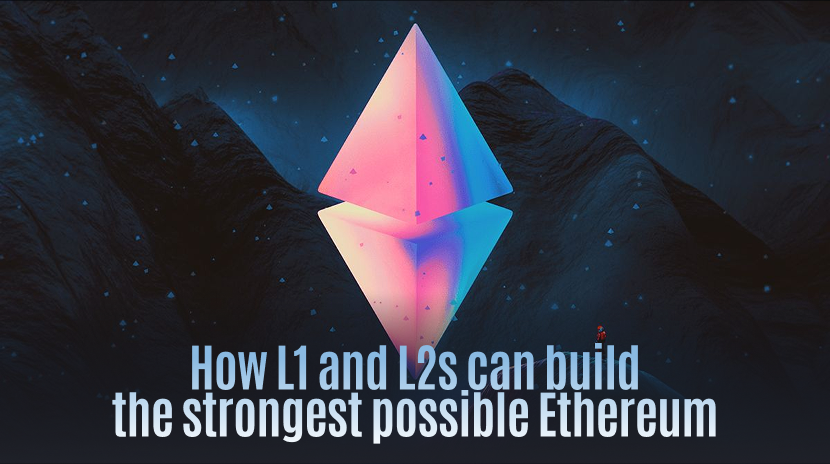
Ethereum 2.0's Top-Level Constitution: Shifting from "Scaling" to "Differentiation." In March 2026, the Ethereum Foundation restructured the division of labor between L1 and L2: L1 solidifies into an ultra-secure "settlement hub," while L2 evolves from a scaling tool into an "application engine" offering customized services such as privacy and high-frequency execution. By eliminating fragmentation through "native rollup" technology, the EF aims to build a unified yet differentiated global on-chain operating system.
2026-03-25 08:36:31
The article provides an in-depth analysis of Ethereum's predicaments and missteps on its "rollup-centric" roadmap, offering a comprehensive reflection on the underlying causes of its imbalances across technology, economic incentives, and cultural structure.
2026-03-25 07:21:17
In today’s crypto market, where high volatility and swift sector rotation are the norm, traditional ETH staking is exposing its liquidity limitations. GTETH overcomes these challenges with built-in yield and a no-lockup structure, giving ETH both earning potential and mobility. As a result, GTETH stands out as an asset management tool that aligns with the pace and demands of modern markets.
2026-03-25 06:11:25