Source: Celestia Foundation; Compilation: Baishui, Golden Finance
After years of development, the Celestia Mainnet BETA was launched last year. Since then, the early ecosystem has formed, with developers deploying the first 20 aggregations, and Celestia blob accounting for 40% of the total data already released.
With the development of the early ecosystem, the core developer community of Celestia has been committed to the next stage of the protocol, with 16 public core developer conference calls and an active ZK working group composed of participants from many teams. The community has drafted or proposed 24 Celestia Improvement Proposals (CIPs), representing six different core development entities.
The core developers are preparing for the first major upgrade, starting from Lemongrass, and now a technical roadmap contributed by multiple teams has been proposed.
Expand to 1 GB Block
The roadmap of the community has one core goal: to continuously expand to a 1 GB Block, greatly improving the data throughput of the Celestia aggregation ecosystem.
Before Celestia, expanding permissionless blockchains typically meant optimizing single-chip L1 in terms of Consensus or individual VM execution.
But Celestia is not limited by the overhead or state bloat of the execution layer, which allows the roadmap to scale throughput beyond the current single-chip constraint. And developers are not limited to a single Smart Contract language, Virtual Machine, or even a consolidated framework.
On the contrary, developers can build anything.
With Celestia, developers can deploy high-throughput, unstoppable applications using any VM, whether to scale existing ecosystems (such as Ethereum) or as their own sovereign network.
High-throughput DA has accelerated existing encryption applications, providing end users with latency similar to Web2, and making alt-VM L2 performance higher than single-chip L1.
In the previous era, Visa’s transaction throughput (about 24,000 TPS) was considered the ideal target for any scaling roadmap. The advent of world-class computers is still far off.
By relentlessly focusing on DA, now just increasing the Block size can achieve a huge increase in throughput. Various technological innovations on the roadmap pave the way for 1 GB Blocks, including content-addressable mempool, compact Blocks, optimized CometBFT Block propagation, internal Sharding Nodes, and improved data availability sampling protocol.
With a 1 GB Block, Celestia will provide capacity for multiple Visa networks simultaneously. This will unlock on-chain applications and functionalities that were previously considered impractical, with enough throughput to support verifiable web applications and a fully on-chain world.
Anyone can verify it with any device
Forcing users to rely on trusted black box APIs first undermines the original intention of encryption applications. The community is working hard to enable lightweight nodes to run in web browsers so that anyone on any device can verify applications deployed in Celestia Block space.
Anyone can try the early version of Light Node in the browser, which was built by Eiger on Lumina.rs.
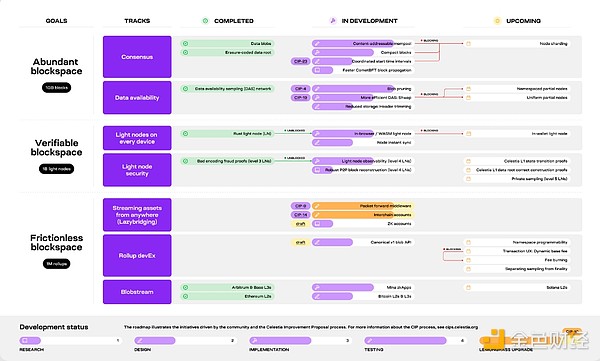
The roadmap is built according to this vision, divided into three main workflows:
1. Sufficient Block Space: The desire to achieve 1GB Block ensures that Celestia has enough capacity to scale to a large number of different rollups, even for many Visa-scale Payment Networks, fully on-chain games, high-throughput Decentralized Finance, and other high-throughput use cases. This is also true. Unlock true scalability and low Money Laundering for end users. There are two core ways to increase DA throughput:
- Consensus: Optimize the Consensus network of Celestia to achieve maximum throughput, so as to generate larger Blocks and allow users to access sufficient Block space.
- Data Availability: Improve Celestia’s data availability network to enable sampling and reconstruction of larger Blocks, while dropping resource requirements for various Node types. This allows users to choose to run Nodes on devices or Wallets with limited resources.
2. Verifiable Block Space: Ensure that anyone, anywhere, on any device can verify the correctness of the Block space, allowing users to directly verify the correctness of the Block space protected by Celestia.
- light node on each device: Introduce light node to each device and the end user Wallet. This enhances their security and reduces reliance on third-party committees or centralized infrastructure.
- Light Node Security: Minimize trust assumptions for end users and node operators, providing them with higher security.
3. Barrier-free Zone for Blockchain Space: Committed to eliminating any barriers for rollup developers and end users. This goal is divided into three parts:
- Streaming assets from anywhere (Lazybridging): Improve interoperability between aggregation on Celestia and the underlying layer itself, addressing modular fragmentation issues.
- Summarize developer experience: Aim to achieve the best developer experience for summarizing developers.
- Blobstream: By streaming the data proof of Celestia to another L1, it extends any ecosystem.
Explore the roadmap now
In order to help you understand the technical features and plans mentioned in the roadmap, we have compiled a comprehensive table. Click here to explore.
Community and Governance
The Celestia community drives all updates and plans through the Celestia Improvement Proposal (CIP) process. Learn more about the CIP process and the current CIPs in progress here. This is an open process, and all discussions surrounding it are public. Anyone in the community can express their opinions and participate.
Get involved
As the Celestia community continues to innovate, please continue to follow for more updates. Join the discussion now and contribute to the future of Celestia!
Disclaimer: The information on this page may come from third parties and does not represent the views or opinions of Gate. The content displayed on this page is for reference only and does not constitute any financial, investment, or legal advice. Gate does not guarantee the accuracy or completeness of the information and shall not be liable for any losses arising from the use of this information. Virtual asset investments carry high risks and are subject to significant price volatility. You may lose all of your invested principal. Please fully understand the relevant risks and make prudent decisions based on your own financial situation and risk tolerance. For details, please refer to
Disclaimer.


