Author: Nick Shaheen, Bankless author; Translated by AIMan@Golden Finance
Stablecoins have been gradually developing, ultimately becoming the largest use case in the cryptocurrency space. While progress seems slow, things are accelerating, and it feels like we are at a “breakthrough” moment.
The past month has made this clearer than ever.
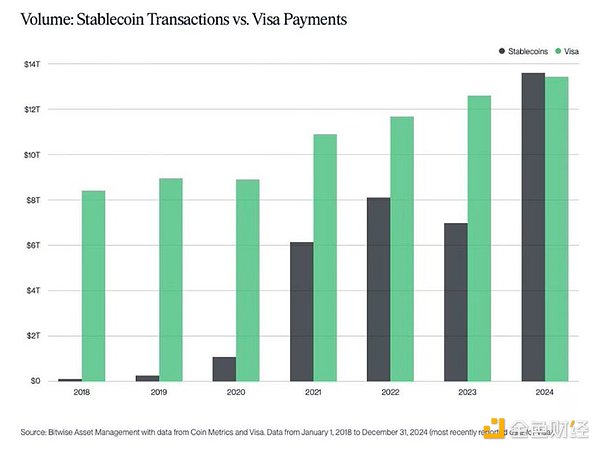
Stripe and Meta are the two largest tech companies in the world, and both have joined the ranks of stablecoins. The trading volume of stablecoins has officially surpassed that of Visa. Despite facing political resistance, regulation is now just a matter of time, not a question of whether it will happen.
The era of stablecoins has arrived. It was originally progressing slowly, but now it seems to have come about all at once.
1. Stripe’s stablecoin account has launched in over 100 countries/regions.
Stripe has quietly launched a stablecoin financial account, enabling businesses in over 100 countries to hold, send, and receive funds in USDC or USDB (Bridge’s infrastructure stablecoin).
It is essentially a dollar account without a bank.
Behind the scenes, Stripe is leveraging its acquisition of Bridge to handle the custody and operations of stablecoins. The key is that these accounts are backed 1:1 by dollar reserves held at BlackRock.
No ACH delays, no foreign exchange fees, no need for local banking infrastructure. Just programmable internet-native dollars.
This is the future that PayPal should build.
2. The Revival of Meta Stablecoins: WhatsApp Payments Are Coming Soon
According to reports, Meta is in talks with cryptocurrency companies to reintroduce stablecoins on its platforms, including WhatsApp.
Yes, it’s the Diem that Congress humiliated and forced Meta to shut down three years ago.
Scale is the key. WhatsApp has over 2 billion users. If Meta can achieve this, the adoption of stablecoins will no longer be a trickle but a flood.
3. Stablecoin trading volume surpasses Visa
According to the Q1 2025 cryptocurrency market commentary released by Bitwise, the trading volume of stablecoins in 2024 was $27.6 trillion, surpassing Visa and Mastercard.
95% of transactions are settled on Ethereum. That’s right, Ethereum is now one of the most important financial channels on Earth.
Let this sink in.
4. Developer Gold Rush: Bridge and USDB
The USDB of Bridge is quickly becoming the most suitable stablecoin for developers in the market.
Unlike traditional issuing institutions that retain reserve earnings, Bridge will distribute them - both developers and users can participate. Developers can earn rewards simply by switching to USDB via the API.
- Can I exchange for USDC? Free.
- Minting and redemption? Global.
- Treasury collateral? Stored at BlackRock.
If stablecoins are the new dollar, then Bridge is building the Stripe of programmable money.

5. Although the GENIUS Act has failed, it has not perished.
Last week, the U.S. Senate failed to pass the GENIUS Act, which was the first serious attempt at federal stablecoin legislation.
The bill failed to pass in a procedural vote of 48 to 51, not due to a lack of support, but because of last-minute changes made by the Republicans that caught key cryptocurrency-friendly Democrats off guard.
Even some co-sponsors of the bill voted against it, citing concerns that the amendments were too rushed and lacked transparency.
Nevertheless, people’s interest remains. Senator Warner stated that stablecoins “are undoubtedly a part of the financial future” and promised to revise and pass the bill as soon as possible.
The “GENIUS Act” will:
- Establish federal oversight for stablecoin issuers
- Set capital and liquidity standards
- Enforce anti-money laundering compliance regulations in accordance with the Bank Secrecy Act.
Critics believe that this regulation is too lenient - precisely meeting the conditions that cryptocurrency companies expect. But there is no doubt: this is the United States’ choice to regulate stablecoins onshore, rather than allowing them to develop overseas.
This vote may fail, but the next vote could pass as early as this week.
️The most important thing is
Stablecoins are no longer a “crypto use case”; they are use cases in themselves.
Various institutions have also emerged.
- Stripe has built a wallet.
- Meta is building the interface.
- Ethereum is the backend.
- Developers are building everything else.
In 2020, stablecoins were still a novelty. By 2024, they had developed into a multi-trillion dollar industry. Now, in 2025, the world’s largest companies and legislators are putting stablecoins to the test.
The financial system is undergoing changes. First slowly, and then suddenly it has changed.
Disclaimer: The information on this page may come from third parties and does not represent the views or opinions of Gate. The content displayed on this page is for reference only and does not constitute any financial, investment, or legal advice. Gate does not guarantee the accuracy or completeness of the information and shall not be liable for any losses arising from the use of this information. Virtual asset investments carry high risks and are subject to significant price volatility. You may lose all of your invested principal. Please fully understand the relevant risks and make prudent decisions based on your own financial situation and risk tolerance. For details, please refer to
Disclaimer.


