Author: Marcel Pechman, CoinTelegraph; Translated by: Deng Tong, Jinse Finance
Summary
- Returning to the $2,200 level remains the primary price challenge facing ETH.
- If the Pectra upgrade can drive a surge in DApp and Ethereum network activity, the ETH price may rebound.
Ethereum successfully implemented a crucial network upgrade on May 7, but the price of Ethereum and its derivative indicators reacted mildly to this upgrade. This lackluster market response surprised traders and raised questions among analysts about whether there is still a real possibility for Ethereum to rise by 22% and return to the $2200 level.
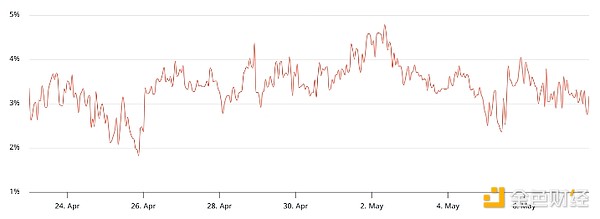
Ethereum 30-day futures annualized premium. Source: Laevitas.ch
The ETH futures premium has consistently remained below the neutral threshold of 5%, indicating a lack of interest from leveraged bulls. More importantly, after the Pectra upgrade, this metric has still remained at 3%, indicating that despite the successful deployment of the upgrade, traders have not adjusted their positions.
Market reaction has been tepid, partly due to investors focusing on macroeconomic issues, as the uncertainty of global trade disputes has intensified the risk of economic recession. However, traders have shown a lack of interest in ETH, which predates the recent deterioration of risk aversion. In fact, in the first three months of 2025, ETH underperformed the broader cryptocurrency market cap by 28%.
After the upgrade, Pectra’s price performance has been flat, reflecting the general dissatisfaction in the market, as competing blockchains have gained momentum.
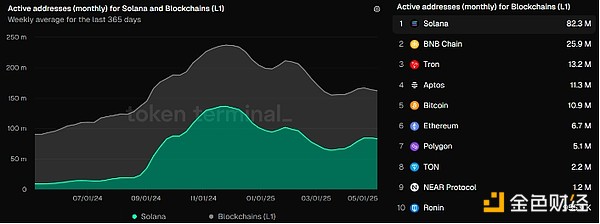
Comparison of Solana’s monthly active addresses with Layer-1 competitors. Source: Token Terminal
Historically, high base layer fees on Ethereum may have limited network activity, but since mid-February, these fees have fallen below $1. Additionally, according to Token Terminal data, Ethereum’s leading Layer-2 solution, Base, currently has 10.3 million monthly active users, far below Solana’s 82.2 million and BNB Chain’s 25.9 million.
Ethereum Lags in DApp Interoperability - Will This Hurt ETH’s Price?
Solana dominates the decentralized exchange space by providing an integrated user experience, especially in token issuance. Similarly, Hyperliquid has exceeded expectations in perpetual contract trading, indicating that traders’ primary focus is not limited to the decentralization and security of Ethereum. Meanwhile, Tron has made significant progress in the stablecoin market.
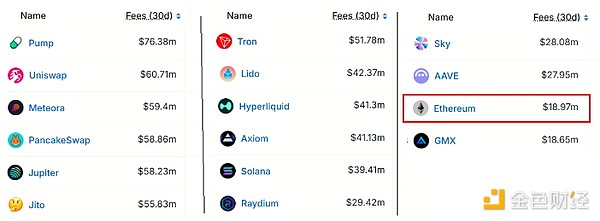
Blockchain and DApp 30-day fees (USD). Source: DefiLlama
Ethereum still maintains its leading position in total locked value (TVL), reaching 5.37 billion dollars, without any doubt. However, according to data from DefiLlama, this has not brought much benefit to ETH holders, as the network fees over the past 30 days have been relatively low, at only 19 million dollars. In contrast, Tron accumulated 51.8 million dollars in fees during the same period, while Solana accumulated 39.4 million dollars.
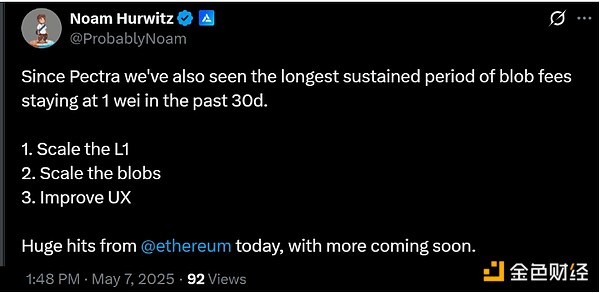
Alchemy Engineering Director Noam Hurwitz pointed out that Ethereum blob fees have fallen to their lowest level since the Pectra upgrade. For Hurwitz, the success of Ethereum depends on its underlying scalability, including further improvements to the Rollup mechanism and ultimately a more seamless user experience.
Connecting assets and data in the Ethereum Layer 2 (Layer-2) ecosystem has always been a challenge, while users on Solana and BNB Chain can easily switch between multiple decentralized applications (DApp). Although the Pectra upgrade has taken a step in the right direction, it has not resolved this issue, which also explains why ETH has failed to return to the $2,200 level it had in early March.
To enable the price of ETH to rise by 22% from the current level of $1,810, investors may need to ensure that the network’s progress (whether through deposits or layer two growth) translates into significant gains. Ultimately, there is a need to enhance staking yields or provide stronger incentives to drive broader adoption of DApps, which in turn will stimulate increased demand for ETH within the ecosystem.
Disclaimer: The information on this page may come from third parties and does not represent the views or opinions of Gate. The content displayed on this page is for reference only and does not constitute any financial, investment, or legal advice. Gate does not guarantee the accuracy or completeness of the information and shall not be liable for any losses arising from the use of this information. Virtual asset investments carry high risks and are subject to significant price volatility. You may lose all of your invested principal. Please fully understand the relevant risks and make prudent decisions based on your own financial situation and risk tolerance. For details, please refer to
Disclaimer.


