

Trade
Basic
Futures
Futures
Hundreds of contracts settled in USDT or BTC
Options
HOT
Trade European-style vanilla options
Unified Account
Maximize your capital efficiency
Demo Trading
Futures Kickoff
Get prepared for your futures trading
Futures Events
Futures Mall
Participate in events to win generous rewards
Demo Trading
Use virtual funds to experience risk-free trading
Earn
Launch
CandyDrop
Collect candies to earn airdrops
Launchpool
Quick staking, earn potential new tokens
HODLer Airdrop
Hold GT and get massive airdrops for free
Launchpad
Be early to the next big token project
Alpha Points
NEW
Trade on-chain assets and enjoy airdrop rewards!
Futures Points
NEW
Earn futures points and claim airdrop rewards
Investment
Simple Earn
Earn interests with idle tokens
Auto-Invest
Auto-invest on a regular basis
Dual Investment
Buy low and sell high to take profits from price fluctuations
Soft Staking
Earn rewards with flexible staking
Crypto Loan
0 Fees
Pledge one crypto to borrow another
Lending Center
One-stop lending hub
VIP Wealth Hub
Customized wealth management empowers your assets growth
Private Wealth Management
Customized asset management to grow your digital assets
Quant Fund
Top asset management team helps you profit without hassle
Staking
Stake cryptos to earn in PoS products
Smart Leverage
NEW
No forced liquidation before maturity, worry-free leveraged gains
GUSD Minting
Use USDT/USDC to mint GUSD for treasury-level yields

More


Trending Topics
View More58.15K Popularity
20.58K Popularity
16.04K Popularity
6.96K Popularity
5.57K Popularity




Pin
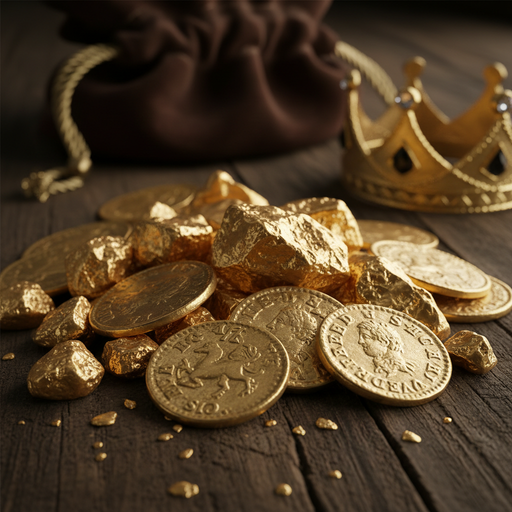
Can Gold Be Made Artificially? Inside China's Lab-Engineered Gold Revolution
Recent reports from Chinese research institutions have reignited a fundamental question in materials science: can gold actually be produced in the laboratory? The answer appears to be yes — and the implications are far more profound than simply replicating a precious metal. A team of researchers has successfully engineered artificial gold that rivals mined gold in virtually every measurable property, from density and luster to electrical conductivity. What makes this development particularly significant is not merely that gold can be made artificially, but that lab-created versions may actually outperform their natural counterparts.
The Technical Foundation: How Artificially Engineered Gold Works
The core breakthrough lies in understanding what makes gold valuable beyond its scarcity. Using advanced nanotechnology and atomic-level engineering, scientists have discovered how to construct artificial gold with nanoporous structures at the microscopic level. These engineered lattices fundamentally alter the metal’s properties — doubling its strength while simultaneously enhancing conductivity and flexibility.
This represents a qualitative leap beyond simple replication. Rather than merely copying natural gold’s appearance, researchers have created a material that can be deliberately optimized for specific applications. The artificial gold isn’t just indistinguishable from mined gold under examination; in controlled tests, it demonstrates superior durability and purity compared to naturally occurring gold. This proves that artificially produced gold doesn’t have to settle for parity with nature — it can exceed it.
Breaking Down the Misconception: Artificial Doesn’t Mean Inferior
A critical misconception persists in discussions about lab-engineered metals: that anything artificial is somehow secondary or fake. The reality contradicts this assumption entirely. Artificially created gold manufactured through atomic metallurgy exhibits consistent properties across every batch, eliminating the variability inherent in mined gold. The precision of laboratory conditions means fewer impurities, greater structural uniformity, and more predictable performance characteristics.
For sectors where reliability matters most — semiconductors, aerospace components, quantum computing systems — artificially made gold offers advantages that nature cannot guarantee. The ethical dimension compounds this advantage: artificial gold requires no toxic extraction processes, no habitat destruction, and no ecological compromise.
Market Disruption: Where Artificial Gold Changes Everything
The implications of sustainable, artificially produced gold extend into multiple sectors simultaneously. The luxury industry gains access to flawless, ethically sourced gold jewelry without environmental guilt. The technology sector obtains superior conductivity and stability for advanced applications. The renewable energy industry benefits from more reliable components for solar cells and other technologies where gold’s properties prove critical.
Most provocatively, artificial gold challenges traditional finance. Gold-backed assets like PAXG and other commodity-linked products derive value partly from gold’s historical scarcity narrative. When artificially engineered gold can be produced at scale with superior qualities, the philosophical foundation of “gold as ultimate store of value” begins to shift. The question becomes: if artificial gold is cleaner, stronger, and more reliable, what exactly makes natural gold intrinsically more valuable?
The Scalability Question: From Laboratory Proof to Industrial Reality
What separates this discovery from countless other laboratory breakthroughs is scalability. The research demonstrates that artificial gold can be engineered consistently, not as one-off specimens but as reproducible products. This transforms the conversation from theoretical achievement to practical implementation.
The sustainability argument becomes economically persuasive once production scales. Manufacturing artificial gold consumes a fraction of the resources and generates a fraction of the environmental damage compared to traditional mining. For investors, industries, and nations focused on ESG compliance, artificially produced gold offers both performance advantages and values alignment.
A Philosophical Pivot in How We Define Value
China’s advancement in artificially producing high-grade gold represents more than incremental scientific progress. For millennia, humanity has regarded gold’s value as intrinsic — stemming from its rarity and the difficulty of extraction. This achievement redefines that equation. Value, it turns out, can be engineered. Scarcity can be addressed through human ingenuity rather than accepted as immutable natural law.
The real breakthrough isn’t simply that artificial gold can be made — it’s that the artificial version can be superior. This inversion of conventional wisdom signals a broader shift in materials science, where laboratory engineering surpasses geological processes. The question “can gold be made artificially?” receives not just an affirmative answer, but evidence that engineered alternatives may constitute the future rather than the novelty.