

Trade
Basic
Futures
Futures
Hundreds of contracts settled in USDT or BTC
Options
HOT
Trade European-style vanilla options
Unified Account
Maximize your capital efficiency
Demo Trading
Futures Kickoff
Get prepared for your futures trading
Futures Events
Futures Mall
Participate in events to win generous rewards
Demo Trading
Use virtual funds to experience risk-free trading
Earn
Launch
CandyDrop
Collect candies to earn airdrops
Launchpool
Quick staking, earn potential new tokens
HODLer Airdrop
Hold GT and get massive airdrops for free
Launchpad
Be early to the next big token project
Alpha Points
NEW
Trade on-chain assets and enjoy airdrop rewards!
Futures Points
NEW
Earn futures points and claim airdrop rewards
Investment
Simple Earn
Earn interests with idle tokens
Auto-Invest
Auto-invest on a regular basis
Dual Investment
Buy low and sell high to take profits from price fluctuations
Soft Staking
Earn rewards with flexible staking
Crypto Loan
0 Fees
Pledge one crypto to borrow another
Lending Center
One-stop lending hub
VIP Wealth Hub
Customized wealth management empowers your assets growth
Private Wealth Management
Customized asset management to grow your digital assets
Quant Fund
Top asset management team helps you profit without hassle
Staking
Stake cryptos to earn in PoS products
Smart Leverage
NEW
No forced liquidation before maturity, worry-free leveraged gains
GUSD Minting
Use USDT/USDC to mint GUSD for treasury-level yields

More


Trending Topics
View More58.15K Popularity
20.58K Popularity
16.04K Popularity
6.96K Popularity
5.57K Popularity




Pin
Lab Grown Gold Breakthrough: How Synthetic Production Could Redefine Global Markets
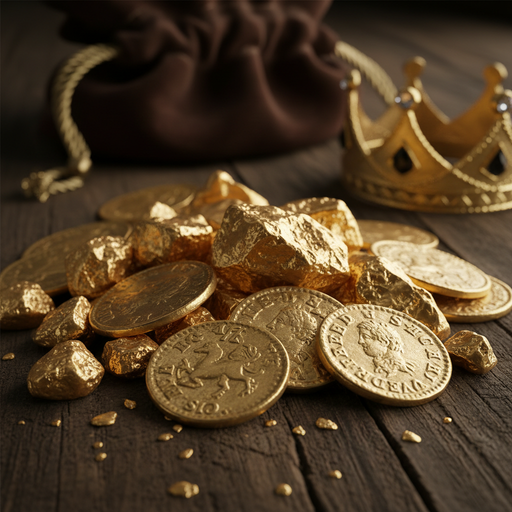
Chinese scientists have announced a significant advancement in materials engineering—the creation of laboratory-grown gold that replicates natural gold at the atomic level. This isn’t a surface treatment or imitation; the synthetic product exhibits identical density, conductivity, crystalline structure, and shine as mined gold. What distinguishes this lab grown gold from conventional mining is its intelligent laboratory production method, eliminating the need for resource extraction while maintaining 100% of gold’s fundamental properties.
The Technology Behind Lab Grown Gold: Beyond Traditional Mining
The innovation leverages advanced nanotechnology to engineer gold atom by atom, achieving a product that is physically and chemically indistinguishable from its naturally mined counterpart. This lab grown gold production method offers several tangible advantages over conventional mining: it completely bypasses the environmental devastation associated with mining operations, eliminates mercury contamination from extraction processes, and creates a more resilient material—one that is reportedly more durable and flexible than naturally sourced gold. The scalability of this laboratory approach means the production model can potentially be replicated across multiple facilities, fundamentally altering how the precious metal reaches markets.
Multi-Sector Impact: From Environmental Benefits to Economic Disruption
The implications span multiple industries and geographies. From an environmental perspective, reducing dependency on mining operations addresses one of the most pressing ecological concerns of the 21st century—the habitat destruction and chemical pollution inherent to traditional gold extraction. The luxury sector stands to gain access to ethically sourced, flawless gold with theoretically boundless availability, reshaping consumer expectations around transparency and sustainability.
In technology and advanced manufacturing, lab grown gold could transform industries ranging from electronics to aerospace and artificial intelligence applications. Its superior properties and controlled production could enable innovations previously limited by natural gold’s scarcity and variability. Yet perhaps most consequentially, this development challenges the fundamental economic principle that has underpinned gold’s value for millennia: scarcity.
The Scarcity Paradox: How Abundant Lab Gold Reshapes Asset Valuations
When a commodity’s value derives primarily from its rarity, the introduction of abundant, high-quality substitutes fundamentally destabilizes that valuation model. If lab grown gold achieves cost-competitive production at scale, traditional gold-backed financial instruments face a critical question: what preserves their value when the underlying asset transitions from scarce to abundant? This applies directly to cryptocurrency derivatives like PAXG, where current trading patterns reflect traditional gold valuations built on supply constraints that may no longer exist.
PAXG and Beyond: What This Means for Gold-Backed Cryptocurrencies
PAX Gold (PAXG), currently trading around $5.12K with a 24-hour gain of +1.00%, represents one of several blockchain-based mechanisms for holding gold as digital assets. Should lab grown gold reach industrial-scale production and economic viability, the supply assumptions underlying these instruments would require recalibration. This could either devalue them by eliminating scarcity premiums or reposition them as utility-focused assets tied to manufacturing quality rather than rarity value.
The emergence of lab grown gold signals a broader transition in how humanity conceptualizes and valuates natural resources. Rather than extracting what Earth provides, advanced materials science enables engineering of atomic-level precision. For gold specifically, this means the commodity’s future may not depend on mining deeper or reaching more remote deposits—it could be produced in controlled laboratory environments at scales previously unimaginable. The global wealth systems built on precious metal scarcity will need to adapt to a paradigm where abundance becomes technically achievable, forcing financial markets to redefine what “value” means in a world where lab grown gold is indistinguishable from traditionally mined alternatives.