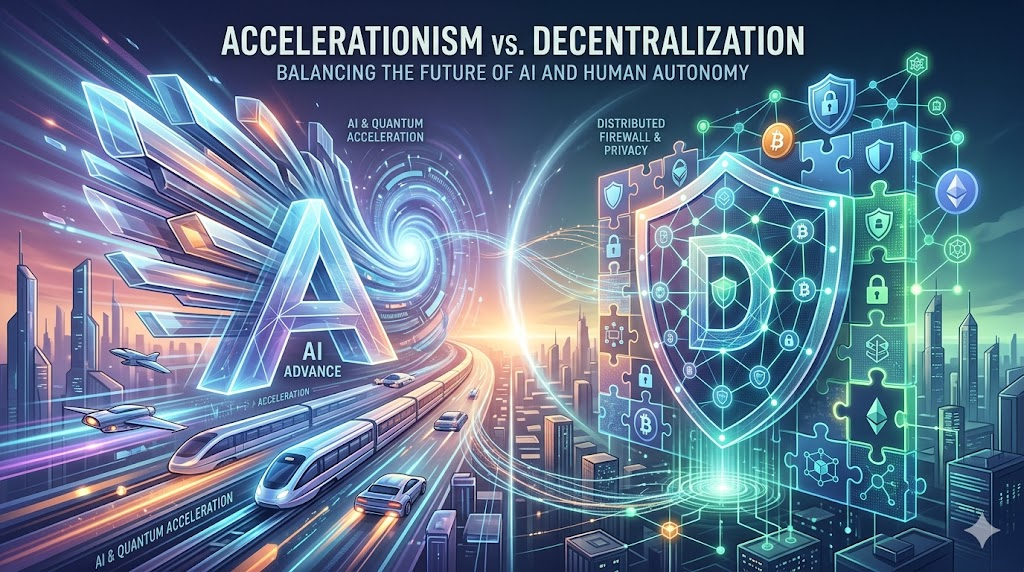
As modern technology evolves at a rapid pace, Accelerationism and Decentralization Technology have emerged as two of the most hotly debated perspectives. Recently, Ethereum founder Vitalik Buterin and Extropic founder Guillaume Verdon (Beff Jezos) engaged in a debate exploring how technology drives societal progress—and warning of the potential risks if technology spirals out of control. These fundamentally different schools of thought pose a central question: How can we drive technological advancement while preserving human agency and fairness?
Accelerationism: Driving Rapid Technological Progress
Accelerationism champions the swift advancement of technology, arguing that technological progress is the defining driver of social development. Supporters believe that only by accelerating technological growth can humanity seize future opportunities and achieve more efficient, advanced lives. From this perspective, technological progress is seen as an unstoppable force—society should embrace innovation and speed up its adoption.
Core Principles of Accelerationism
-
Breakthrough Innovation: Accelerationism advocates for breaking traditional boundaries and propelling the rapid development of frontier technologies, including AI, quantum computing, and decentralized finance (DeFi).
-
Innovation-Driven Social Progress: Proponents assert that technological innovation delivers more solutions to global challenges such as climate change and unequal resource distribution.
However, as technology—especially AI and big data—advances at breakneck speed, concerns are mounting over the societal risks it may bring. Overreliance on technology can lead to excessive concentration of power, erosion of personal privacy, and even shifts in social structure. Thus, simply accelerating technology is not a panacea; it may also carry unforeseen consequences.
Decentralization Technology: Safeguarding Fairness and Autonomy
In contrast to Accelerationism’s focus on speed, Decentralization Technology emphasizes the importance of maintaining control over technology. This perspective holds that while rapid advancement is crucial, ensuring appropriate oversight is even more vital. Decentralized technologies offer effective tools to counteract the excessive concentration of power—particularly in fields like AI, financial systems, and personal data management.
Core Values of Decentralization Technology
-
Data Privacy and Autonomy: Decentralized technologies help protect personal data from misuse and reduce large corporations’ surveillance of user behavior.
-
Fairness and Transparency: Blockchain and related technologies ensure system transparency and help prevent monopolistic practices behind the scenes.
-
Decentralized Governance: By broadening participation in technology decision-making, decentralization prevents a small group of corporations or governments from dominating technological progress.
With this approach, technology is no longer solely about speed, but about serving broader societal needs—ensuring that progress benefits every segment of society and preventing the injustices that can arise from centralized control.
AI and Humanity’s Future: Technology as a Force for Human Augmentation
The debate between Accelerationism and Decentralization Technology is not simply about speed versus control—it’s also about how AI and humans can work together. Vitalik Buterin introduced the concept of “soft merging,” where humans and AI collaborate rather than AI replacing humans. This model can enhance creativity and productivity, empowering people to play a greater role in complex decision-making.
The Vision for Human–AI Collaboration
-
Building a Second Brain: With intelligent tools, AI can serve as a “second brain” for humans, enhancing our analytical, decision-making, and creative abilities.
-
Intelligence Augmentation: Human–AI collaboration enables joint solutions to complex problems, driving society toward greater efficiency and intelligence.
The core of this vision is to ensure technology amplifies human capabilities—rather than replacing human leadership. AI should be an empowering assistant, helping people reach new heights in innovation and productivity.
The Future of Technology and Society: Decentralization as a “Digital Firewall”
As technology continues to advance, AI, quantum computing, and other cutting-edge innovations are reshaping the global economy, politics, and social structures. The debate between Accelerationism and Decentralization reflects a deeper societal dilemma: how to share the benefits of technology globally while avoiding the catastrophic risks of unchecked technological growth.
Decentralization as a Digital Firewall
-
Reducing Surveillance Risks: Decentralized technologies can effectively prevent large corporations or governments from using technology for mass surveillance—protecting individual privacy.
-
Global Collaboration: Decentralization breaks down geographic barriers, enabling the global sharing of technological and innovative achievements and preventing any single nation or enterprise from dominating global tech standards.
-
Digital Currency and Decentralized Finance: Crypto and DeFi have injected new vitality into the global economy, creating a financial system that is unbanked and anti-monopolistic, promoting fair trade and asset mobility.
From Acceleration to Co-Governance: Charting a New Course for Technological Progress
The future of technology may shift from a singular focus on speed to a more rational and controllable trajectory. Through decentralization and human–AI collaboration, technology can boost overall social efficiency while protecting individual autonomy and data privacy. Tomorrow’s technology will be more than a tool—it will be an ecosystem co-created by humans and intelligent systems, advancing the interests of all humanity.
Conclusion: Striking a Balance Between Acceleration and Decentralization
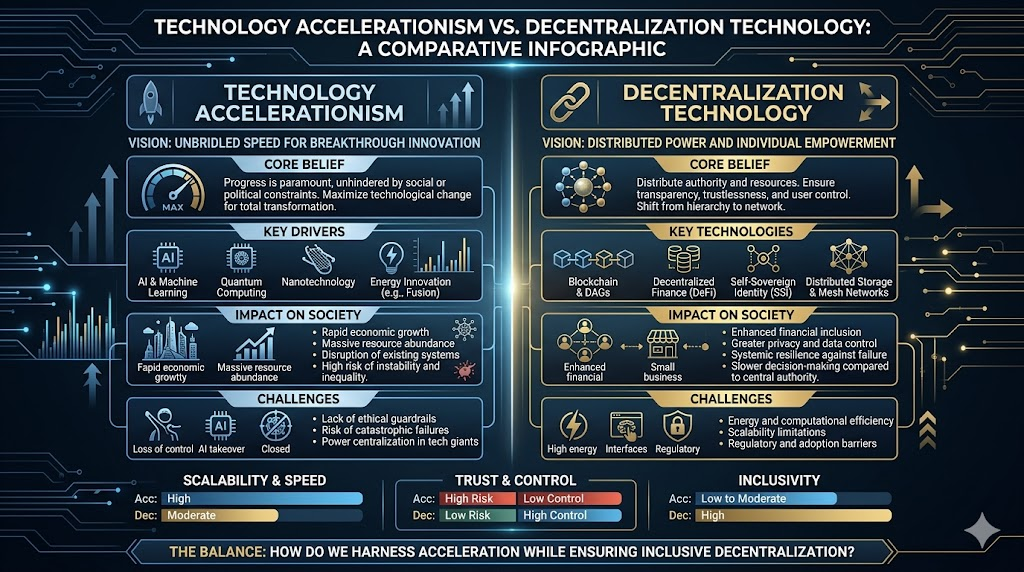
The debate between Vitalik Buterin and Guillaume Verdon highlights two distinct paths for technological development: Accelerationism and Decentralization. These are not mutually exclusive—they can be balanced. Acceleration can drive short-term progress and innovation, while decentralization ensures technology is not abused and safeguards social fairness and autonomy.
As technology continues to advance, the challenge of promoting progress while upholding social justice and individual freedom becomes increasingly critical. In this journey, decentralization and human–AI collaboration may prove to be the keys to a more equitable, transparent, and efficient future.







