In the crypto market, leveraged trading has long been an important way to improve capital efficiency. From traditional futures trading to the newer generation of smart leverage tools, the market continues to offer a wider range of options. However, the differences in how these tools work can create a learning curve for users trying to choose between them.
In this context, Gate Smart Leverage has emerged as a new type of trading tool. By simplifying the leveraged trading process through automation, it is gradually becoming a bridge between spot trading and futures trading. Understanding how it differs from traditional futures trading is essential for users looking to develop effective trading strategies.
Overview of Smart Leverage vs Futures Trading
Futures trading is a margin-based leveraged trading method. Users can choose different leverage levels and take long or short positions to participate in market movements. Its main advantage is flexibility, but it also requires strong risk management skills.
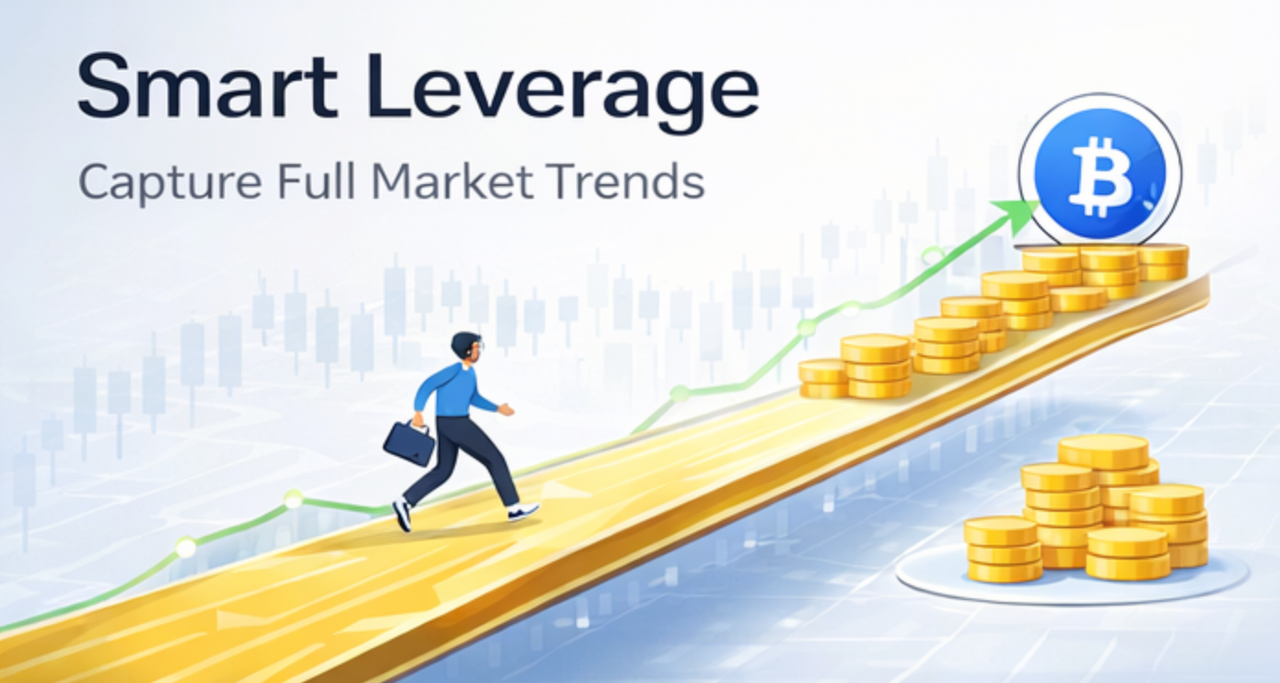
Smart Leverage, on the other hand, is an intelligent leveraged trading tool that does not require margin. Users do not need to borrow funds or manually set leverage. Instead, the system automatically builds and manages positions, adjusting leverage dynamically to control risk. This design reduces operational complexity and makes leveraged trading more accessible.
Comparison and Key Differences between Smart Leverage and Futures Trading
Overall, futures trading is better suited for experienced users seeking greater flexibility and higher potential returns, while Smart Leverage is more appropriate for those who want to simplify operations and avoid liquidation risk.
| Dimension |
Smart Leverage |
Futures Trading |
| Margin |
Not required |
Required |
| Liquidation Risk |
None |
Yes |
| Leverage Control |
System-managed |
User-defined |
| Risk Management |
Automated |
Manual |
| Operational Complexity |
Low |
High |
| Profit Control |
Lower |
Higher |
Key Difference 1: Margin Requirement
Futures trading relies on a margin system. Users must commit funds as collateral and amplify their position size based on the chosen leverage. While this provides flexibility, it also increases the complexity of capital management.
Smart Leverage does not require margin. Users can directly access leveraged exposure without dealing with borrowing or collateral, as these processes are handled behind the scenes by the system. This makes the trading experience more straightforward and intuitive.
Key Difference 2: Liquidation Risk
In futures trading, if the market moves against a user’s position and the margin becomes insufficient, a forced liquidation will occur. This is one of the most significant risks in futures trading.
Smart Leverage does not involve forced liquidation. Instead, the system dynamically adjusts positions to manage risk, so users are not liquidated due to price fluctuations. However, this does not mean there is no risk of loss.
Key Difference 3: Leverage Control
Futures trading allows users to freely choose leverage levels, such as 5x or 10x, and adjust positions at any time. This flexibility makes it suitable for experienced traders.
With Smart Leverage, leverage is automatically managed by the system and adjusted dynamically based on market conditions. Users do not need to set it manually, but they also cannot precisely control the leverage level.
Key Difference 4: Risk Management
In futures trading, risk management is entirely the user’s responsibility, including setting stop-loss and take-profit levels or adjusting positions. Poor decisions can lead to significant losses.
Smart Leverage delegates risk management to the system. Through automatic position adjustments, it reduces risk exposure. While this minimizes human error, it also limits the user’s control.
Key Difference 5: Operational Complexity and User Experience
Futures trading typically requires users to understand margin mechanics, leverage, and risk control strategies, resulting in a steeper learning curve.
In contrast, Smart Leverage operates more like spot trading. Users simply choose a direction and place an order, while the system handles the rest, significantly lowering the barrier to entry.
Key Difference 6: Return and Risk Characteristics
In futures trading, returns are highly dependent on the leverage chosen by the user. While higher returns are possible, they come with increased risk.
Smart Leverage returns are driven by a dynamic leverage system, making outcomes less predictable. It may perform well in trending markets, but in sideways conditions, returns may deviate from expectations.
Smart Leverage vs Futures Trading: Choosing Based on User Type
For beginners, Smart Leverage is easier to use. Its automated system reduces both operational difficulty and liquidation risk, making it a good entry point into leveraged trading.
For experienced traders, futures trading offers greater flexibility and strategic depth, allowing for precise position management based on market conditions.
For short-term traders, both tools can be used. The choice depends on individual preferences regarding risk control and operational complexity.
Conclusion
Smart Leverage and futures trading represent two different approaches to leveraged trading. The former emphasizes automation and risk control, while the latter focuses on flexibility and user-driven decision-making.
There is no universally superior option. The right choice depends on a user’s experience level, risk tolerance, and trading strategy. Understanding the differences between the two is essential for making informed trading decisions.
FAQs
Is Smart Leverage completely risk-free?
No. While it does not involve liquidation, it still carries market risk and uncertainty in returns.
Why does liquidation happen in futures trading?
Liquidation occurs when the margin is no longer sufficient to cover losses.
Which option is better for beginners?
Generally, Smart Leverage is more suitable for beginners.
Can Smart Leverage replace futures trading?
Not entirely. Each serves different use cases.
Can both Smart Leverage and futures trading be used together?
Yes, they can be combined based on different strategies.