Gate Futures Trading Explained: From Risk Control to Practical Execution — A Beginner’s Guide

Beginner
Quick Reads
Last Updated 2026-03-25 12:47:18
Reading Time: 1m
This article takes Gate Exchange as a case study to provide a comprehensive analysis of the fundamental mechanisms behind contract trading, covering margin models, forced liquidation logic, take-profit and stop-loss strategies, and risk management. The objective is to help newcomers build a solid foundation for understanding contract trading.

I. What Is the Contract Trading Feature? Why Beginners Often Misinterpret It

In the cryptocurrency market, contract trading is often associated with “high risk” and “speculation.” However, from a product design standpoint, contract trading isn’t about amplifying risk-taking—it’s about delivering more flexible trading tools.

Unlike spot trading, which only lets you “buy low and sell high,” contract trading allows users to:

  • Trade in both bullish and bearish market conditions
  • Leverage margin to maximize capital efficiency
  • Proactively manage risk using systematic tools

Gate’s contract trading module is built and optimized around these three core aspects.

II. Gate Contract Trading: Core Functional Structure
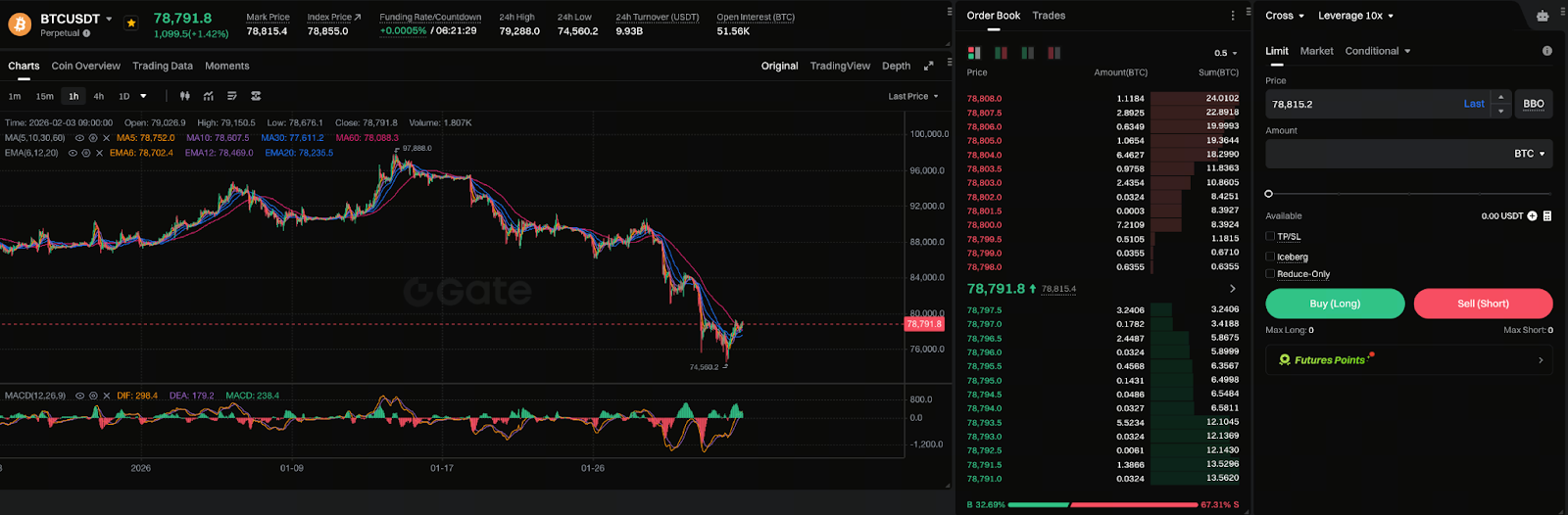

Image: https://www.gate.com/futures/USDT/BTC_USDT

On Gate, the contract trading feature is organized into the following main modules:

  • Contract type selection (USDT-margined, coin-margined, etc.)
  • Leverage and margin configuration
  • Position management dashboard
  • Risk control and liquidation alert system

This modular structure allows users to clearly assess potential risks and account status changes before placing an order, rather than reacting passively during periods of high volatility.

III. Margin Modes: Using Isolated and Cross Margin on Gate

Margin mode is one of the most fundamental and crucial features in contract trading.

Gate offers two primary margin modes:

Isolated Margin

  • Each position’s risk is calculated independently
  • Maximum loss is limited to the margin of that position
  • Ideal for beginners or short-term strategies

Cross Margin

  • All positions share the account’s margin balance
  • Provides greater resilience against market volatility
  • Well-suited for trend trading or managing multiple positions

Gate’s interface clearly indicates liquidation price changes for each mode, minimizing operational errors caused by incorrect selections.

IV. Gate’s Liquidation and Risk Control Mechanisms

Liquidation mechanisms can trigger strong emotional reactions in contract trading, but they are fundamentally system-level risk protection tools.

Gate’s contract system implements risk control logic that includes:

  • Tiered maintenance margin rates
  • Risk alerts before liquidation triggers
  • Partial liquidation to avoid full position clearance

These mechanisms are not designed to “punish traders,” but to prevent uncontrollable losses during extreme market conditions.

For beginners, understanding how liquidation works is far more important than chasing high returns.

V. Key Auxiliary Features in Contract Trading

Many users focus solely on opening positions and overlook several critical auxiliary features in Gate contract trading:

  • Take-profit and stop-loss: Set simultaneously when placing orders to minimize emotional decision-making
  • Planned orders: Strategically target key price ranges in advance
  • Position data visualization: Real-time display of unrealized P&L and liquidation prices

Together, these features form a disciplined trading system that encourages proactive decision-making instead of reactive measures.

VI. Practical Tips for Beginners Using Gate Contract Trading

If you’re new to contract trading, consider the following best practices:

  • Start with low leverage to get familiar with the platform’s features rather than chasing profits
  • Begin with isolated margin mode to clearly define risk for each trade
  • Set a stop-loss for every order—don’t leave it to last-minute decisions
  • Monitor liquidation price changes instead of focusing on short-term profit and loss

The contract trading feature itself isn’t inherently dangerous; the real risk comes from misunderstanding or misusing its functions.

Author: Max
Disclaimer
* The information is not intended to be and does not constitute financial advice or any other recommendation of any sort offered or endorsed by Gate.
* This article may not be reproduced, transmitted or copied without referencing Gate. Contravention is an infringement of Copyright Act and may be subject to legal action.

Related Articles

What is Fartcoin? All You Need to Know About FARTCOIN
Intermediate

What is Fartcoin? All You Need to Know About FARTCOIN

Fartcoin (FARTCOIN) is a representative meme coin within the Solana ecosystem based on an AI-driven narrative. Its core concept originated from an experiment aimed at exploring the "boundaries between AI Agents and humor." More than just a digital asset with social attributes, the project deeply couples absurd humor culture with on-chain financial logic by integrating autonomous AI interaction models.
2026-04-04 22:01:19
Gold Price Forecast for the Next Five Years: 2026–2030 Trend Outlook and Investment Implications, Could It Reach $6,000?
Beginner

Gold Price Forecast for the Next Five Years: 2026–2030 Trend Outlook and Investment Implications, Could It Reach $6,000?

Analyze current gold price trends alongside authoritative five-year forecasts, integrating an evaluation of market risks and opportunities. This gives investors insight into the potential trajectory of gold prices and the main drivers expected to shape the market over the next five years.
2026-03-25 18:13:30
Aster vs Hyperliquid: Which Perp DEX Will Prevail?
Beginner

Aster vs Hyperliquid: Which Perp DEX Will Prevail?

Aster and Hyperliquid are the two representative protocols of the "purpose-built L1 path" within the current decentralized perpetual exchange (Perp DEX) sector. As a pioneer in the field, Hyperliquid has built a deep liquidity moat through its highly mature order book architecture and strong community consensus. Conversely, Aster, as a rising challenger, seeks to leapfrog the competition in high-performance trading through more aggressive multi-chain aggregation logic, private transaction modules, and an underlying execution environment optimized for 2026 market demands.
2026-03-24 11:58:33
AI-Native Settlement Layers: How United Stables Is Building the Next Financial Rail
Beginner

AI-Native Settlement Layers: How United Stables Is Building the Next Financial Rail

Stablecoins were originally designed as dollar substitutes within exchanges, primarily used for asset pricing and trade settlement. As on-chain financial ecosystems have matured, their role has expanded beyond simple payments to include collateral assets, cross-chain liquidity mediums, and unified settlement units. In particular, as AI systems and automated agents begin to participate directly in economic activity, demand has risen sharply for programmable value units capable of instant settlement. This shift is pushing stablecoins toward the role of foundational financial infrastructure.
2026-03-25 03:16:17
ASTER Tokenomics: Buybacks, Burns, and Staking as the Value Foundation of ASTER in 2026
Beginner

ASTER Tokenomics: Buybacks, Burns, and Staking as the Value Foundation of ASTER in 2026

ASTER is the native equity and governance token of the Aster ecosystem, with its core value built upon a radical "Deflationary Engine." Beyond serving as a governance tool, ASTER integrates multiple utilities including staking rewards, trading fee discounts, and liquidity incentives. Through its deep integration with the upcoming dedicated Layer 1 mainnet, it enables direct value capture from protocol cash flow to token holders.
2026-03-25 07:38:07
2026 Silver Price Forecast: Bull Market Continuation or High-Level Pullback? In-Depth Analysis of Silver Candlestick Chart
Beginner

2026 Silver Price Forecast: Bull Market Continuation or High-Level Pullback? In-Depth Analysis of Silver Candlestick Chart

2026 Silver Price Forecast: Latest Outlook This article integrates current market trends, silver candlestick chart analysis, and momentum factors to assess the potential key support and resistance levels, upside targets, and pullback risks for silver prices. The goal is to help investors make informed, rational decisions.
2026-03-25 16:08:59