
Futures
Access hundreds of perpetual contracts
TradFi
Gold
One platform for global traditional assets
Options
Hot
Trade European-style vanilla options
Unified Account
Maximize your capital efficiency
Demo Trading
Introduction to Futures Trading
Learn the basics of futures trading
Futures Events
Join events to earn rewards
Demo Trading
Use virtual funds to practice risk-free trading
Launch
CandyDrop
Collect candies to earn airdrops
Launchpool
Quick staking, earn potential new tokens
HODLer Airdrop
Hold GT and get massive airdrops for free
Launchpad
Be early to the next big token project
Alpha Points
Trade on-chain assets and earn airdrops
Futures Points
Earn futures points and claim airdrop rewards


More






Warning signs in the US stock market: Retail investors are "no longer bottom-fishing, selling on rallies"!
The behavior patterns of American retail investors have been undergoing the most alarming shift since 2020—rather than stepping in to buy the dip during downturns, they have been steadily reducing their positions using rebound opportunities.
According to JPMorgan Chase’s latest report, in March, the total net purchases by U.S. retail investors in the stock market fell by nearly 50% from the historical peak in January. Last Wednesday saw a partial market rebound for a period; while the retail inflow data was overall still acceptable, the structure clearly leaned more toward fixed-income ETFs rather than equity assets—meaning retail risk appetite is continuing to contract instead of being restored as the market improves.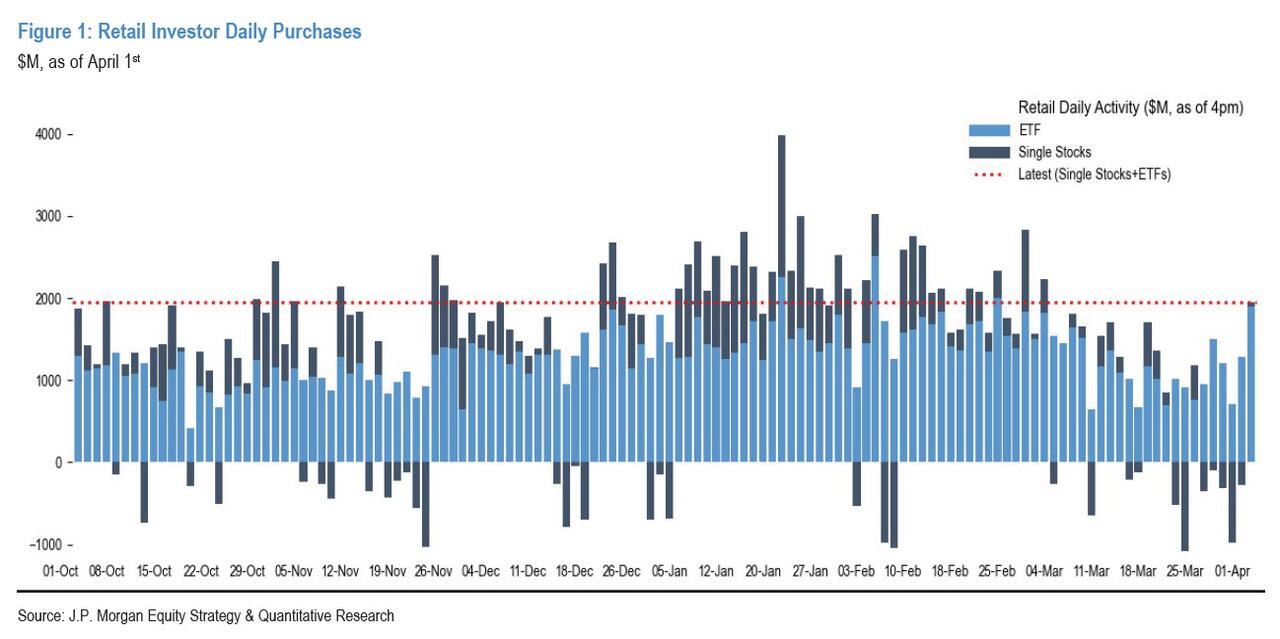
The potential impact of this behavior change on the market cannot be underestimated. Retail investors have historically been an important marginal buyer force when U.S. stocks fall, and their “buy-the-dip” inertia naturally helps stabilize the market. Now that this support is showing signs of wavering, and at the same time institutions have also not been seen entering meaningfully, the funding vacuum between the long and short sides is widening, increasing the market’s vulnerability.
A historic reversal: “momentum crowded” surpasses “buy-the-dip crowded”
JPMorgan analysts Arun Jain said that since late 2023, retail investors have been steadily chasing momentum strategies, and after entering 2024 they have gradually taken profits in long-term winners while also looking for opportunities in laggards. Historical patterns show that retail investors typically prefer to buy on declines, and concentrate adding to positions in the securities that have experienced lagged declines within a three-month window—since 2020, this “left-tail buying” strategy has averaged positive returns.
However, this behavior has recently experienced a historic reversal: for the first time, the extent to which retail is crowded into short-term momentum names has surpassed the extent to which it is crowded into lagging names. This means retail investors currently still hold high-beta assets (crowding is at the 92.5th percentile, closely matching short-term momentum), rather than adding to positions in low-volatility (i.e., currently lagging) names. At the same time, retail investors are also continuing to reduce their exposure to cyclical assets.
A fundamental shift in this behavior logic marks retail moving from its prior role as a “stabilizer” for the market toward a more defensive posture—potentially even avoiding risk on the short term. For U.S. stocks that rely on retail capital to provide bottom support, this is a structural warning worth ongoing attention.
Retail purchases plunge; March data shrinks by nearly half versus January’s peak
On the data front, the retreat in March’s overall retail purchasing power is larger than expected.
According to JPMorgan’s report, as of last Tuesday, although retail investors still maintained modest net inflows into ETFs, at the single-stock level they continued to show a net selling trend—despite a rebound in the market during that period.
When the market strengthened last Wednesday, the retail investors’ overall inflow for the day was at the 76.6th percentile, which looks healthy on the surface, but was mainly driven by ETFs (at the 96.4th percentile).
More importantly, the incremental ETF buying was concentrated in fixed-income ETFs (at the 98th percentile), led by short-duration products such as SGOV, rather than risk assets like stocks. On the single-stock side, retail investors recorded some inflows at midday (at the 64.7th percentile), but then continued to cut positions in the afternoon, nearly reverting to flat by the close (at the 38.1th percentile) — a typical “rebound to distribute” pattern.
Energy posts the largest weekly net outflow in history
At the individual stock level, after excluding “Mag 7” (the seven large technology giants), retail investors were net sellers across almost all sectors for the week ending April 1, with only consumer staples as the exception.
Selling in the energy sector was especially severe.
Retail investors have been net selling energy stocks since February, but last week’s selling intensified sharply, peaked on Wednesday, and set the largest weekly net outflow on record—far exceeding the prior historical extreme. ExxonMobil (XOM), Chevron (CVX), and Occidental (OXY) were the main drags; their z-scores on Wednesday were -6.9, -6.6, and -5.6, respectively.
The storage chip sector also faced pressure. After Google released a new compression technology that can reduce the memory demands of AI models, Micron (MU) and SanDisk (SNDK) became the most heavily sold storage-related stocks that week, with z-scores of -2.3 and -3.0, respectively.
The technology sector overall was also difficult to escape. Even though retail investors continued to buy retail favorites such as TSLA, MSFT, and NVDA, they kept net selling technology stocks other than the “Mag 7,” causing the technology sector’s overall positioning to fall to the lowest level in nearly six months.
Risk Disclosure and Disclaimer