Author: Alex O’Donnell, CoinTelegraph; Translation: Wuzhu, Jinse Finance
BTC has always been a great store of value, but the returns have been poor. Luckily, the days of BTC with a yield below 0.5% are about to end. Opportunities arising from BTC Layer 2 (L2) and the Decentralized Finance (DeFi) ecosystem have changed the game. Here’s how to prepare for the upcoming BTC yield surge.
BTCMining used to be the only way to obtain meaningful BTC rewards. Ordinary holders had to settle for unreliable CeFi (CeFi) platforms (such as the now defunct Celsius and Voyager) or meager Decentralized Finance returns. As of September 5th, the annual interest rate paid by Aave, a Decentralized Finance lending platform, to Wrapped Bitcoin (WBTC) depositors was only 0.04%.
This situation is changing. After years of quiet development, BTC’s L2 expansion network (such as Lightning Network, Core Chain, Rootstock (RSK), and Stacks) is gaining follow. According to DeFiLlama’s data, as of September 5th, the Total Value Locked (TVL) of BTC L2 has soared to about 1.4 billion US dollars. So far this year, this number has risen by nearly 275%, and it has risen 10 times since 2023.
CoreDAO developer Brendon Sedo pointed out that he expects BTC L2 to account for a significant portion of the market cap of over 1 trillion USD in the coming years.
Bitcoin原生stake
Some L2 solutions (including Core Chain, Babylon, and Spiderchain) are exploring BTC native stake. Similar to Proof of Stake (PoS) networks like Ethereum, BTC L2 stakers lock BTC as Collateral to secure the network in exchange for rewards.
Meanwhile, the liquidity stake derivatives (LSD) protocol is bringing BTC staking rewards to more L2s. These protocols issue tokens on staking pools, including Core Earn, Bedrock, Stroom, and Pell Network.
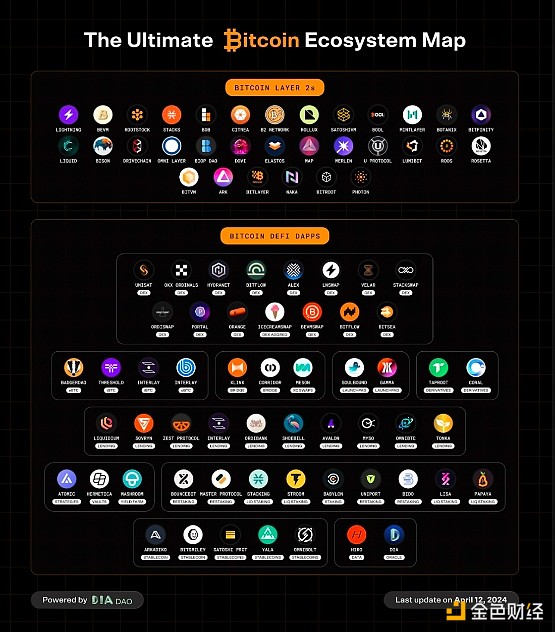
As of April 12, 2024, the BTC Layer 2 and Decentralized Finance ecosystem. Source: DIA DAO
It’s still too early. Spiderchain is still in the Testnet stage, and Babylon has not yet started distributing rewards. However, CoreChain’s LSD, stBTC, has gone live with a claimed reward rate of 8.8%.
This is much higher than the PoS network Solana.
It is crucial that Core Chain pays fees to stakers with its native Token CORE, not BTC. Remember to do your own research and carefully consider whether the Cryptocurrency strategy is suitable for you before emulating—otherwise, you will lose money!
BTC L2 is not just stake. There are also RSK, Merlin, and Stacks - already hosting the native Decentralized Finance ecosystem of BTC, including Decentralizationexchange (ALEX, Bitflow), lending protocol (MoneyOnChain, Zest), and integrated platforms such as Sovryn. Merlin even boasts the native Derivativesprotocol Surf for BTC.
According to DeFiLlama’s data, the payment protocol Lighting Network was launched in 2018 and is still highly respected, with a Total Value Locked of nearly 300 million USD. According to the data from the Lightning channel market Magma, Node operators - providing BTC Liquidity to the Lightning payment channel in exchange for fees - earn an average annual interest rate of 5.62% in BTC.
Similar to BTCMining, Lightning Node is mainly dominated by professional stores (such as LQWD Technologies Corp) rather than individual holders.
Institutional Interests
These BTC stake protocols will not be overlooked in the long run. Institutional stake services, including Kiln and Figment, already support staking Stacks’ native Token STX, and the Token rewards are paid in BTC form from network fees. They may soon add more networks.
In May, asset management company Valour launched the Valour Bitcoin Staking (BTC) SEK ETP, which is an exchange-traded product (ETP) listed on the Nordic Growth Market exchange in Scandinavia. It stakes BTC on the Core Chain. Valour launched the Core Chain validator Node in June.
On September 3rd, asset management company 21.co launched its regulated BTC wrapper 21.co Wrapped Bitcoin (21BTC). It is expected to bring more Liquidity from institutions.
Encapsulate Bitcoin
The most promising potential of BTC in Decentralized Finance may be on the ETH network. When the EigenLayer stake protocol is launched in 2023, it will change the game rules of Crypto Assets, and BTC is no exception.
EigenLayer supports an increasing number of Active Verification Services (AVS) - protocols that use EigenLayer’s nearly $1.2 billion ETH re-staking pool to protect themselves. In November, AVS will start paying for this privilege from protocol revenue, creating returns for re-stakers.
EigenDA is EigenLayer’s first and largest AVS, which added native L2 Token staking in August. This effectively extends staking from ETH and EigenLayer’s native EIGEN Token to almost any virtual asset, including wrapped BTC.
In August, the liquidity protocol Swell launched swBTC to pay the yield of WBTC. EigenLayer is expected to soon add wrapped BTC for staking.
Another interesting option is Synthetix, which is a Decentralized Finance Derivatives platform that launched its next-generation V3 protocol on Arbitrum (ARB) in July. Unlike its competitors, Synthetix V3 aims to accept almost any Token as Collateral. Liquidity Providers (LPs) earn transaction fees, plus additional rewards in the native Synthetix Token SNX. As of September 5th, the yield for wrapped ETH LPs on Arbitrum is 7.6%.
Currently only a few pools are active, and creating a new pool requires approval from Synthetix governance advisors. However, the WBTC pool is expected to appear on Synthetix v3 soon.
One thing is for sure. Holding BTC is becoming more and more interesting, whether it’s on the Ethereum scaling chain or BTC L2. Stay alert, or opportunities may slip away from you.


