Original Author: Mankiw Brand Department
Editor’s Note:
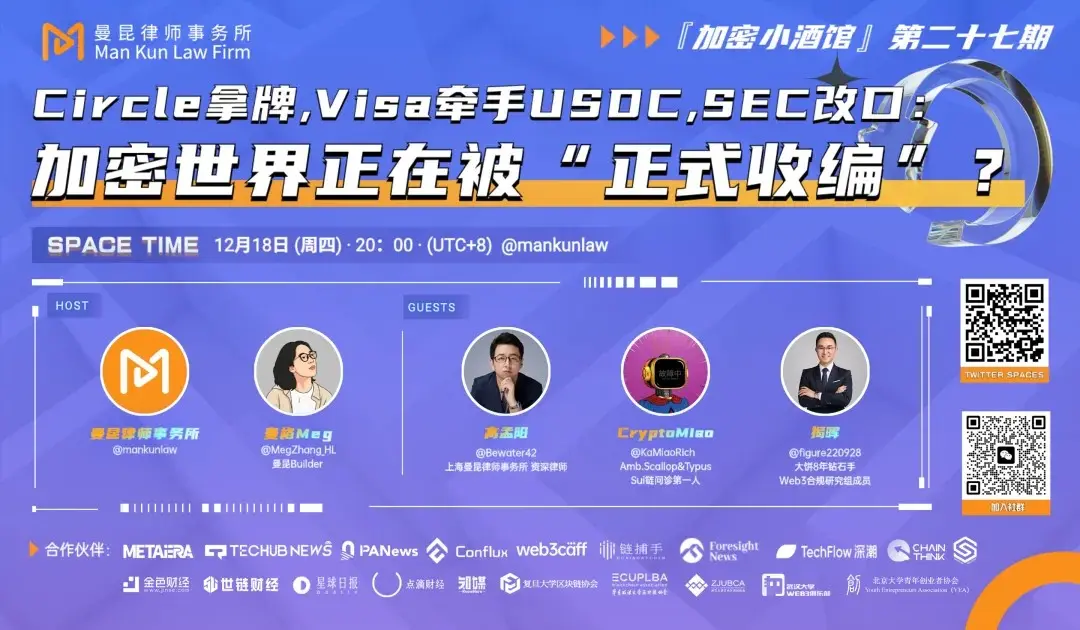
In this issue, amidst a quiet market environment, we focus on three major signals:
- Circle obtains a banking license in the US
- Visa announces support for USDC settlement
- SEC shifts to a proactive stance by promoting crypto user education
This is not the crypto world being “absorbed” by traditional finance, but rather a proactive and in-depth process of compliance integration and differentiation. Traditional financial giants are entering the crypto space through compliance channels, while native crypto forces are exploring different survival paths.
Whether you are an industry trend observer, a builder seeking opportunities, or a cautious investor, this episode’s guests will clarify the connections and clashes between the crypto industry and traditional finance from legal, financial, tax, and frontline risk perspectives, providing highly valuable insights.
**Meg: **The tavern’s topics are relatively light-hearted, breaking the stereotype of lawyers being “boring.” It’s a platform for Web3 builders to catch hot topics and exchange viewpoints in a relaxed, down-to-earth manner. Now, let’s get to the main points.
Q1: How do you view Circle obtaining a banking license?
CrypoMiao: Let’s talk about Circle getting a banking license. From an industry researcher’s perspective, this is undoubtedly a proactive move rather than a compromise. Circle’s core market in the US is in the compliance sector; their strategy is to focus on compliance and seize the opportunity in the Web3 legalization process.
Previously, Circle faced extremely high compliance costs, which eroded a large portion of profits. After successfully going public and gaining support from capital markets, they are more confident in pushing for the integration of Web3 and Web2. Applying for a national banking license is a key step — not only to meet regulatory requirements but also to establish a leading position before clear regulations are in place. Once the US officially recognizes stablecoins for payments and settlements, USDC is likely to become the preferred choice.
Additionally, Circle has already obtained licenses in the EU, Abu Dhabi, and other regions. Now, by completing the US banking trust license, it can transfer custody services from third parties to its own bank, significantly reducing friction and costs in intermediary links. This is essentially an upstream business integration, further strengthening its moat. The partnership with Visa also confirms this — settlement relies on banking interfaces, and internalizing this profit segment is part of Circle’s long-term strategy.
In short, Circle is betting on a future: before the US fully adopts stablecoins, it aims to become a cornerstone recognized by mainstream finance through thorough compliance.
Summary: Circle is not compromising but is actively positioning itself for the future stablecoin payment and settlement infrastructure through comprehensive compliance.
Q2: What does Visa’s support for USDC signify?
Jie Hui: As a global financial clearing giant, Visa connects banks, merchants, and national financial systems. Compliance and risk control are its lifelines; it would never partner with opaque, poorly audited stablecoins like USDT. Circle operates within a clear US regulatory framework; having just obtained a banking license, it is already ahead in the legal positioning game. Cooperation with Visa is almost inevitable.
But this doesn’t mean USDT is out. Instead, it may usher in a layered stablecoin era: USDC, as a compliant stablecoin, will become the “settlement layer,” connecting with traditional financial infrastructure like Visa; USDT will continue to dominate the “circulation layer,” remaining active in exchanges and DeFi applications.
More importantly, this partnership signifies a fundamental shift in the identity of Circle and USDC — from a crypto company to an infrastructure recognized by traditional finance. It can be seen as completing a crucial “coming of age” ceremony.
Summary: Visa’s support marks the entry of stablecoins into a “layered era,” with USDC becoming the “settlement layer” recognized by traditional finance. This collaboration signifies a fundamental transformation of Circle and USDC’s identity.
Q3: How do you view SEC’s shift from “risk prevention” to “public education”?
Gao Mengyang: The SEC’s attitude has changed, which is related to the current US government’s direction — they are relatively open to crypto. Circle and Tether have taken two very different paths: one aggressively pursuing compliance to enter traditional finance; the other less transparent, more native to crypto. This makes us think: Will crypto ultimately become part of traditional finance, or will it forge a new path? Honestly, everyone is still exploring.
CrypoMiao: Tether has undergone audits, but about 20% of its reserves are in Bitcoin and gold, effectively “betting” with user funds. If other issues arise, USDT could also depreciate. Under strict regulation, such operations are hard to pass, so Tether takes a high-risk, flexible approach, quite different from Circle’s steady style.
Jie Hui: Veteran players tend to prefer USDC for stability. SEC’s current approach is clear: first warn about risks, then educate investors, and likely soon start to delineate responsibilities, treating many tokens as securities. Regulation is gradually taking shape.
In fact, as regulation becomes clearer, the market is changing. Many altcoins can’t rise; some projects raise funds but fade away after a brief hype — I can’t even remember their names. The industry is undergoing reshuffling, which may also be part of moving toward standardization.
Summary: SEC’s shift is a systemic regulatory groundwork, aiming to establish responsibility frameworks, accelerating industry reshuffling and formalization.
Q4: This round of regulation is beneficial for the industry, but many operations don’t yield satisfactory returns. Under this new trend, which sectors might become the main drivers of the next market cycle?
CrypoMiao: I believe that beyond stablecoins, once compliant valuation tools are available on-chain, many real-world assets can be “tokenized.” For example, RWA (Real World Assets), and various securitized tokens like equity in private companies, storage rights, etc. Although current scale might be only hundreds of billions, the potential is huge.
So why is Circle pursuing a banking license? Because when massive transactions happen on-chain, each transaction needs to go through compliant banking channels for settlement. They aim not just to be a Web3 company but to become the underlying settlement layer for bringing traditional assets onto the chain.
Besides these money-related assets, in the next 3-5 years, more application-oriented innovations will emerge, such as copyright on-chain, decentralized storage, blockchain-based encrypted identity login, and even true ownership of game assets by players. The first wave of Web3 adoption will focus on payments and trading, but over time, giants like Tencent and Meta could emerge. This evolution takes time, but the direction is clear.
Summary: RWA and securitized tokens are mid-term clear directions, while long-term, super applications based on new financial infrastructure will emerge.
Q5: As industry compliance improves, do legal risks really decrease for practitioners? Which areas are still high-risk pitfalls?
Gao Mengyang: I think risks haven’t decreased; they might even be greater. Because when we talk about compliance, most refer to regulations outside China — domestic regulation has always been quite clear.
For individuals, holding virtual currencies in mainland China isn’t illegal per se, but policies don’t support it. Your investment gains or losses are more about business risks. The real legal pitfalls are in the withdrawal process — when you exchange UST or other stablecoins for fiat, it’s hard to verify the source of the funds. Dirty UST obviously carries risks, but the investigation and consequences for “dirty money” are much more severe — banks can trace many pathways. This is the biggest risk for individual users.
For practitioners, risks are more complex. Only projects that explicitly block Chinese users, lack Chinese interfaces, and exclude Chinese users in their user agreements are relatively safer — similar to doing remote outsourcing overseas.
In summary, personal investment isn’t legally prohibited, but withdrawal must be cautious. Practitioners need to clearly understand their position and the nature of their projects; compliance isn’t just talk but depends on specific user bases and operational details.
Summary: Global compliance doesn’t equal legality domestically. The biggest risk is in withdrawal, and risks for practitioners vary greatly depending on project location and user targeting.
Quick Q&A Time
Q1: How do you see the evolution of the crypto world?
Jie Hui: Since holding Bitcoin in 2017, I initially believed in “one coin, one villa.” Although it has risen a lot, I haven’t reached that goal, and the risks of deposits and withdrawals are high, so I haven’t moved. I think the early crypto world was very “wild,” full of permissionless, code-as-law utopian elements; now, with big institutions entering, compliance, licensing, and KYC have become mainstream — a big change. But the underlying consensus and decentralization rules of Bitcoin haven’t changed. As a holder, I will continue to hold.
Q2: What do young people lack most?
Gao Mengyang: I believe what everyone lacks most is risk awareness. Individual investors should be cautious about “dirty money” risks when withdrawing; practitioners must be especially careful, especially in China, where this industry isn’t encouraged — many places are just “waiting for rice to cook.” He emphasizes that prevention is always better than remediation!
Q3: What are your expectations for Web3 in the next 5 years?
CrypoMiao: I think initially it will resemble a hybrid of banking and tech, because it needs financial infrastructure to connect Web2 and Web3, like settlement agencies and exchanges. But in 3-5 years, the focus will shift to application layers, such as on-chain storage, encryption, content platforms, which will be more like the pure internet.
Closing Remarks
Risk Reminder:
The crypto industry is not simply “absorbed,” but under compliance pressure, it is undergoing deeper segmentation and restructuring. Compliance is not the finish line but a filtering mechanism that determines which entities can remain in the system.
For individuals, in a phase of increased uncertainty, risk control should always take precedence over profit expectations; for practitioners, understanding your position and the nature of your project is more important than technical skills.


