What Is Talus? A Revolutionary Infrastructure for the Automated Digital Economy
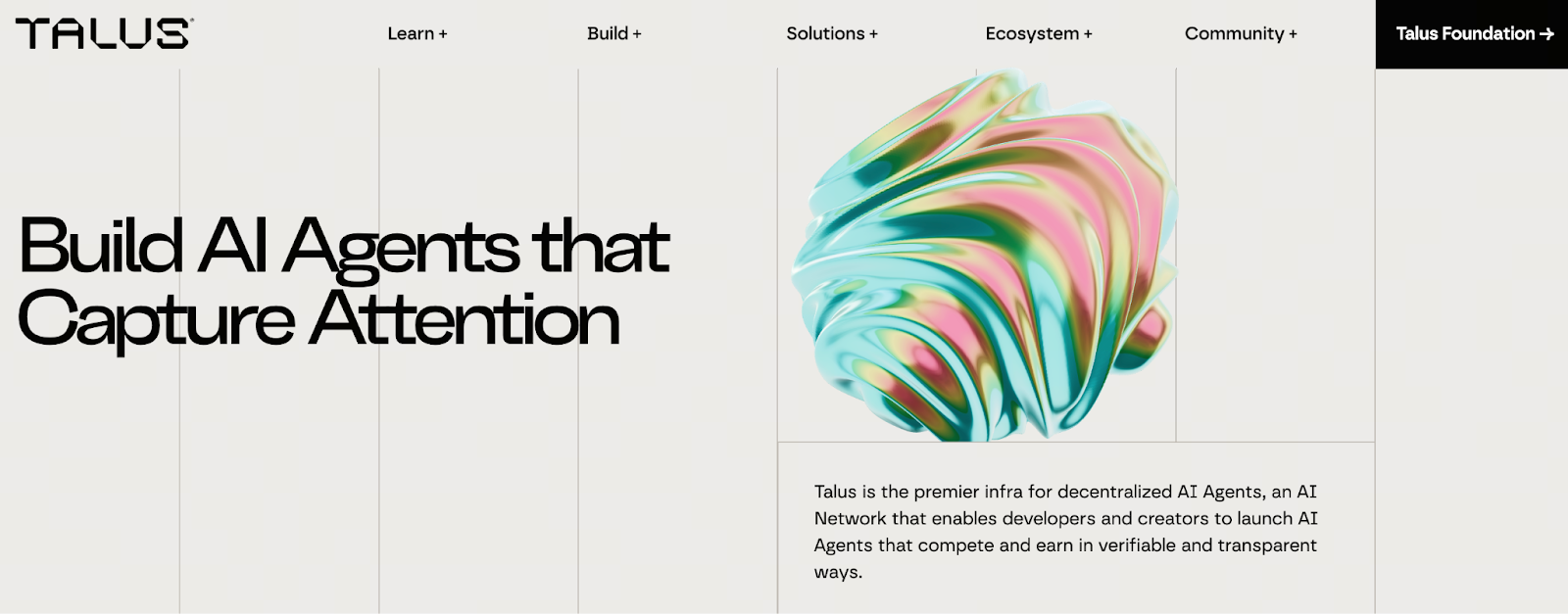
Image: https://talus.network/
As blockchain technology advances, a growing number of industries are exploring ways to achieve more efficient transactions and services in decentralized environments. Yet, existing blockchain systems face major challenges, including a lack of flexible decision-making mechanisms and limited automated execution capabilities. Talus Network was created to address these issues, delivering essential infrastructure for decentralized economies—particularly in integrating artificial intelligence (AI) and automation.
Talus Network Overview
Talus Network is a decentralized platform focused on building a smarter, more efficient digital economy by leveraging artificial intelligence and blockchain technology. Its core offering, the Talus Agentic Framework (TAF), together with the Nexus protocol, transforms blockchain from a passive ledger into a dynamic network capable of intelligent decision-making and automated task execution.
Key Features of Talus Network
Talus stands out for its ability to combine artificial intelligence with blockchain, empowering blockchain to move beyond traditional smart contract logic into more complex decision-making and execution scenarios. The following core features deliver significant value to developers and users:
1. Talus Agentic Framework (TAF)
TAF is the backbone of Talus, providing standardized computational interfaces for decentralized applications. It enables developers to securely connect computational resources outside of standard smart contracts to the blockchain. With TAF, developers can create asynchronous workflows that execute tasks automatically, without human intervention. This approach overcomes resource constraints and inflexibility in smart contract execution, allowing blockchain systems to handle more sophisticated operations and decisions.
2. Nexus Protocol
Nexus is the execution layer of the Talus Network, responsible for validating smart contract execution and managing tool custody. The Nexus protocol coordinates workflow execution through a decentralized leader network, ensuring secure payments and data transmission. It not only supports the development of decentralized applications (dApps), but also enables AI-powered workflow execution, enhancing both efficiency and transparency in blockchain applications.
3. Automated Agents
Automated agents (Talus Agents) in the Talus Network can execute a wide range of tasks automatically, following predefined workflows. For example, users can delegate digital asset management, conduct transactions, or perform specific protocol operations through Talus automated agents. By automating execution, Talus significantly reduces manual intervention, making workflows more efficient and transparent.
Talus’s Role in the Decentralized Economy
The Talus Network provides intelligent infrastructure for decentralized economies, enabling many economic activities to be automated. For example, decentralized finance (DeFi) applications can leverage Talus’s automated agents for market trading and fund management, eliminating reliance on traditional centralized systems. Talus not only boosts transaction efficiency, but also improves overall transparency and fairness in the economy.
How Talus Enables Automated Digital Workflows
Talus’s automation tools empower Web3 applications to manage resources, exchange data, and process payments with minimal human involvement. For instance, developers can use Talus’s tools to create decentralized asset management workflows that automatically allocate and trade assets, reducing human error and risk.
Talus’s Impact on Blockchain
Talus expands the scope of blockchain applications, moving beyond basic transactions and smart contract execution to support complex automated tasks and intelligent decision-making. By integrating artificial intelligence, Talus enables blockchain to respond more flexibly to dynamic market and environmental changes, providing robust support for decentralized economies.
Conclusion
Talus is the seamless fusion of blockchain and artificial intelligence, unlocking new possibilities for the decentralized economy. Through intelligent decision-making and automated execution, the Talus Network dramatically increases the efficiency of economic activities, offering greater value to developers and users. As Talus Network continues to grow, it is poised to become a foundational pillar of the future digital economy.
Share
Content


Related Articles
2025 BTC Price Prediction: BTC Trend Forecast Based on Technical and Macroeconomic Data
Flare Crypto Explained: What Is Flare Network and Why It Matters in 2025

Pi Coin Transaction Guide: How to Transfer to Gate.com
How to Use a Crypto Whale Tracker: Top Tool Recommendation for 2025 to Follow Whale Moves

What is N2: An AI-Driven Layer 2 Solution