Bitcoin is tracking a hidden $400 billion Fed liquidity signal that matters more than rate cuts
Bitcoin’s price action continues to drift into the Federal Reserve’s final policy decision of the year with little outward volatility, yet the underlying market structure reflects a very different reality.
What appears to be a stable range is concealing a period of concentrated stress, as on-chain data shows that investors are realizing close to $500 million in daily losses, leverage has been sharply reduced across futures markets, and nearly 6.5 million BTC now sit at an unrealized loss.
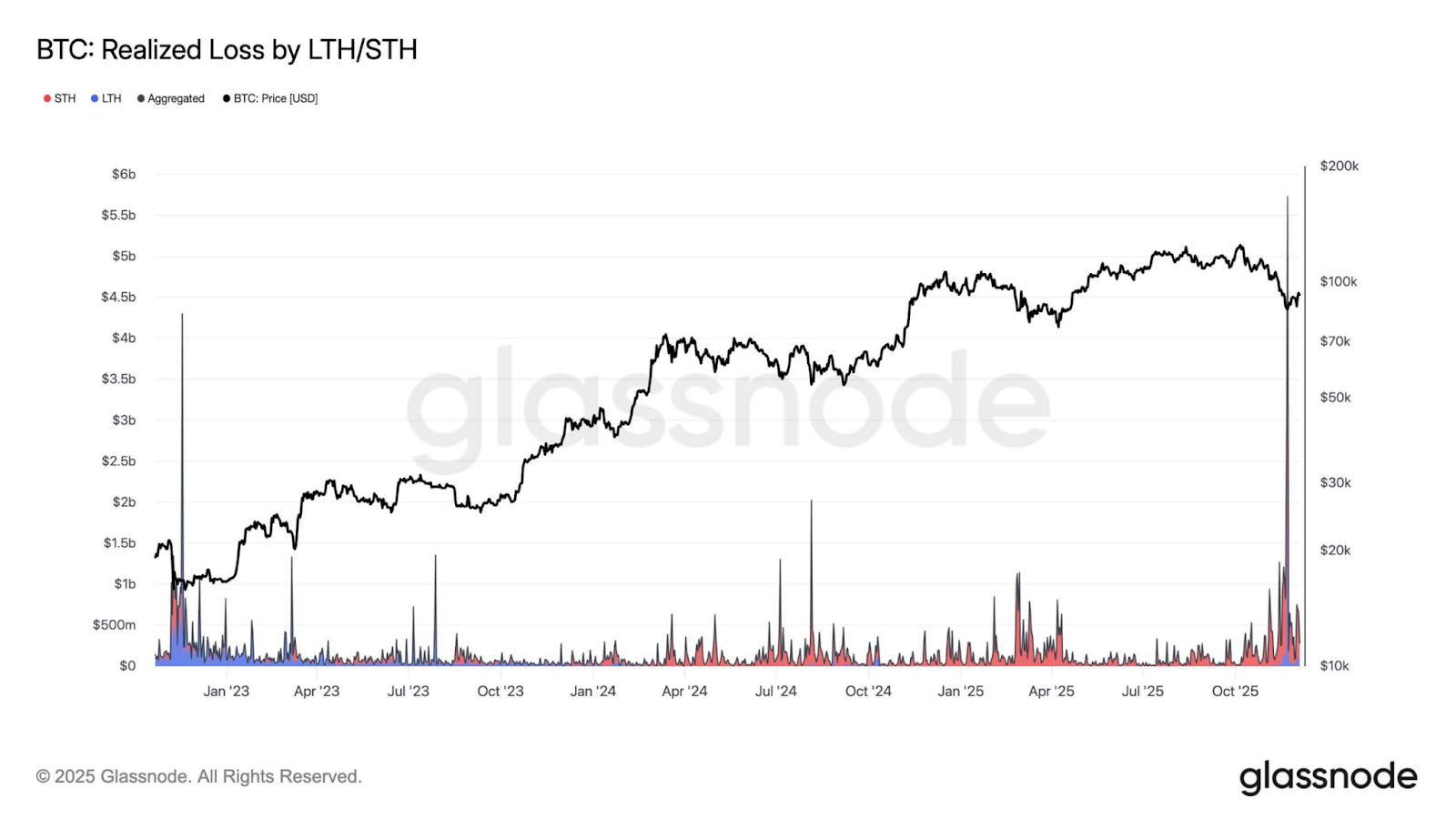
Bitcoin Realized Loss Levels (Source: Glassnode)
These conditions resemble the late stages of prior market contractions rather than a benign consolidation.
However, a structural reset unfolding beneath a static surface is not unusual for Bitcoin, but the timing is notable.
The internal capitulation coincides with an external inflection point in US monetary policy. The Fed has already wound down the most aggressive phase of balance sheet reduction in over a decade, and markets expect the December meeting to provide clearer contours for a shift toward reserve rebuilding.
Considering this, the intersection of on-chain stress and a pending liquidity transition forms the backdrop for this week’s macro events.
The liquidity pivot
According to the Financial Times, Quantitative Tightening formally ended on December 1, bringing to a close a period during which the Federal Reserve reduced its balance sheet by roughly $2.4 trillion.
As a result, bank reserves have declined toward levels historically associated with funding strain, and the Secured Overnight Financing Rate (SOFR) has periodically tested the upper bound of the policy corridor.
These developments indicate a system that is no longer flush with liquidity but edging into the territory where reserve scarcity becomes a concern.
Against this backdrop, the most consequential signal from the FOMC will not be the widely anticipated 25-basis-point rate cut but the direction of its balance sheet strategy.
The Fed is expected to outline, either explicitly or through its implementation notes, how it intends to transition to Reserve Management Purchases (RMP).
According to Evercore ISI, this program could begin as early as January 2026 and involve roughly $35 billion per month in Treasury bill purchases as runoff from mortgage-backed securities is reinvested into shorter-duration assets.
The mechanics matter. While the Fed is unlikely to frame RMP as stimulus, reinvesting into bills steadily rebuilds reserves and shortens the maturity profile of the System Open Market Account.
The operation gradually lifts reserves, resulting in an annualized balance sheet increase of more than $400 billion.
Such a transition would mark the first sustained expansionary impulse since QT began. Historically, Bitcoin has tracked these liquidity cycles more closely than changes in policy rates.
Meanwhile, broader monetary aggregates suggest the liquidity cycle may already be turning.
Notably, the M2 money supply has reached a record $22.3 trillion, surpassing its early-2022 peak after an extended contraction.
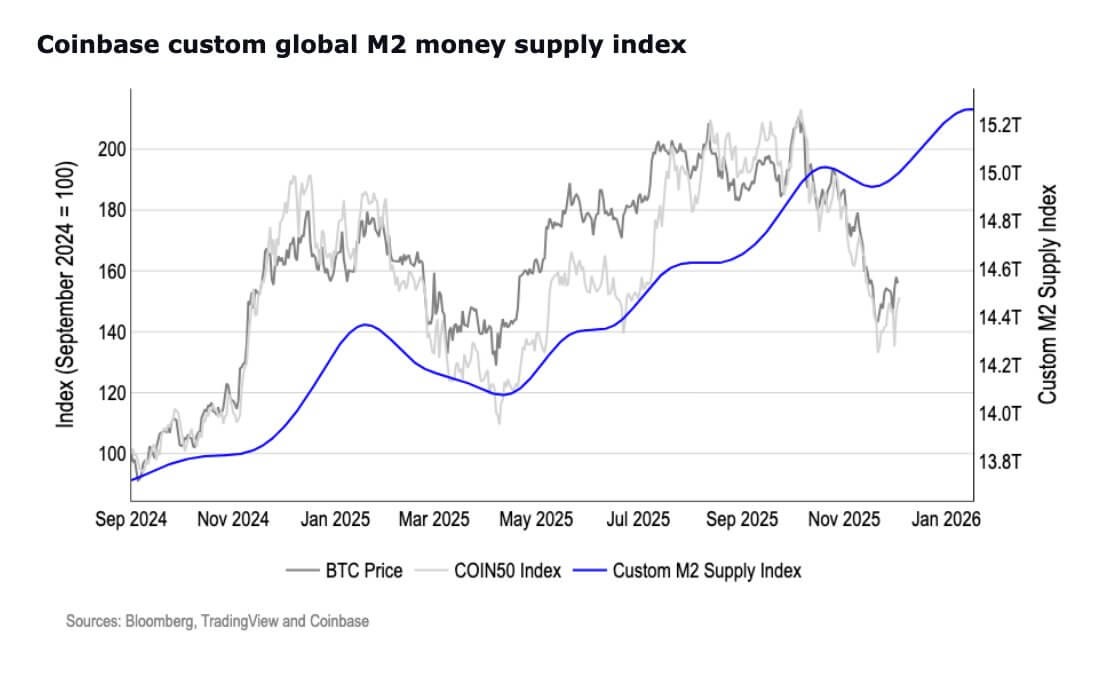
US M2 Money Supply (Source: Coinbase)
So, if the Fed confirms that reserve rebuilding is underway, Bitcoin’s sensitivity to balance sheet dynamics could regain prominence quickly.
The macro trap
The rationale for this pivot lies in the labor data.
Nonfarm payrolls have declined in five of the last seven months, and the deceleration in job openings, hiring rates, and voluntary quits has shifted the employment narrative from resilience toward fragility.
The “soft landing” framework becomes more difficult to defend as these indicators cool, and the Fed faces a narrowing set of policy options.
Inflation has moderated but remains above target, yet the cost of a tighter-for-longer policy is rising.
The risk is that labor-market weakness compounds before disinflation fully completes. Consequently, this week’s press conference may hold more informational value than the rate decision itself.
Markets will focus on how Powell balances the need to preserve labor-market stability with the need to protect the credibility of the inflation path. His characterization of reserve adequacy, balance sheet strategy, and the timing of RMP will guide expectations for 2026.
For Bitcoin, this introduces conditional rather than binary outcomes.
If Powell acknowledges labor softness and provides clarity on reserve rebuilding, the market is likely to interpret the current range-bound price as misaligned with the direction of policy. A move through the $92,000–$93,500 range would signal that traders are positioning for a liquidity expansion.
However, suppose Powell emphasizes caution or defers clarity on RMP. In that case, Bitcoin may remain within or revisit the lower consolidation band between $82,000 and $75,000, where ETF bases, corporate treasury thresholds, and historical areas of structural demand cluster.
Bitcoin capitulation?
Meanwhile, Bitcoin’s internal market dynamics reinforce the notion that the flagship digital asset has been resetting underneath the surface.
Short-term holders continue to distribute coins into weakness, and mining economics have deteriorated as production costs approach $74,000.
At the same time, mining difficulty registered its sharpest decline since July 2025, indicating that marginal operators are scaling back or shutting down.
Yet these signs of stress coexist with early evidence of supply tightening.
BRN Research told CryptoSlate that Large wallets have accumulated approximately 45,000 BTC over the past week, exchange balances continue to trend lower, and stablecoin inflows indicate that capital is preparing to re-engage should conditions improve.
Moreover, Bitwise’s supply metrics show accumulation across wallet cohorts even as retail sentiment registers “extreme fear.” Coins are moving away from liquid venues toward longer-term custody, reducing the portion of supply available to absorb further selling.
This pattern, a combination of forced distribution, miner pressure, and selective accumulation, typically forms the substrate for durable market floors.
Bitwise added:
“Capital inflows into Bitcoin continue to contract, with 30-day Realised Cap growth slowing to just +0.75% per month. This indicates that profit taking and loss taking are now broadly balanced, with losses only marginally outweighing gains. This rough equilibrium suggests the market has entered a state of rest, with neither side exerting meaningful dominance.”
The technical verdict
From a market-structure perspective, Bitcoin remains bracketed by two critical zones.
A sustained break above $93,500 would lift the asset into a region where momentum models are more likely to trigger, with subsequent levels at $100,000, the $103,100 short-term holder cost basis, and the longer-term moving averages.
Conversely, failure to clear resistance in the face of a cautious Fed message could pull the market back toward $82,000–$75,000, a range that has repeatedly acted as a reservoir of structural demand.
BRN pointed out that cross-asset performance supports this sensitivity. Gold and Bitcoin have traded inversely in the lead-up to the meeting, reflecting rotations driven by shifting liquidity expectations rather than risk sentiment alone.
So, should Powell’s comments reinforce the idea that reserve rebuilding is the next phase of the policy cycle, flows are likely to reorient quickly toward assets that respond positively to expanding liquidity conditions.
Disclaimer:
- This article is reprinted from [cryptoslate]. All copyrights belong to the original author [Oluwapelumi Adejumo]. If there are objections to this reprint, please contact the Gate Learn team, and they will handle it promptly.
- Liability Disclaimer: The views and opinions expressed in this article are solely those of the author and do not constitute any investment advice.
- Translations of the article into other languages are done by the Gate Learn team. Unless mentioned, copying, distributing, or plagiarizing the translated articles is prohibited.
Share


Related Articles

In-depth Explanation of Yala: Building a Modular DeFi Yield Aggregator with $YU Stablecoin as a Medium

BTC and Projects in The BRC-20 Ecosystem

What Is a Cold Wallet?

Blockchain Profitability & Issuance - Does It Matter?
What is the Altcoin Season Index?