HMT vs LRC: Comparing Two Blockchain-Based Token Standards for Digital Asset Management

Introduction: HMT vs LRC Investment Comparison
In the cryptocurrency market, the comparison between HUMAN (HMT) vs Loopring (LRC) has always been a topic that investors cannot ignore. The two not only show significant differences in market cap ranking, application scenarios, and price performance, but also represent different positioning in crypto assets.
HUMAN (HMT): Since its launch in 2021, it has gained market recognition for its human-computer cooperation protocol.
Loopring (LRC): Introduced in 2017, it has been hailed as a decentralized exchange protocol, representing one of the pioneering projects in the field of decentralized finance (DeFi).
This article will comprehensively analyze the investment value comparison between HMT and LRC, focusing on historical price trends, supply mechanisms, institutional adoption, technological ecosystems, and future predictions, attempting to answer the question that investors are most concerned about:
"Which is the better buy right now?"
I. Price History Comparison and Current Market Status
HUMAN (HMT) and Loopring (LRC) Historical Price Trends
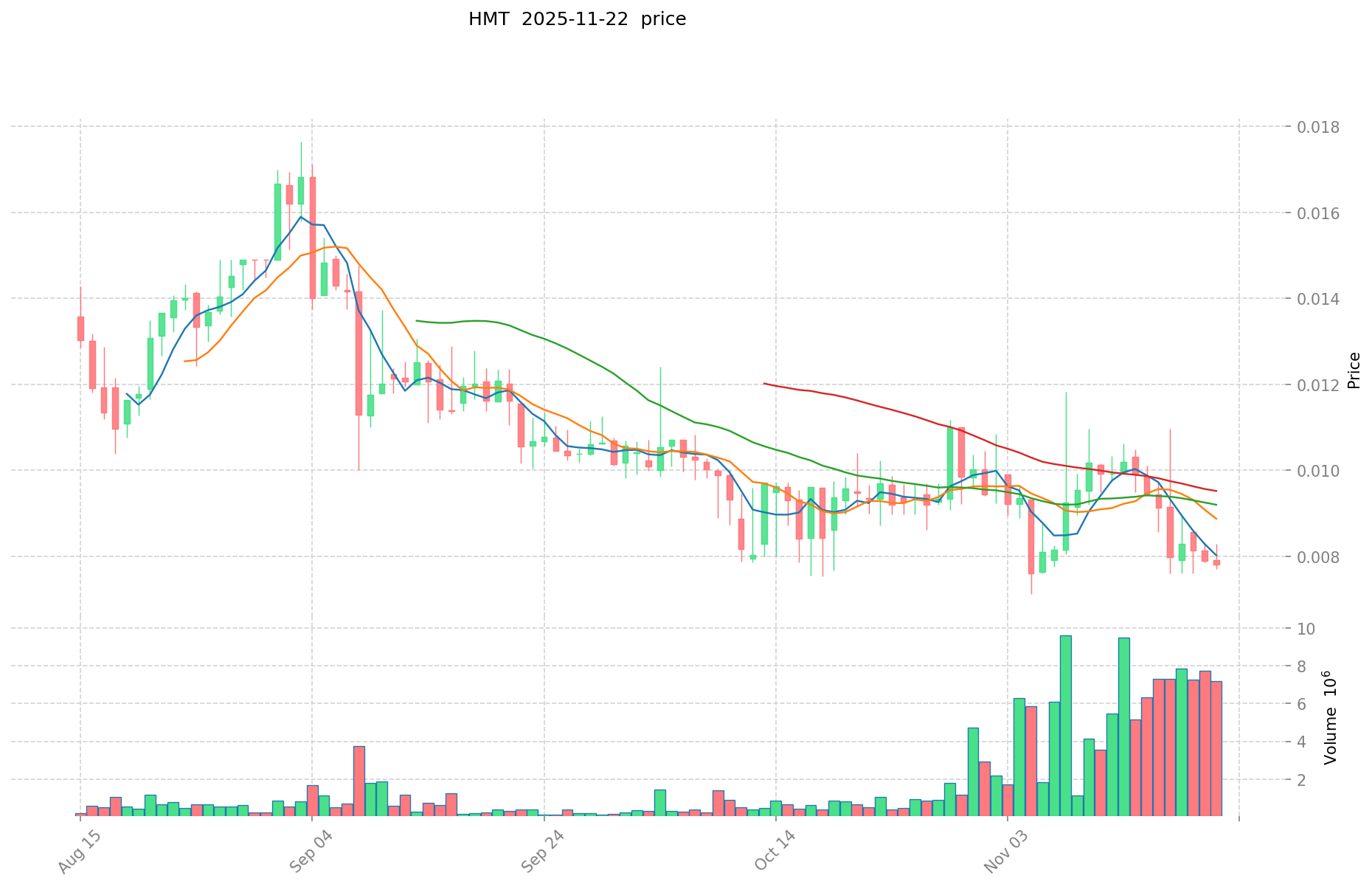
- 2021: HMT reached its all-time high of $1.37 on August 14, 2021.
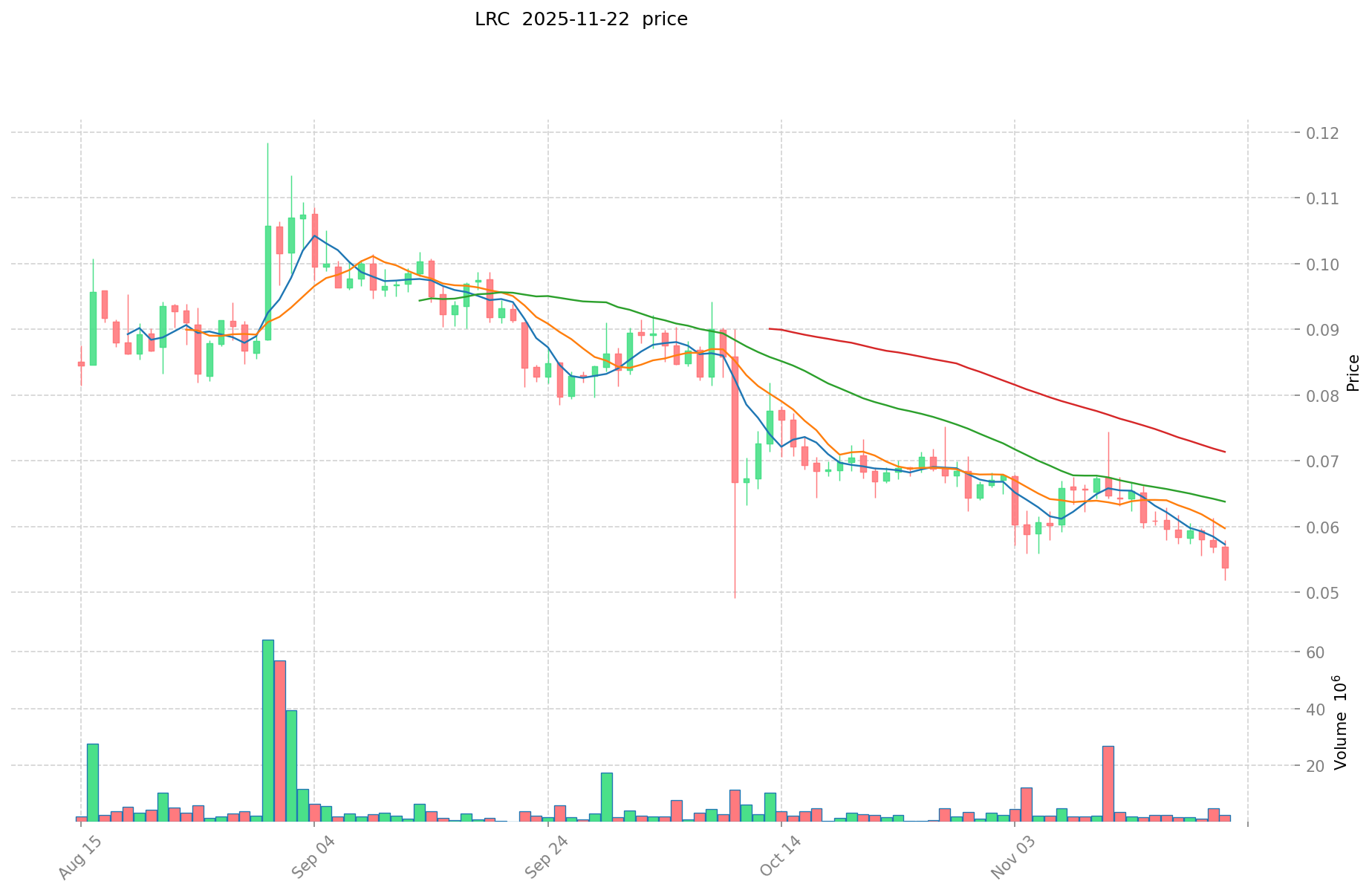
- 2021: LRC hit its all-time high of $3.75 on November 10, 2021, likely due to increased interest in Layer 2 scaling solutions.
- Comparative analysis: In the recent market cycle, HMT has fallen from its all-time high of $1.37 to a current price of $0.007978, while LRC has declined from $3.75 to $0.05269.
Current Market Situation (2025-11-22)
- HMT current price: $0.007978
- LRC current price: $0.05269
- 24-hour trading volume: HMT $58,000.18 vs LRC $136,191.42
- Market Sentiment Index (Fear & Greed Index): 11 (Extreme Fear)
Click to view real-time prices:
- View HMT current price Market Price
- View LRC current price Market Price
II. Core Factors Affecting HMT vs LRC Investment Value
Supply Mechanism Comparison (Tokenomics)
- HMT: Fixed supply model with a maximum cap of 1 billion tokens
- LRC: Deflationary model with token burning mechanism through transaction fees
- 📌 Historical Pattern: Fixed supply tokens like HMT tend to be more price stable, while deflationary models like LRC create upward price pressure during high network usage periods.
Institutional Adoption and Market Applications
- Institutional Holdings: LRC appears more established with institutional interest due to its longer history and integration with decentralized exchanges
- Enterprise Adoption: LRC has stronger adoption in decentralized exchange infrastructure, while HMT focuses on human validation services
- Regulatory Attitudes: Both tokens face regulatory uncertainty, with LRC potentially having more regulatory scrutiny due to its DEX functionality
Technical Development and Ecosystem Building
- HMT Technical Upgrades: Focus on enhancing the HUMAN Protocol's capability for validating human work and reducing AI-related fraud
- LRC Technical Development: Layer 2 scaling solutions and zkRollup technology advancement for Ethereum-based decentralized exchanges
- Ecosystem Comparison: LRC has a more established DeFi ecosystem around decentralized exchanges, while HMT is focused on labor markets and AI validation use cases
Macroeconomic Factors and Market Cycles
- Inflation Environment Performance: Both tokens have limited historical data to conclusively determine inflation resistance
- Macroeconomic Monetary Policy: As utility tokens, both are affected by broader crypto market conditions which correlate with monetary policy shifts
- Geopolitical Factors: HMT's human validation services may see increased demand with growing concerns about AI-generated content internationally
III. 2025-2030 Price Prediction: HMT vs LRC
Short-term Prediction (2025)
- HMT: Conservative $0.0042984 - $0.00796 | Optimistic $0.00796 - $0.010348
- LRC: Conservative $0.031308 - $0.05218 | Optimistic $0.05218 - $0.0714866
Mid-term Prediction (2027)
- HMT may enter a growth phase, with prices expected to range $0.0073767509 - $0.0126755438
- LRC may enter a consolidation phase, with prices expected to range $0.0610913004 - $0.09517381536
- Key drivers: Institutional capital inflow, ETF developments, ecosystem growth
Long-term Prediction (2030)
- HMT: Base scenario $0.01509741423879 - $0.021287354076693 | Optimistic scenario $0.021287354076693+
- LRC: Base scenario $0.10372209595176 - $0.115131526506453 | Optimistic scenario $0.115131526506453+
Disclaimer: The above predictions are based on historical data and market analysis. Cryptocurrency markets are highly volatile and subject to rapid changes. These forecasts should not be considered as financial advice. Always conduct your own research before making investment decisions.
HMT:
| 年份 | 预测最高价 | 预测平均价格 | 预测最低价 | 涨跌幅 |
|---|---|---|---|---|
| 2025 | 0.010348 | 0.00796 | 0.0042984 | 0 |
| 2026 | 0.01162558 | 0.009154 | 0.00695704 | 14 |
| 2027 | 0.0126755438 | 0.01038979 | 0.0073767509 | 30 |
| 2028 | 0.016953020343 | 0.0115326669 | 0.01037940021 | 44 |
| 2029 | 0.01595198485608 | 0.0142428436215 | 0.012106417078275 | 78 |
| 2030 | 0.021287354076693 | 0.01509741423879 | 0.011172086536704 | 89 |
LRC:
| 年份 | 预测最高价 | 预测平均价格 | 预测最低价 | 涨跌幅 |
|---|---|---|---|---|
| 2025 | 0.0714866 | 0.05218 | 0.031308 | 0 |
| 2026 | 0.066779964 | 0.0618333 | 0.046993308 | 17 |
| 2027 | 0.09517381536 | 0.064306632 | 0.0610913004 | 22 |
| 2028 | 0.091701257232 | 0.07974022368 | 0.0733610057856 | 51 |
| 2029 | 0.12172345144752 | 0.085720740456 | 0.08057749602864 | 62 |
| 2030 | 0.115131526506453 | 0.10372209595176 | 0.066382141409126 | 96 |
IV. Investment Strategy Comparison: HMT vs LRC
Long-term vs Short-term Investment Strategies
- HMT: Suitable for investors focused on AI validation and human labor markets
- LRC: Suitable for investors interested in DeFi and decentralized exchange infrastructure
Risk Management and Asset Allocation
- Conservative investors: HMT: 30% vs LRC: 70%
- Aggressive investors: HMT: 60% vs LRC: 40%
- Hedging tools: Stablecoin allocation, options, cross-currency portfolio
V. Potential Risk Comparison
Market Risks
- HMT: Limited market adoption and relatively new project
- LRC: Highly competitive DEX market and potential Layer 2 alternatives
Technical Risks
- HMT: Scalability, network stability
- LRC: Smart contract vulnerabilities, zkRollup technology risks
Regulatory Risks
- Global regulatory policies may have different impacts on both tokens, with LRC potentially facing more scrutiny due to its DEX functionality
VI. Conclusion: Which Is the Better Buy?
📌 Investment Value Summary:
- HMT advantages: Unique focus on human validation services, potential growth in AI-related markets
- LRC advantages: Established presence in DeFi, Layer 2 scaling solutions for Ethereum
✅ Investment Advice:
- New investors: Consider a balanced approach with a slight preference for LRC due to its more established market presence
- Experienced investors: Explore HMT for potential growth opportunities while maintaining LRC exposure
- Institutional investors: Evaluate LRC for DeFi infrastructure exposure and HMT for AI validation market potential
⚠️ Risk Warning: The cryptocurrency market is highly volatile, and this article does not constitute investment advice. None
VII. FAQ
Q1: What are the main differences between HMT and LRC? A: HMT is focused on human-computer cooperation and AI validation, while LRC is a decentralized exchange protocol. HMT has a fixed supply of 1 billion tokens, whereas LRC uses a deflationary model with token burning. LRC has a longer history in the market (since 2017) compared to HMT (launched in 2021).
Q2: Which token has performed better historically? A: LRC reached a higher all-time high of $3.75 in November 2021, compared to HMT's all-time high of $1.37 in August 2021. However, both have seen significant declines since their peaks, with LRC currently trading at $0.05269 and HMT at $0.007978.
Q3: What are the key factors affecting the investment value of HMT and LRC? A: Key factors include supply mechanisms, institutional adoption, technical development, ecosystem building, and macroeconomic conditions. LRC has more established institutional interest and a stronger presence in DeFi, while HMT focuses on emerging AI validation markets.
Q4: What are the price predictions for HMT and LRC by 2030? A: For HMT, the base scenario predicts a range of $0.01509741423879 - $0.021287354076693. For LRC, the base scenario predicts a range of $0.10372209595176 - $0.115131526506453. However, these are speculative and should not be considered financial advice.
Q5: How should investors allocate their portfolio between HMT and LRC? A: Conservative investors might consider allocating 30% to HMT and 70% to LRC, while aggressive investors might opt for 60% HMT and 40% LRC. The exact allocation should depend on individual risk tolerance and investment goals.
Q6: What are the main risks associated with investing in HMT and LRC? A: For HMT, risks include limited market adoption and scalability issues. For LRC, risks involve competition in the DEX market and potential smart contract vulnerabilities. Both face regulatory risks, with LRC potentially facing more scrutiny due to its DEX functionality.
Q7: Which token is better for new investors? A: New investors might consider a balanced approach with a slight preference for LRC due to its more established market presence and integration with decentralized exchanges. However, individual research and risk assessment are crucial before making any investment decisions.
Share
Content
Introduction: HMT vs LRC Investment Comparison
I. Price History Comparison and Current Market Status
II. Core Factors Affecting HMT vs LRC Investment Value
III. 2025-2030 Price Prediction: HMT vs LRC
IV. Investment Strategy Comparison: HMT vs LRC
V. Potential Risk Comparison
VI. Conclusion: Which Is the Better Buy?
VII. FAQ
How to Buy Cryptocurrency


Trending Cryptocurrencies



AIA vs OP: The Battle for Supremacy in Digital Insurance Innovation

What is ELF: Understanding the Executable and Linkable Format in Linux Systems

What is NEAR Protocol's Fundamental Analysis and Future Outlook in 2025?
How Does NEAR Protocol's On-Chain Data Reveal Its Growth in 2025?
Viction's Whitepaper Logic: Driving 75.6% Growth with Zero-Gas Innovations in 2025

2025 NEAR Price Prediction: A Comprehensive Analysis of Factors Driving the Next Bull Run in the NEAR Protocol Ecosystem

What is tokenomics and how does token distribution allocation work in crypto projects?

What Is Internet Computer (ICP)? A Complete Fundamentals Analysis of Whitepaper Logic, Use Cases, and Roadmap Progress

Affordable Ways to Trade Pi Coins in India: A Complete How-To Guide

What is tokenomics: how does DOT token allocation, inflation design, and governance mechanisms work?

How active is Polkadot's community and ecosystem with 8,898 developers and growing user engagement in 2025?