GMX vs THETA: A Comprehensive Comparison of Two Leading Blockchain Tokens and Their Market Performance in 2024
Introduction: GMX vs THETA Investment Comparison
In the cryptocurrency market, GMX vs THETA comparisons have always been an important consideration for investors. The two assets differ significantly in market cap ranking, use cases, and price performance, representing distinct positioning within the crypto asset landscape. GMX (GMX): A decentralized perpetual exchange token that serves as both a utility and governance token, with holders entitled to 30% of platform-generated fees. THETA (THETA): A blockchain-based decentralized video streaming platform token developed by Theta Labs, designed to optimize content distribution through peer-to-peer networks and incentivize users to share bandwidth resources as cache or relay nodes. This article will provide a comprehensive comparison of GMX vs THETA investment value across historical price trends, supply mechanisms, market adoption, and technological ecosystems, addressing the key question investors are asking:
"Which is the better buy right now?"
Comparative Analysis of GMX and Theta Network: Market Performance and Asset Overview
I. Historical Price Comparison and Current Market Status
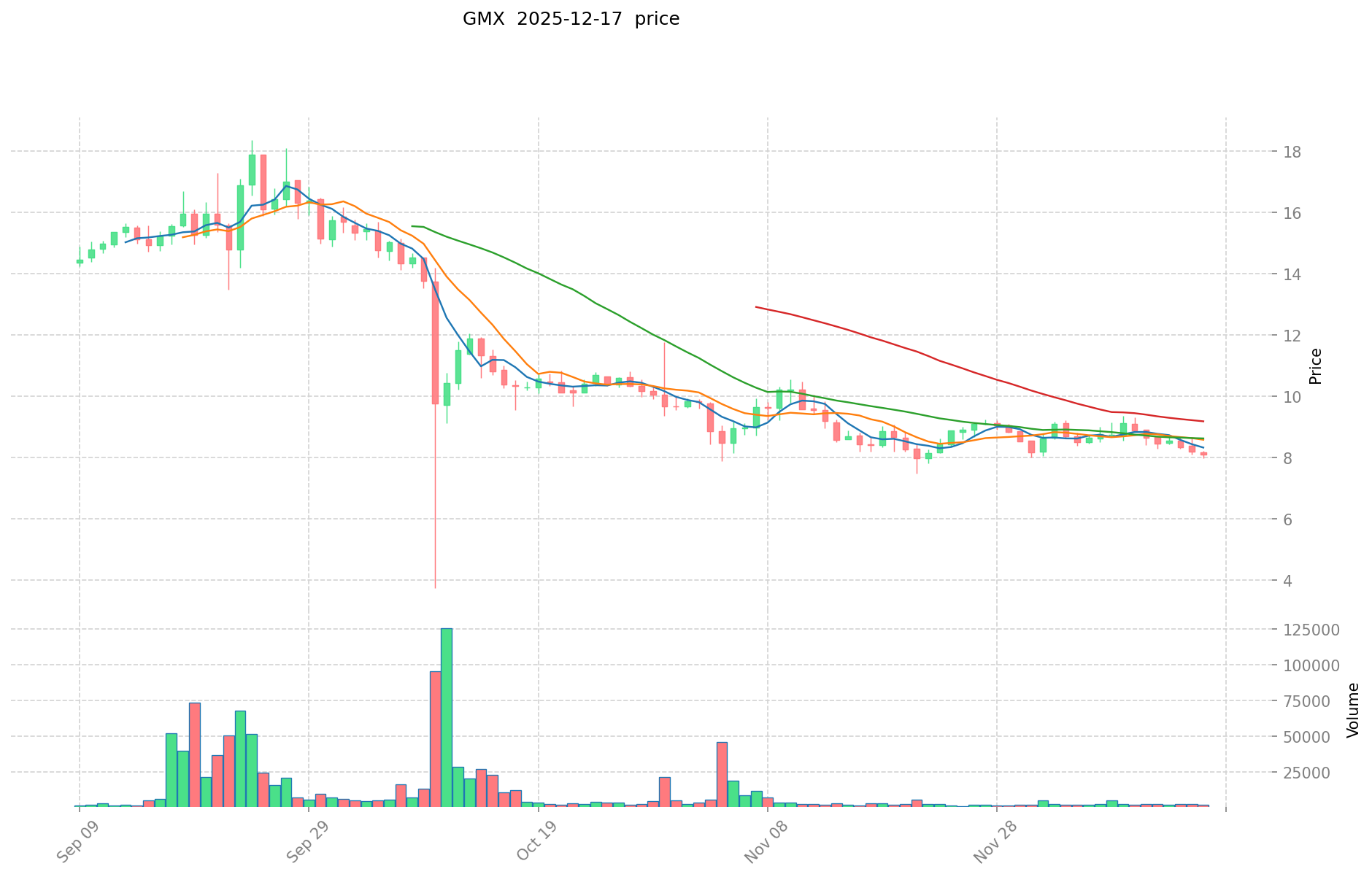
GMX and THETA Historical Price Trends
GMX Performance:
- All-Time High (ATH): $91.07 on April 18, 2023
- All-Time Low (ATL): $6.92 on October 11, 2025
- Current Price: $8.215 as of December 17, 2025
- 1-Year Change: -77.91%
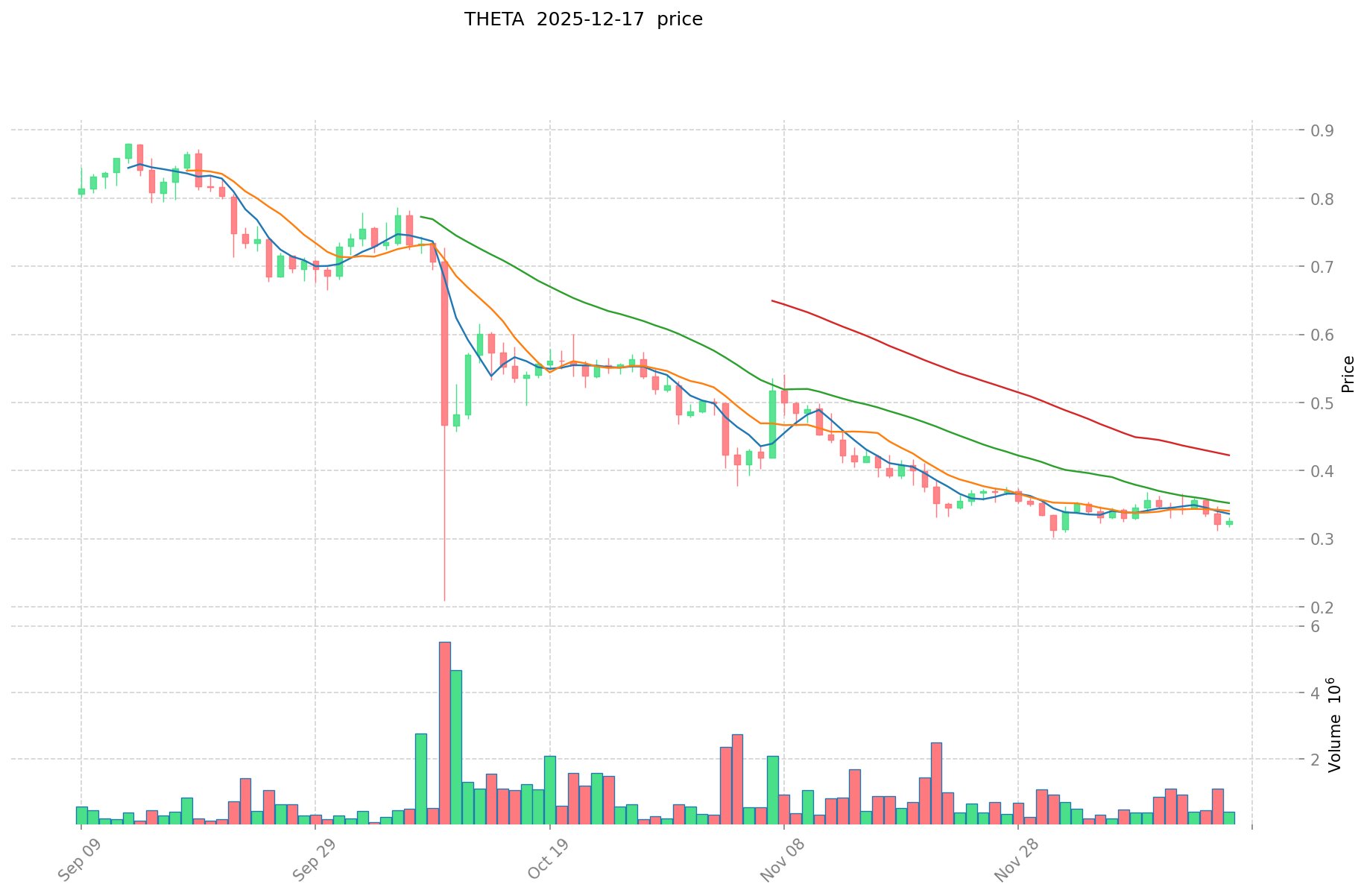
THETA Performance:
- All-Time High (ATH): $15.72 on April 16, 2021
- All-Time Low (ATL): $0.04039979 on March 13, 2020
- Current Price: $0.325 as of December 17, 2025
- 1-Year Change: -87.92%
Comparative Analysis: Both tokens have experienced significant depreciation over the past year. GMX has declined 77.91% from its year-ago price of approximately $36.44, while THETA has declined 87.92% from its 1-year-ago level. GMX reached its historical peak of $91.07 during the 2023 bull market, whereas THETA peaked at $15.72 in 2021. Both assets remain substantially below their historical highs, reflecting broader cryptocurrency market headwinds and shifting investor sentiment.
Current Market Status (December 17, 2025)
Price and Market Data:
- GMX Current Price: $8.215
- THETA Current Price: $0.325
- GMX 24-Hour Trading Volume: $12,752.53
- THETA 24-Hour Trading Volume: $248,656.48
- GMX Market Capitalization: $85,114,407.70
- THETA Market Capitalization: $325,000,000.00
- GMX Market Rank: #381
- THETA Market Rank: #171
Short-Term Price Movement:
- GMX 1-Hour Change: +2.00%
- GMX 24-Hour Change: +1.45%
- GMX 7-Day Change: -7.93%
- GMX 30-Day Change: -3.51%
- THETA 1-Hour Change: +2.41%
- THETA 24-Hour Change: +0.70%
- THETA 7-Day Change: -5.99%
- THETA 30-Day Change: -21.64%
Market Sentiment: Fear & Greed Index: 16 (Extreme Fear)
Current Market Data:
- GMX Real-Time Price: Market Data
- THETA Real-Time Price: Market Data
II. Project Overview and Fundamental Characteristics
GMX - Decentralized Perpetual Exchange
Project Description: GMX is a decentralized and sustainable exchange platform built on the Arbitrum blockchain. The GMX token functions as both a utility and governance token, providing holders with participation rights in protocol decisions and revenue distribution.
Token Economics:
- Circulating Supply: 10,360,853.04 GMX
- Maximum Supply: 13,250,000 GMX
- Circulation Ratio: 78.20%
- Fully Diluted Valuation (FDV): $85,114,407.70
Key Features:
- Revenue Sharing: GMX token holders receive 30% of platform-generated fees
- Decentralized Governance: Token holders participate in protocol decision-making
- Multi-Chain Support: Primary deployment on Arbitrum blockchain
Network Activity:
- Token Holders: 300,901
- Trading Pairs Available: 31 exchanges
THETA - Decentralized Video Streaming Network
Project Description: THETA is a blockchain-based decentralized video streaming platform developed by Theta Labs. The network enables peer-to-peer (P2P) content delivery by incentivizing users to share bandwidth and computing resources as cache or relay nodes for video streams.
Token Economics:
- Circulating Supply: 1,000,000,000 THETA
- Maximum Supply: 1,000,000,000 THETA
- Circulation Ratio: 100%
- Fully Diluted Valuation (FDV): $325,000,000.00
Core Mechanism:
- Bandwidth Sharing: Users receive THETA token rewards for sharing surplus bandwidth and computational power
- Content Distribution: Network reduces content delivery network (CDN) costs for video platforms
- Quality Improvement: Peer-to-peer architecture enhances video stream quality and reduces latency for ultra-high definition content (4K, 8K)
- Final-Mile Solution: Addresses the "last-mile" transmission bottleneck in traditional content distribution
Network Activity:
- Token Holders: 12,696
- Trading Pairs Available: 28 exchanges
III. Supply Dynamics and Valuation Metrics
GMX Supply Structure
GMX operates with a capped maximum supply of 13,250,000 tokens, with current circulation at 10,360,853 representing 78.20% of total supply. The allocation structure includes:
- XVIX & Gambit Migration: 45.28%
- Reserve Fund: 15.09%
- Floor Price Fund: 15.09%
- Liquidity Pool: 15.09%
- Marketing & Partnerships: 7.55%
- Contributors: 1.89%
THETA Supply Structure
THETA implements a fixed supply model with 1,000,000,000 tokens, all currently in circulation (100% circulation ratio). This represents a fully distributed supply with no additional token minting planned.
Valuation Comparison
The market capitalization differential reflects distinct supply mechanics: GMX's market cap of $85.1M with restricted supply contrasts with THETA's $325M market cap despite lower per-token pricing. The price-to-supply relationship indicates market valuation of utility cases and network adoption levels.
IV. Market Performance and Risk Indicators
Price Volatility Assessment
GMX Volatility:
- 24-Hour Range: $7.959 - $8.247
- Recent Momentum: Mixed (positive hourly and daily changes offset by weekly decline)
- Distance from ATH: -91.14% ($82.86 decline)
- Distance from ATL: +16.59% ($1.30 above low)
THETA Volatility:
- 24-Hour Range: $0.3134 - $0.3329
- Recent Momentum: Mild positive short-term, negative medium-term
- Distance from ATH: -79.33% ($15.40 decline)
- Distance from ATL: +704.85% ($0.283 above low)
Liquidity Metrics
THETA demonstrates higher absolute trading volume ($248,656.48) compared to GMX ($12,752.53), despite GMX's higher per-token price. This volume differential reflects market participation patterns and liquidity distribution across exchanges.
V. Market Accessibility and Trading Infrastructure
GMX Exchange Presence:
- Listed on 31 exchanges
- Primary Chain: Arbitrum (0xfc5a1a6eb076a2c7ad06ed22c90d7e710e35ad0a)
- Notable Trading Pairs: GMX/USDT across multiple CEX platforms
THETA Exchange Presence:
- Listed on 28 exchanges
- Trading Pairs: Multiple THETA/USDT pairs
- Regional Availability: Global exchange coverage
Official Resources:
- GMX Website: https://gmx.io/
- THETA Website: https://www.thetatoken.org/
- GMX Block Explorer: https://arbiscan.io/token/0xfc5a1a6eb076a2c7ad06ed22c90d7e710e35ad0a
VI. Key Observations
-
Market Sentiment Context: The Extreme Fear sentiment (index: 16) indicates widespread market pessimism, affecting both assets
-
Supply Dynamics Distinction: GMX's restricted supply model contrasts with THETA's fixed, fully-distributed supply approach
-
Price Recovery Gap: Both tokens remain far below historical peaks, with GMX at 91% below ATH and THETA at 79% below ATH
-
Adoption Metrics: GMX shows 23x higher token holder count (300,901 vs 12,696), suggesting broader distribution
-
Medium-Term Weakness: Both tokens show negative 7-day and 30-day performance despite near-term hourly gains
Data as of: December 17, 2025, 23:15:57 UTC
Report on Core Factors Influencing GMX vs THETA Investment Value
I. Executive Summary
This report analyzes the investment value drivers of GMX and THETA tokens based on available reference materials. GMX operates in the decentralized perpetual derivatives space, while THETA focuses on decentralized video streaming infrastructure. The analysis examines technological innovations, market positioning, and competitive dynamics affecting both projects.
II. Core Factors Influencing GMX vs THETA Investment Value
Technological Innovation and Protocol Design
GMX: Decentralized Perpetual Contracts
In 2021, GMX innovated upon Uniswap's spot exchange model by introducing a fundamentally different trading mechanism. Unlike traditional spot exchanges where users directly buy and sell tokens, GMX users deposit collateral and hold long or short positions. This design enables perpetual futures trading on a decentralized protocol, allowing leveraged exposure without centralized intermediaries.
THETA: Decentralized Video Streaming
THETA's core focus is building decentralized video streaming infrastructure. The protocol aims to create a network where users participate in content delivery, distinguishing it from centralized video platforms.
Market Structure and Competitive Positioning
GMX Market Context:
According to reference materials, the decentralized derivatives landscape has experienced significant shifts. While GMX was innovative in establishing perpetual contracts on-chain, the competitive environment has evolved. Reference sources note comparative analysis between various on-chain derivatives protocols, suggesting GMX operates within an increasingly competitive market segment.
THETA Market Context:
THETA tokens function within the video streaming vertical, which represents a distinct application area from derivatives trading. The token's valuation depends on network growth and user engagement in the video streaming ecosystem.
Risk Characteristics and Product Structure
GMX Perpetuals:
On-chain perpetual contracts present specific risk profiles compared to options. Reference materials indicate that options products with "non-linear payoff" characteristics offer advantages over perpetual futures, including inherent liquidation risk mitigation. This comparison is relevant for understanding GMX's relative positioning in the derivatives landscape.
Collateral and Risk Management:
GMX positions utilize deposited collateral as margin. Market makers and liquidity providers (such as Lyra) hedge against directional exposure by taking offsetting positions in protocols like GMX or Synthetix, indicating the protocol's integration within the broader derivatives ecosystem.
Network Adoption and Value Drivers
GMX Value Dependencies:
- Protocol innovation in perpetual contract design
- Liquidity provision and trading volume
- Fee generation models for token holders
- User retention and platform activity levels
THETA Value Dependencies:
- Network growth in video streaming participation
- Adoption rate by content creators and consumers
- Community engagement and ecosystem development
- Technical infrastructure scalability
Market Sentiment and Correlation Patterns
Reference materials indicate that both GMX and THETA are monitored within broader cryptocurrency market correlation studies. Their valuations respond to overall market trends, technology adoption metrics, and network utilization patterns alongside Bitcoin and Ethereum price movements.
III. Key Observations
-
Distinct Market Segments: GMX operates in decentralized derivatives trading, while THETA serves video streaming infrastructure. Each token's investment case depends on sector-specific adoption rather than direct competition.
-
Protocol-Specific Factors: GMX's value hinges on perpetual contract innovation, liquidity depth, and trading volume. THETA's value depends on decentralized video network growth and user engagement metrics.
-
Evolving Competitive Landscape: The on-chain derivatives space shows dynamic competition, requiring continuous protocol innovation and market adaptation.
-
Ecosystem Integration: GMX demonstrates integration within the broader DeFi derivatives ecosystem through hedging relationships with other protocols, while THETA operates within the decentralized video streaming vertical.
IV. Limitations of Available Analysis
The provided reference materials contain limited quantitative data regarding:
- Current tokenomics specifications for both projects
- Comparative institutional adoption metrics
- Specific regulatory frameworks by jurisdiction
- Detailed technical roadmap comparisons
- Macroeconomic correlation analysis specific to these tokens
Disclaimer: This report is based on available reference materials and does not constitute investment advice. Cryptocurrency investments carry substantial risk. All analysis reflects data available as of December 17, 2025, and market conditions evolve continuously.
III. 2025-2030 Price Forecast: GMX vs THETA
Short-term Forecast (2025)
- GMX: Conservative $4.46-$8.25 | Optimistic $11.55
- THETA: Conservative $0.22-$0.33 | Optimistic $0.44
Mid-term Forecast (2026-2028)
- GMX may enter consolidation phase with price range $8.75-$12.38, reflecting market maturation and ecosystem stabilization
- THETA shows stronger momentum entering growth phase with projected price range $0.52-$0.76, driven by network adoption expansion
- Key Drivers: Institutional capital inflows, derivative trading volumes, protocol governance evolution, and DeFi ecosystem integration
Long-term Forecast (2029-2030)
- GMX: Base scenario $7.83-$12.37 | Optimistic scenario $16.85-$20.82 (potential 45-76% gains)
- THETA: Base scenario $0.42-$0.69 | Optimistic scenario $0.73-$0.88 (potential 100-113% gains)
Disclaimer: Price forecasts are based on historical data analysis and market modeling. Cryptocurrency markets remain highly volatile and unpredictable. This analysis does not constitute investment advice. Past performance does not guarantee future results. Investors should conduct independent research and consult financial advisors before making investment decisions.
GMX:
| 年份 | 预测最高价 | 预测平均价格 | 预测最低价 | 涨跌幅 |
|---|---|---|---|---|
| 2025 | 11.5528 | 8.252 | 4.45608 | 1 |
| 2026 | 10.199472 | 9.9024 | 9.308256 | 21 |
| 2027 | 12.66417936 | 10.050936 | 5.5280148 | 23 |
| 2028 | 12.3797378712 | 11.35755768 | 8.7453194136 | 39 |
| 2029 | 16.853479841352 | 11.8686477756 | 7.833307531896 | 45 |
| 2030 | 20.8235425222902 | 14.361063808476 | 8.76024892317036 | 76 |
THETA:
| 年份 | 预测最高价 | 预测平均价格 | 预测最低价 | 涨跌幅 |
|---|---|---|---|---|
| 2025 | 0.43624 | 0.328 | 0.21976 | 0 |
| 2026 | 0.534968 | 0.38212 | 0.2751264 | 17 |
| 2027 | 0.63279072 | 0.458544 | 0.40351872 | 40 |
| 2028 | 0.7584776304 | 0.54566736 | 0.5238406656 | 67 |
| 2029 | 0.736841919576 | 0.6520724952 | 0.534699446064 | 100 |
| 2030 | 0.88196065338276 | 0.694457207388 | 0.42361889650668 | 113 |
Comparative Investment Analysis: GMX vs THETA
I. Investment Strategy Comparison: GMX vs THETA
Long-term vs Short-term Investment Strategies
GMX: Suitable For
- Investors focused on decentralized derivatives ecosystem growth
- Users seeking exposure to perpetual futures trading infrastructure
- Participants interested in DeFi protocol governance and fee-sharing mechanisms
- Medium to long-term holders betting on on-chain derivatives market maturation
THETA: Suitable For
- Investors targeting decentralized video streaming infrastructure adoption
- Users seeking exposure to content delivery network (CDN) disruption
- Participants interested in peer-to-peer bandwidth incentive models
- Long-term holders betting on video streaming network expansion
Risk Management and Asset Allocation
Conservative Investor Profile:
- GMX: 25% | THETA: 20% | Stablecoins: 55%
Aggressive Investor Profile:
- GMX: 45% | THETA: 35% | Stablecoins: 20%
Hedging Instruments:
- Stablecoin allocation (USDT/USDC) for volatility mitigation
- Cross-exchange arbitrage strategies
- Dollar-cost averaging approach for both positions
- Portfolio rebalancing on 30-day cycles
II. Potential Risk Comparison
Market Risk
GMX:
- Perpetual contract liquidation cascade risks during flash crashes
- Dependence on trading volume and user activity for protocol sustainability
- Competition from established centralized derivatives exchanges
- Liquidity concentration risk with relatively low 24-hour trading volume ($12,752.53)
THETA:
- Network adoption risk dependent on video streaming platform partnerships
- Bandwidth monetization model uncertainty in competitive CDN market
- User participation incentive sustainability concerns
- Low token holder count (12,696) indicates concentration risk
Technology Risk
GMX:
- Smart contract vulnerability exposure on Arbitrum blockchain
- Scalability limitations relative to trading volume growth requirements
- Oracle price feed reliability for perpetual contract settlement
- Liquidation mechanism efficiency under extreme market conditions
THETA:
- Peer-to-peer network stability and node participation reliability
- Video quality assurance standards across distributed cache nodes
- Network consensus mechanism security
- Latency and throughput optimization for ultra-high-definition streaming
Regulatory Risk
- Both assets face evolving cryptocurrency regulatory frameworks globally
- Derivatives regulation (GMX) subject to increasing scrutiny in major markets
- Content delivery platforms (THETA) may encounter content moderation compliance requirements
- Token governance structures may trigger securities law interpretation challenges
- Jurisdiction-specific staking and yield farming restrictions
III. Conclusion: Which Is the Better Buy?
Investment Value Summary:
GMX Advantages:
- Established decentralized derivatives protocol with 300,901 token holders
- Direct fee-sharing mechanism (30% of platform fees) providing revenue yield
- Integration within broader DeFi ecosystem
- Higher per-token price reflecting scarcity economics ($8.215 vs $0.325)
THETA Advantages:
- Larger market capitalization ($325M vs $85.1M) indicating broader valuation recognition
- Fixed supply model (fully distributed) eliminating dilution risk
- Higher trading volume ($248,656.48) suggesting greater market liquidity
- Long-term growth forecast showing 113% potential upside (2030 optimistic scenario)
Investment Recommendations:
Beginner Investors:
- Allocate 70% stablecoins for downside protection
- Distribute 15% to GMX and 15% to THETA
- Establish monthly dollar-cost averaging purchases
- Avoid leverage or margin trading given current extreme fear sentiment (index: 16)
Experienced Investors:
- Implement sector rotation strategy: increase GMX exposure during derivatives bull markets, increase THETA exposure during streaming adoption acceleration
- Utilize 20-25% portfolio allocation across both tokens
- Monitor technical indicators (7-day and 30-day trends remain negative for both)
- Consider adding to positions during further downside if technical support levels hold
Institutional Investors:
- Conduct due diligence on protocol governance proposals and roadmap execution
- Evaluate protocol sustainability through fee generation metrics and transaction volume trends
- Assess management team continuity and development activity on GitHub repositories
- Consider both assets as complementary exposure to different DeFi vertical sectors
Risk Disclaimer:
⚠️ Important Notice: The cryptocurrency market exhibits extreme volatility and unpredictability. Both GMX and THETA tokens have experienced significant depreciation (77.91% and 87.92% respectively over 12 months). This analysis does not constitute investment advice, financial recommendation, or endorsement of either asset.
Price forecasts are speculative projections based on historical data modeling and represent uncertain scenarios. Actual price movements may diverge substantially from predictions. Past performance provides no guarantee of future results. Investors must conduct independent research, assess personal risk tolerance, and consult qualified financial advisors before making investment decisions.
Cryptocurrency investments carry inherent risks including total capital loss. Current market sentiment reflects extreme fear conditions, warranting heightened caution and conservative positioning strategies.
Data as of: December 17, 2025, 23:15:57 UTC None
FAQ: GMX vs THETA Investment Comparison
I. What are the fundamental differences between GMX and THETA tokens?
Answer: GMX is a decentralized perpetual futures exchange token on the Arbitrum blockchain that provides holders with 30% of platform-generated fees and governance rights. THETA is a decentralized video streaming network token designed to incentivize peer-to-peer bandwidth sharing and content distribution. They operate in entirely different sectors—derivatives trading vs. video streaming infrastructure—and serve distinct use cases within the crypto ecosystem.
II. Which token has better liquidity for trading?
Answer: THETA demonstrates significantly higher 24-hour trading volume ($248,656.48) compared to GMX ($12,752.53), approximately 19.5x greater trading activity. However, GMX trades at a higher per-token price ($8.215 vs. $0.325). Both tokens are listed on 28-31 exchanges globally. THETA's superior trading volume suggests better short-term liquidity, though investors should verify current exchange availability before trading.
III. How have GMX and THETA performed over the past year?
Answer: Both tokens experienced severe depreciation in the past 12 months. GMX declined 77.91% from approximately $36.44 to $8.215 as of December 17, 2025. THETA declined 87.92% from its year-ago level to $0.325. Both remain substantially below their historical peaks (GMX at 91% below its $91.07 ATH; THETA at 79% below its $15.72 ATH), reflecting challenging market conditions and a Fear & Greed Index reading of 16 (Extreme Fear).
IV. What are the supply dynamics and dilution risks for each token?
Answer: GMX operates with a capped maximum supply of 13,250,000 tokens, currently 78.20% circulating (10,360,853 tokens). The supply follows a structured allocation including legacy migrations, reserve funds, and marketing allocations. THETA implements a fixed supply model with 1,000,000,000 tokens already fully in circulation (100% circulation ratio) with no additional minting planned. THETA eliminates future dilution risk, while GMX retains approximately 2,889,147 tokens that could eventually circulate.
V. Which token shows stronger market adoption metrics?
Answer: GMX demonstrates significantly broader market adoption with 300,901 token holders compared to THETA's 12,696 holders—approximately 23.7x higher holder count. However, THETA maintains a larger market capitalization ($325M vs. GMX's $85.1M), ranking #171 globally versus GMX's #381 ranking. GMX's higher holder count suggests broader distribution, while THETA's larger market cap indicates stronger overall valuation recognition by the market.
VI. What are the price forecast scenarios for 2029-2030?
Answer: For GMX, base scenario projections suggest $7.83-$12.37 range with optimistic scenario reaching $16.85-$20.82 (45-76% potential gains). For THETA, base scenario projects $0.42-$0.69 range with optimistic scenario reaching $0.73-$0.88 (100-113% potential gains). These forecasts are speculative projections based on historical data modeling and do not constitute investment predictions. Actual performance may differ substantially from projections, and past performance provides no guarantee of future results.
VII. What investment strategy suits different risk profiles?
Answer: Conservative investors should allocate approximately 25% GMX and 20% THETA with 55% stablecoins for downside protection, implementing monthly dollar-cost averaging. Aggressive investors may allocate 45% GMX and 35% THETA with 20% stablecoins. Experienced investors should consider sector rotation—increasing GMX exposure during derivatives bull markets and THETA during streaming adoption acceleration. All investors should avoid leverage given extreme fear market sentiment and conduct independent research before making investment decisions.
VIII. What are the primary risk factors distinguishing these tokens?
Answer: GMX faces liquidation cascade risks during market volatility, dependence on perpetual trading volume, and liquidity concentration concerns ($12,752.53 daily volume). THETA faces network adoption uncertainties, peer-to-peer reliability concerns, and low token holder concentration (12,696 holders). Both tokens encounter regulatory risks from evolving cryptocurrency frameworks and potential securities law interpretations. Technology risks include smart contract vulnerabilities, scalability limitations, and oracle reliability for GMX, while THETA faces peer-to-peer network stability and video quality assurance challenges. Current extreme fear sentiment (index: 16) amplifies volatility risks for both assets.
Disclaimer: This analysis does not constitute investment advice or financial recommendations. Cryptocurrency investments carry substantial risk including potential total capital loss. Investors must conduct independent research and consult qualified financial advisors before making investment decisions. All data current as of December 17, 2025.
Share
How to Buy Cryptocurrency


Trending Cryptocurrencies



XZXX: A Comprehensive Guide to the BRC-20 Meme Token in 2025

Bitcoin Fear and Greed Index: Market Sentiment Analysis for 2025

Top Crypto ETFs to Watch in 2025: Navigating the Digital Asset Boom
5 ways to get Bitcoin for free in 2025: Newbie Guide

Bitcoin Market Cap in 2025: Analysis and Trends for Investors
2025 Bitcoin Price Prediction: Trump's Tariffs' Impact on BTC

What are the compliance and regulatory risks of PEPE crypto in 2025?

What Are Technical Indicators: How to Use MACD, RSI, and Moving Averages for Crypto Trading in 2025

What is AIOT Price Volatility: Historical Trends, Support and Resistance Levels in 2025?

# What is WLFI: Understanding World Liberty Financial's Core Fundamentals, USD1 Stablecoin, and RWA Strategy
How does XLM price correlate with Federal Reserve policy and inflation data in 2025?