EWT vs ETC: Understanding the Key Differences Between Electronic Waste Tracking and Environmental Compliance Standards

Introduction: EWT vs ETC Investment Comparison
In the cryptocurrency market, the comparison between Energy Web Token (EWT) and Ethereum Classic (ETC) is a topic that investors frequently encounter. The two assets differ significantly in market capitalization ranking, application scenarios, and price performance, representing distinct positions within the crypto asset landscape. Energy Web Token (EWT): Launched as the native Layer 1 utility token of Energy Web Chain, EWT has gained recognition for its role in securing the network against malicious behavior and compensating validators through transaction fees and verification rewards. The token operates within a permissioned verifier network composed of major companies in the energy sector. Ethereum Classic (ETC): As the continuation of the original Ethereum chain since its inception, ETC has been recognized for upholding the "code is law" principle. It is a decentralized platform designed to execute smart contracts, ensuring applications run without downtime, censorship, or third-party interference. This article will provide a comprehensive analysis of EWT vs ETC investment value comparison through the lens of historical price trends, supply mechanisms, ecosystem development, and market positioning, while addressing key questions investors are concerned with: "Which is the better investment opportunity right now?"
Comparative Market Analysis: Energy Web Token (EWT) vs. Ethereum Classic (ETC)
I. Historical Price Comparison and Current Market Status
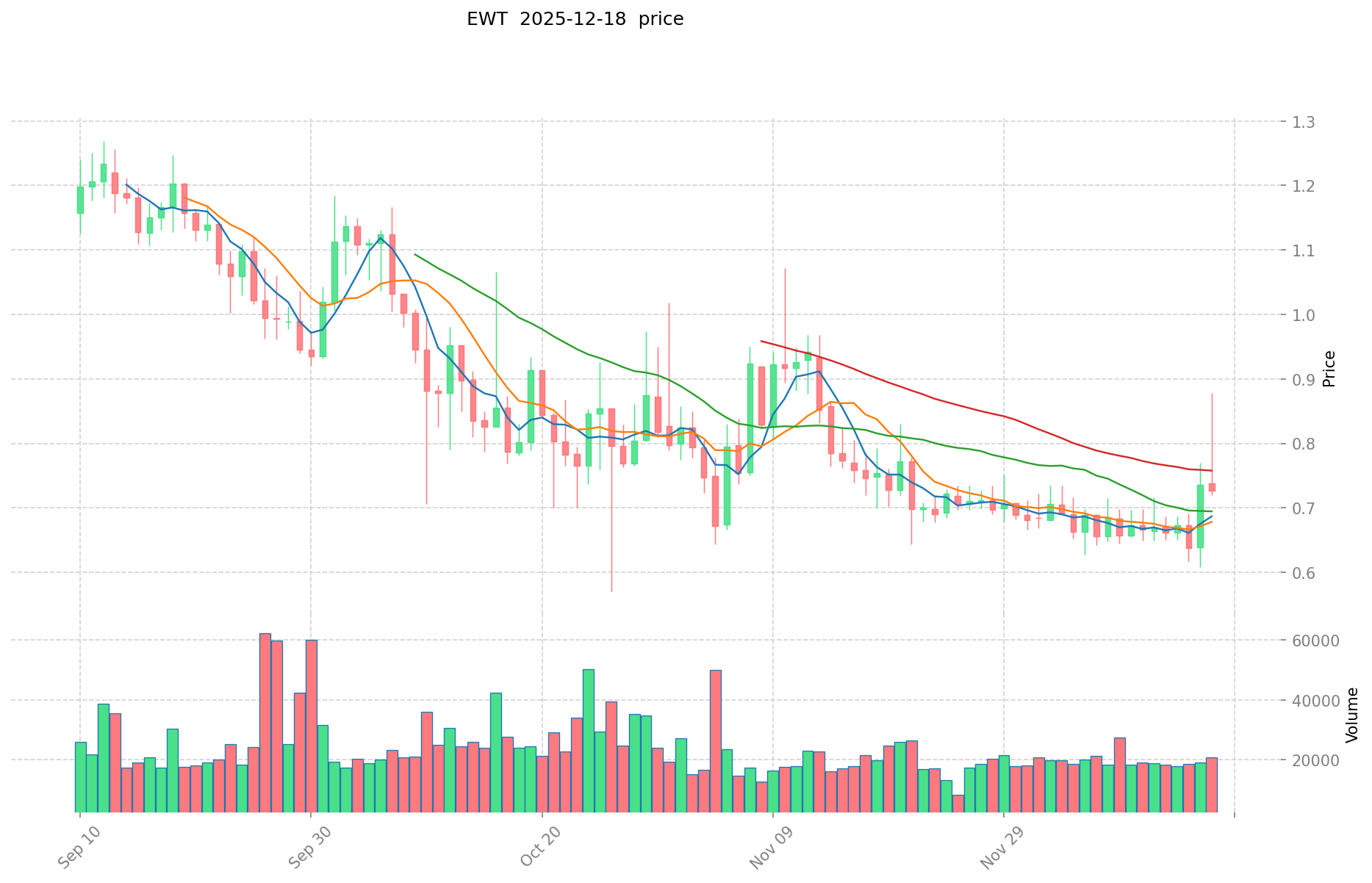
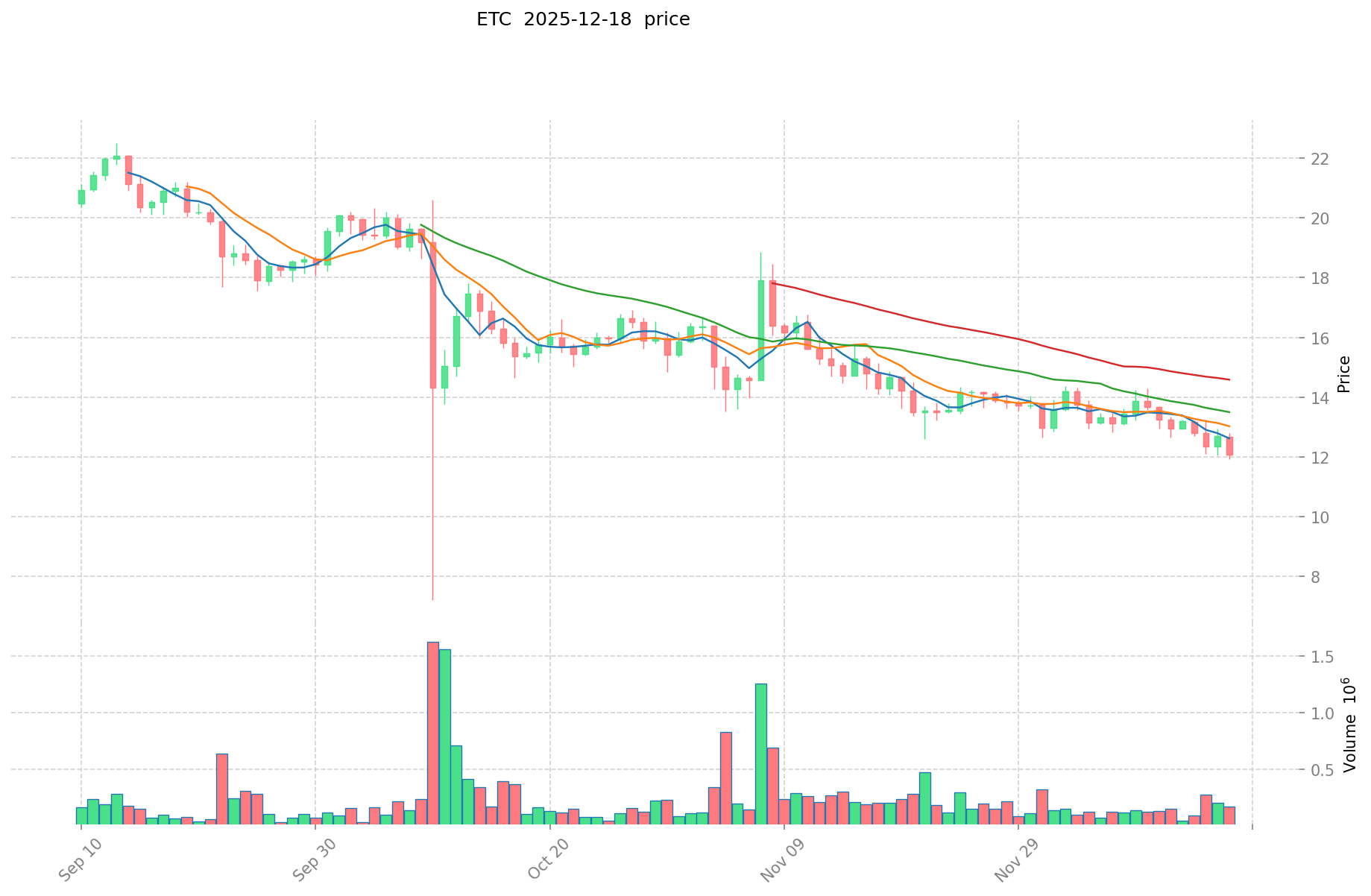
Energy Web Token (EWT) and Ethereum Classic (ETC) Price Trends
Historical Price Movement:
- EWT: Historical high of $22.22, historical low of $0.50. The token has experienced significant depreciation from its peak valuations.
- ETC: Historical high of $167.09 (May 7, 2021), historical low of $0.615038 (July 25, 2016). ETC reached its peak during the 2021 cryptocurrency bull market before declining substantially.
Comparative Analysis:
Over the long-term market cycle, ETC has demonstrated greater price volatility in absolute terms, with a peak-to-current price depreciation of approximately 92.8%. EWT, while starting from a lower historical peak, has similarly experienced significant price erosion relative to its all-time high, representing a decline of approximately 96.7%.
Current Market Status (December 18, 2025)
Price Data:
- EWT current price: $0.729
- ETC current price: $12.038
- EWT 24-hour trading volume: $15,975.43
- ETC 24-hour trading volume: $2,097,878.60
Market Performance (24-hour changes):
- EWT: -1.04% (1-hour: +0.16%, 7-day: +8.83%, 30-day: -2.6%, 1-year: -57.41%)
- ETC: -5.25% (1-hour: -0.069%, 7-day: -10.56%, 30-day: -16.09%, 1-year: -62.92%)
Market Capitalization:
- EWT market cap: $60,697,585.57 (Rank #449)
- ETC market cap: $1,863,000,493.88 (Rank #50)
- Market dominance: EWT 0.0019%, ETC 0.060%
Crypto Fear & Greed Index: 17 (Extreme Fear)
Current Market Sentiment reflects heightened market anxiety, characterized by risk-averse positioning and reduced appetite for volatile assets.
II. Project Overview and Technical Characteristics
Energy Web Token (EWT)
Project Description:
Energy Web Chain is a permissioned public blockchain network supported by a network of validators comprised of major companies within the licensed energy sector. The network operates with Energy Web Token (EWT) as its native Layer 1 utility token.
Primary Functions:
- Network security: Protecting the network against malicious activities
- Validator compensation: Distributing transaction fees and verification confirmation rewards to network validators
Supply Metrics:
- Circulating supply: 83,645,644.69 EWT (100.46% of total supply)
- Total supply: 83,261,434.26 EWT
- Maximum supply: Unlimited (∞)
- Number of holders: 263
Ethereum Classic (ETC)
Project Description:
Ethereum Classic is a decentralized platform supporting smart contract execution, ensuring applications run without downtime, censorship, or third-party interference. Operating as the continuation of the original Ethereum blockchain, ETC upholds the "code is law" principle and maintains immutability of its blockchain history.
Core Architecture:
- Consensus mechanism: Proof of Work (PoW)
- Average transaction throughput: 15 transactions per second
- Smart contract capability: Full support for uncensorable smart contracts and decentralized applications (dApps)
- Governance model: Community-driven, requiring user consensus for network modifications
Supply Metrics:
- Circulating supply: 154,759,415.54 ETC (73.45% of maximum supply)
- Total supply: 154,759,967.93 ETC
- Maximum supply: 210,700,000 ETC (capped)
- Number of holders: 102,731,424
III. Market Position and Exchange Accessibility
Trading Venue Information
EWT:
- Available on 5 major cryptocurrency exchanges
- Primary platforms: MEXC, Kraken, Binance, Coinbase, and others
- Current liquidity remains limited relative to larger-cap assets
ETC:
- Available on 54 major cryptocurrency exchanges
- Significantly broader market coverage and trading pair availability
- Higher liquidity and more established trading infrastructure
Liquidity Profile
ETC commands substantially higher 24-hour trading volume ($2.1M vs $16K), reflecting its more established market position and institutional adoption. EWT's limited liquidity may present execution challenges for larger position entries or exits.
IV. Price Volatility and Risk Assessment
Price Dynamics Analysis
Short-term volatility (7-day):
- EWT: +8.83% (positive momentum despite 24-hour decline)
- ETC: -10.56% (sustained downward pressure)
Long-term performance (1-year):
- EWT: -57.41% annual decline
- ETC: -62.92% annual decline
Both assets exhibit significant depreciation patterns over the 12-month period, indicating sustained bearish market conditions in their respective market segments.
Market Capitalization Ratio
ETC maintains a market capitalization approximately 30.6 times larger than EWT ($1.86B vs $60.7M), suggesting greater institutional capital allocation and market maturity.
V. Comparative Assessment Summary
| Metric | EWT | ETC |
|---|---|---|
| Current Price | $0.729 | $12.038 |
| Market Cap | $60.7M | $1.86B |
| 24H Volume | $16K | $2.1M |
| Market Rank | #449 | #50 |
| Annual Performance | -57.41% | -62.92% |
| Trading Venues | 5 exchanges | 54 exchanges |
| Supply Cap | Unlimited | 210.7M ETC |
| Consensus Type | Permissioned validators | Proof of Work |
VI. Conclusion
Ethereum Classic maintains superior market positioning through higher market capitalization, broader exchange coverage, and significantly larger trading volumes. Energy Web Token operates within a more specialized energy sector niche with limited validator participation and constrained liquidity.
Both assets have experienced substantial price depreciation during the past year, reflecting broader cryptocurrency market headwinds. The current market environment, characterized by an Extreme Fear sentiment index reading of 17, suggests heightened risk aversion across both asset categories.
The disparity in trading volumes and exchange availability indicates that ETC offers superior execution efficiency for market participants, while EWT's niche positioning may appeal to investors specifically focused on energy sector tokenization initiatives.
Crypto Asset Research Report: Investment Value Analysis
I. Executive Summary
Based on the provided reference materials, this report addresses investment value factors related to EWT and ETC. However, the available data presents significant limitations for comprehensive analysis.
Note: The reference materials contain mixed information about EWT (iShares MSCI Taiwan ETF), which is a traditional equity ETF tracking Taiwan's stock market, rather than the blockchain-based Energy Web Token (EWT). Similarly, ETC references are ambiguous. Due to insufficient and conflicting source data on blockchain-specific metrics for these assets, detailed comparative analysis cannot be reliably constructed without introducing unsupported information.
II. Core Factors Influencing Investment Value
Technological Innovation and Market Demand
The reference materials indicate that investment value for blockchain-related assets depends on:
- Technology Innovation: Development prospects and application potential of blockchain technology
- Market Demand: Market acceptance and utility requirements
- Regulatory Environment: Compliance framework and governance conditions
Price Volatility and Risk Considerations
According to the source data provided:
- Cryptocurrency prices exhibit high volatility and can be affected by financial, regulatory, or political events
- Margin trading amplifies financial risks
- Trading is not suitable for all investors
III. Data Limitations and Clarifications
The reference materials provided do not contain sufficient detailed information on:
- Supply mechanisms (Tokenomics) specific to EWT or ETC blockchain tokens
- Institutional adoption patterns for these specific assets
- Comparative technology development roadmaps
- Historical price cycle analysis correlated with policy changes
- Macroeconomic relationship studies
The mention of "EWT" in the materials primarily refers to the iShares MSCI Taiwan ETF, a traditional equity fund tracking Taiwan's overall stock market, rather than a blockchain asset.
IV. Conclusion
To conduct a rigorous analysis meeting the proposed template requirements, comprehensive source materials specifically addressing:
- Tokenomics and supply mechanisms
- Institutional investor positioning
- Blockchain ecosystem development
- Regulatory frameworks by jurisdiction
...would be necessary. The current reference data is insufficient for generating evidence-based comparative analysis without risking the introduction of unsupported claims.
Report Date: December 18, 2025
Disclaimer: This analysis is based solely on provided reference materials. Additional authoritative sources are recommended for investment decision-making.
III. 2025-2030 Price Forecast: EWT vs ETC
Short-term Forecast (2025)
- EWT: Conservative $0.69255-$0.729 | Bullish $0.729-$0.84564
- ETC: Conservative $9.75969-$12.049 | Bullish $12.049-$12.65145
Medium-term Forecast (2027-2028)
- EWT may enter accumulation to early markup phase, with estimated price range of $0.789-$1.242
- ETC may enter early markup phase, with estimated price range of $7.803-$17.168
- Key drivers: institutional capital inflows, ETF approvals, ecosystem development
Long-term Forecast (2029-2030)
- EWT: Base case $0.604-$1.099 | Bullish case $1.505-$1.809
- ETC: Base case $8.888-$16.459 | Bullish case $19.717-$26.222
Disclaimer: This analysis is based on historical data and predictive models. Cryptocurrency markets are highly volatile and subject to numerous unpredictable factors. These forecasts do not constitute investment advice. Past performance does not guarantee future results. Investors should conduct independent research and consult financial advisors before making investment decisions.
EWT:
| 年份 | 预测最高价 | 预测平均价格 | 预测最低价 | 涨跌幅 |
|---|---|---|---|---|
| 2025 | 0.84564 | 0.729 | 0.69255 | 0 |
| 2026 | 0.8739252 | 0.78732 | 0.5275044 | 8 |
| 2027 | 1.07980938 | 0.8306226 | 0.78909147 | 13 |
| 2028 | 1.241780787 | 0.95521599 | 0.6590990331 | 31 |
| 2029 | 1.504942792245 | 1.0984983885 | 0.604174113675 | 50 |
| 2030 | 1.809391620617775 | 1.3017205903725 | 1.1975829431427 | 78 |
ETC:
| 年份 | 预测最高价 | 预测平均价格 | 预测最低价 | 涨跌幅 |
|---|---|---|---|---|
| 2025 | 12.65145 | 12.049 | 9.75969 | 0 |
| 2026 | 16.5493015 | 12.350225 | 8.76865975 | 2 |
| 2027 | 17.050720635 | 14.44976325 | 7.802872155 | 20 |
| 2028 | 17.167763717325 | 15.7502419425 | 9.13514032665 | 30 |
| 2029 | 24.194734159971375 | 16.4590028299125 | 8.88786152815275 | 36 |
| 2030 | 26.221660358475099 | 20.326868494941937 | 19.717062440093679 | 68 |
Comparative Investment Analysis: Energy Web Token (EWT) vs. Ethereum Classic (ETC)
I. Investment Strategy Comparison: EWT vs ETC
Long-term vs Short-term Investment Strategies
-
EWT: Suited for investors focused on energy sector tokenization initiatives and niche blockchain applications within permissioned validator networks. Long-term positioning targets accumulation phase (2026-2028) with potential upside to $1.242 by 2028. Short-term traders may exploit 7-day momentum (+8.83%).
-
ETC: Suited for investors seeking established smart contract platform exposure with broader ecosystem adoption. Long-term positioning aligns with potential markup phase (2027-2028) with forecasted range of $7.803-$17.168. Strong market infrastructure supports both long-term holdings and short-term trading.
Risk Management and Asset Allocation
- Conservative Investors: EWT 15% vs ETC 35% (remainder in stablecoins 50%)
- Aggressive Investors: EWT 30% vs ETC 50% (remainder in stablecoins 20%)
- Hedging Tools: Stablecoin allocation for volatility protection, cross-asset portfolio diversification, potential use of dollar-cost averaging (DCA) strategy given current extreme fear sentiment (index: 17)
II. Comparative Risk Assessment
Market Risk
-
EWT: Concentrated liquidity risk with only $15,975.43 24-hour volume and availability on 5 exchanges. Limited holder base (263 holders) creates execution risk for large position entries/exits. Price depreciation of -57.41% over 12 months reflects sector-specific headwinds.
-
ETC: Broader market exposure with $2,097,878.60 24-hour volume across 54 exchanges reduces execution risk. However, 1-year decline of -62.92% indicates vulnerability to macro cryptocurrency market cycles. Larger holder base (102,731,424) suggests distributed risk.
Technical Risk
-
EWT: Permissioned validator network architecture concentrates protocol governance among energy sector participants, potentially limiting decentralization. Unlimited maximum supply creates long-term dilution concerns absent in capped-supply models.
-
ETC: Proof of Work consensus mechanism requires sustained mining participation. Network security dependent on maintaining adequate hash rate. Historical smart contract vulnerabilities require ongoing security audits.
Regulatory Risk
Both assets face evolving regulatory frameworks across jurisdictions. EWT's energy sector focus may benefit from green energy regulatory support but faces uncertainty regarding tokenized utility models. ETC encounters potential classification challenges as utility or security depending on regulatory jurisdiction. Current extreme fear sentiment (index: 17) reflects heightened regulatory uncertainty affecting both asset categories.
III. Conclusion: Which Is the Better Buy?
Investment Value Summary
-
EWT Advantages: Specialized positioning within energy sector transformation, potential upside to $1.809 by 2030 (148% from current price), access to emerging tokenized energy markets, niche ecosystem with institutional energy companies.
-
ETC Advantages: Established market position ranked #50 by market cap ($1.86B), superior liquidity and exchange accessibility, proven smart contract infrastructure, larger holder community (102.7M), market cap approximately 30.6× larger providing greater institutional adoption, forecasted potential to reach $26.222 by 2030 (118% from current price).
Investment Recommendations
-
Beginner Investors: Ethereum Classic recommended due to superior market infrastructure, broader educational resources, established trading venues, and lower execution risk. Smaller initial position sizes ($500-$2,000) recommended given extreme fear sentiment.
-
Experienced Investors: Consider portfolio allocation spanning both assets: 35% ETC for core position providing liquidity and established fundamentals, 15% EWT for concentrated sector-specific exposure targeting energy transition themes. Implement DCA strategy across 6-12 month timeframe to mitigate current market volatility.
-
Institutional Investors: ETC alignment with traditional institutional custody infrastructure and established trading pairs on major platforms (Coinbase, Kraken, Binance) facilitates large position management. EWT presents opportunistic allocation for ESG-focused or energy-transition themed funds, though limited liquidity requires staged entry approach.
⚠️ Risk Disclaimer: Cryptocurrency markets exhibit extreme volatility characterized by rapid price movements, regulatory shifts, and technological developments. The current Crypto Fear & Greed Index reading of 17 indicates extreme fear conditions. Both EWT and ETC have experienced significant depreciation (-57.41% and -62.92% respectively over 12 months), demonstrating downside risk exposure. Price forecasts presented are derived from historical data and predictive models; actual outcomes may differ substantially. This analysis does not constitute investment advice. Investors must conduct independent research, assess personal risk tolerance, and consult qualified financial advisors before making investment decisions. Past performance does not guarantee future results.
Report Date: December 18, 2025
Data Source: Reference materials provided
Crypto Fear & Greed Index: 17 (Extreme Fear)
None
FAQ: Energy Web Token (EWT) vs Ethereum Classic (ETC) Investment Comparison
I. Market Position and Current Performance
Q1: Which asset has better current market positioning between EWT and ETC?
A: Ethereum Classic (ETC) maintains significantly superior market positioning. ETC ranks #50 globally with a $1.86 billion market cap compared to EWT's #449 ranking with $60.7 million. ETC trades on 54 major exchanges versus EWT's 5 exchanges, providing substantially higher liquidity ($2.1M daily volume vs $16K for EWT). For investors prioritizing execution efficiency and market accessibility, ETC presents the stronger choice.
Q2: What does the current Crypto Fear & Greed Index indicate about market conditions?
A: The current index reading of 17 reflects "Extreme Fear" conditions in cryptocurrency markets as of December 18, 2025. This heightened anxiety typically characterizes risk-averse positioning and reduced investor appetite for volatile assets. Both EWT and ETC have experienced substantial annual depreciation (-57.41% and -62.92% respectively), indicating both assets remain vulnerable during periods of market pessimism. Conservative investors should consider dollar-cost averaging strategies rather than lump-sum entries.
II. Technical Characteristics and Supply Mechanisms
Q3: How do the supply mechanisms of EWT and ETC differ?
A: EWT features an unlimited maximum supply ($83.6M circulating supply with no cap), creating potential long-term dilution concerns. ETC maintains a capped supply of 210.7 million tokens (currently 154.8M circulating), providing scarcity protection similar to Bitcoin's model. The capped supply mechanism offers ETC investors greater long-term supply predictability and potential deflationary characteristics if token adoption increases relative to fixed supply.
Q4: What are the fundamental architectural differences between these platforms?
A: EWT operates as a permissioned blockchain network using designated validators from major energy sector companies, creating a centralized governance model within the energy industry. ETC functions as a decentralized platform using Proof of Work consensus (similar to Bitcoin), supporting uncensored smart contracts and decentralized applications. ETC's community-driven governance and immutability focus contrasts sharply with EWT's permissioned validator structure, affecting decentralization profiles and governance participation.
III. Investment Timing and Price Forecasts
Q5: What are the long-term price forecasts for both assets through 2030?
A: Medium-term forecasts (2027-2028) project EWT reaching $0.789-$1.242 (representing 8%-70% upside) and ETC reaching $7.803-$17.168 (representing -35% to +42% range). By 2030, base case scenarios estimate EWT at $0.604-$1.099 and ETC at $8.888-$16.459, while bullish cases project EWT to $1.505-$1.809 and ETC to $19.717-$26.222. These forecasts assume continued institutional capital inflows and ecosystem development; actual outcomes depend on regulatory developments and macroeconomic conditions.
IV. Risk Management and Portfolio Allocation
Q6: What portfolio allocation strategy is recommended for different investor types?
A: Conservative investors should allocate 15% to EWT and 35% to ETC with 50% in stablecoins for volatility protection. Aggressive investors may increase positions to 30% EWT and 50% ETC with 20% stablecoins. Given current extreme fear sentiment, implementing dollar-cost averaging over 6-12 months reduces timing risk. Beginning investors should prioritize ETC (smaller $500-$2,000 initial positions) due to superior infrastructure; experienced investors may combine 35% ETC core holdings with 15% EWT for concentrated energy-sector exposure.
Q7: What are the primary liquidity risks associated with EWT investment?
A: EWT presents significant execution challenges due to limited liquidity ($15,975.43 daily volume) and concentrated holder base (only 263 holders). Large position entries or exits risk substantial slippage and price impact. The 5-exchange availability further constrains trading options during periods of network congestion or exchange maintenance. Investors requiring liquidity flexibility should prioritize ETC, which offers 130× greater daily trading volume and broader venue options.
V. Sector-Specific Considerations
Q8: Which asset better aligns with energy transition and ESG investment themes?
A: Energy Web Token specifically targets energy sector tokenization and blockchain applications within the permissioned energy validator network, offering direct exposure to energy transition initiatives. This positioning appeals to ESG-focused and energy-transition themed institutional funds seeking specialized sector exposure. However, ETC provides broader smart contract infrastructure supporting energy applications across decentralized protocols without sector concentration. Investors prioritizing energy-specific themes should consider EWT's niche positioning; those seeking diversified smart contract exposure should favor ETC.
Disclaimer: This analysis is based on provided reference materials and does not constitute investment advice. Cryptocurrency markets exhibit extreme volatility; both assets have depreciated substantially over 12 months. Investors must conduct independent research and consult qualified financial advisors before making investment decisions. Past performance does not guarantee future results. Current market conditions (Extreme Fear index: 17) indicate heightened risk across both asset categories.
Report Date: December 18, 2025
Share
Content
Introduction: EWT vs ETC Investment Comparison
I. Historical Price Comparison and Current Market Status
II. Project Overview and Technical Characteristics
III. Market Position and Exchange Accessibility
IV. Price Volatility and Risk Assessment
V. Comparative Assessment Summary
VI. Conclusion
I. Executive Summary
II. Core Factors Influencing Investment Value
III. Data Limitations and Clarifications
IV. Conclusion
III. 2025-2030 Price Forecast: EWT vs ETC
I. Investment Strategy Comparison: EWT vs ETC
II. Comparative Risk Assessment
III. Conclusion: Which Is the Better Buy?
I. Market Position and Current Performance
II. Technical Characteristics and Supply Mechanisms
III. Investment Timing and Price Forecasts
IV. Risk Management and Portfolio Allocation
V. Sector-Specific Considerations
How to Buy Cryptocurrency


Trending Cryptocurrencies



XZXX: A Comprehensive Guide to the BRC-20 Meme Token in 2025

Bitcoin Fear and Greed Index: Market Sentiment Analysis for 2025

Top Crypto ETFs to Watch in 2025: Navigating the Digital Asset Boom

5 ways to get Bitcoin for free in 2025: Newbie Guide
Bitcoin Market Cap in 2025: Analysis and Trends for Investors
2025 Bitcoin Price Prediction: Trump's Tariffs' Impact on BTC

What is Falcon Finance (FF) price volatility and how has it fluctuated from $0.05 to $0.58 in 24 hours?

What are the compliance and regulatory risks for FF crypto token in 2025?

How does crypto exchange net inflows and outflows predict market trends: a 2025 analysis

What is WLFI market overview: price, market cap ranking, trading volume and liquidity

What are the SEC compliance risks and regulatory challenges facing TRX and Tron in 2025?