BCH vs VET: A Comprehensive Comparison of Two Leading Blockchain Ecosystems


Introduction: BCH vs VET Investment Comparison
In the cryptocurrency market, comparisons between Bitcoin Cash and VeChain have always been a focal point for investors. The two assets not only exhibit significant differences in market capitalization ranking, application scenarios, and price performance, but also represent distinct positions within the crypto ecosystem.
Bitcoin Cash (BCH): Launched in 2017 via a hard fork from Bitcoin, BCH has gained market recognition through its on-chain scaling capabilities and commitment to Satoshi's vision for global adoption through enhanced transaction throughput with 8MB blocks.
VeChain (VET): Founded in 2015, VeChain began as a blockchain solution for supply chain transparency and anti-counterfeiting, evolving into an enterprise-grade Layer-1 network validated through partnerships with major organizations such as DNV, Walmart, and Boston Consulting Group.
This article will comprehensively analyze the investment value comparison between BCH and VET across historical price trends, supply mechanisms, enterprise adoption, technical ecosystems, and future outlooks, while addressing the key question investors are asking:
"Which is the better buy right now?"
Comparative Analysis Report: Bitcoin Cash (BCH) and VeChain (VET)
I. Historical Price Comparison and Current Market Status
Bitcoin Cash (BCH) and VeChain (VET) Historical Price Trends
Bitcoin Cash (BCH):
- 2017: BCH emerged from a Bitcoin hard fork in July 2017, with an initial price of $555.89. The asset reached its all-time high of $3,785.82 on December 20, 2017, driven by the broader cryptocurrency market expansion and adoption of on-chain scaling solutions.
- Price Range: BCH has traded between a historical low of $76.93 (December 16, 2018) and its peak of $3,785.82, representing a significant volatility trajectory typical of first-generation hard fork assets.
VeChain (VET):
- 2015-2017: VeChain was founded by Sunny Lu in 2015 as a supply chain transparency solution. The ICO in 2017 established the foundation for the VeChainThor blockchain, an enterprise-grade Layer-1 network.
- 2021: VET reached its all-time high of $0.280991 on April 19, 2021, during the broader cryptocurrency market peak.
- 2020-Present: VET has experienced a substantial decline, with its historical low of $0.00191713 recorded on March 13, 2020, followed by a prolonged downtrend.
Comparative Analysis: BCH demonstrates higher absolute price volatility with a trading range from $76.93 to $3,785.82, while VET operates at significantly lower price levels, ranging from $0.00191713 to $0.280991. BCH's price trajectory reflects the market cycles of hard fork assets, whereas VET's performance illustrates the challenges faced by enterprise-focused blockchain platforms in maintaining long-term market momentum.
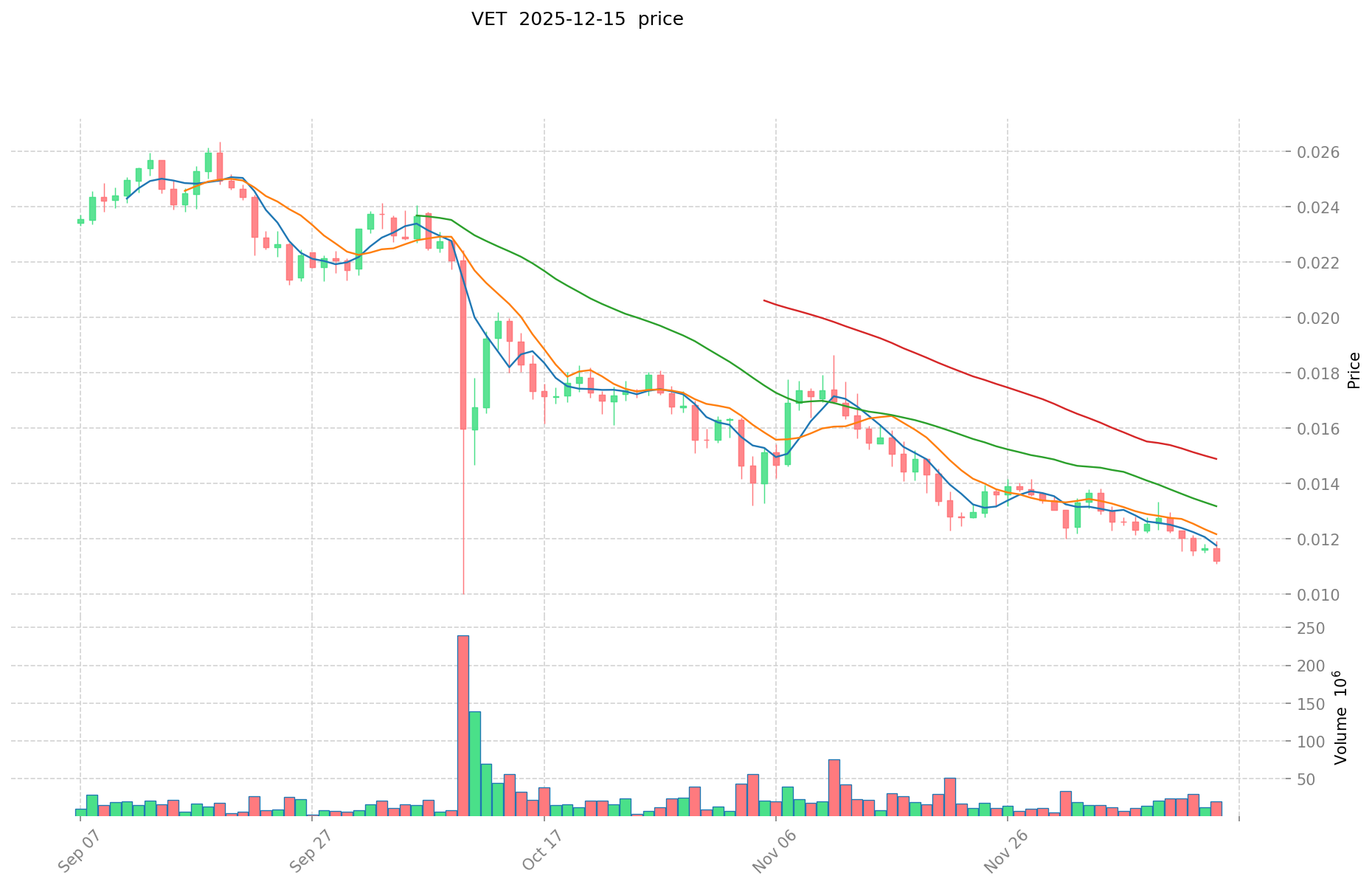
Current Market Status (December 15, 2025)
| Metric | Bitcoin Cash (BCH) | VeChain (VET) |
|---|---|---|
| Current Price | $564.13 | $0.01117 |
| 24-Hour Change | -2.02% | -2.86% |
| 24-Hour Volume | $2,663,351.04 | $247,057.15 |
| Market Capitalization | $11,264,027,724.35 | $960,452,909.95 |
| Market Dominance | 0.34% | 0.029% |
| Circulating Supply | 19,967,078.02 | 85,985,041,177 |
| Market Ranking | 13th | 89th |
Market Sentiment Indicator (Fear & Greed Index): 16 (Extreme Fear)
Access Real-Time Prices:
- Bitcoin Cash (BCH): Market Price
- VeChain (VET): Market Price
II. Price Performance Analysis
Short-Term Price Movements
| Time Period | Bitcoin Cash (BCH) | VeChain (VET) |
|---|---|---|
| 1-Hour Change | -0.58% | -0.44% |
| 24-Hour Change | -2.02% | -2.86% |
| 7-Day Change | -5.1% | -12.049% |
| 30-Day Change | +13.43% | -28.67% |
| 1-Year Change | +5.7% | -80.36% |
Key Observations:
- BCH demonstrates relative stability with positive monthly and yearly returns, suggesting some degree of investor confidence in its positioning as a payment-focused asset.
- VET exhibits sustained downward pressure, particularly over the medium to long term, with a -80.36% decline over the past year indicating significant headwinds facing the enterprise blockchain sector.
24-Hour Trading Range
- BCH: Trading between $554.4 and $576.78
- VET: Trading between $0.0111 and $0.01159
III. Project Fundamentals and Technology
Bitcoin Cash (BCH)
Core Features:
- On-chain scaling with 8MB block size, designed to enable faster and cheaper transactions
- Enhanced transaction signatures and new difficulty adjustment algorithm
- Decentralized development model following Satoshi Nakamoto's original vision for global adoption
- Launched by ViaBTC via hard fork from Bitcoin in 2017
Market Characteristics:
- 31.6 million token holders indicating broad distribution
- Listed on 68 exchanges, providing high liquidity and accessibility
- Maintains 95.08% circulation ratio relative to maximum supply (21 million BCH)
VeChain (VET)
Core Features:
- Enterprise-grade Layer-1 blockchain designed for supply chain transparency and anti-counterfeiting
- Strategic partnerships including DNV, Walmart, and Boston Consulting Group
- Renaissance roadmap implementation including:
- Ethereum-compatible infrastructure
- Delegated Proof of Stake (dPoS) consensus mechanism
- Dynamic VTHO tokenomics model
- StarGate NFT staking system
Regulatory and Compliance Focus:
- Token architecture compliant with European Union MiCA (Markets in Crypto-assets) standards
- Enhanced cross-chain interoperability capabilities
Market Characteristics:
- 14.3 million token holders
- Listed on 40 exchanges
- 99.16% circulation ratio relative to maximum supply (86.7 billion VET)
IV. Market Position and Risk Assessment
Market Capitalization and Dominance
BCH maintains a significantly larger market capitalization ($11.26 billion) compared to VET ($960.45 million), representing approximately 11.7x the market value. BCH's market dominance of 0.34% versus VET's 0.029% reflects the higher institutional recognition and trading volume for hard fork assets relative to specialized enterprise blockchain platforms.
Liquidity and Trading Activity
BCH's 24-hour volume of $2.66 million substantially exceeds VET's $247,057, indicating more robust market liquidity and trading interest in Bitcoin Cash despite both assets trading in a negative sentiment environment.
Risk Considerations
Bitcoin Cash:
- Price volatility remains significant relative to major cryptocurrencies
- Market sentiment currently reflects extreme fear conditions
- Sustained competition from the original Bitcoin network and other payment-focused cryptocurrencies
VeChain:
- Severe long-term underperformance (-80.36% over one year) raises questions regarding market adoption of enterprise blockchain solutions
- Extended losses across multiple timeframes suggest structural challenges in achieving mainstream enterprise adoption
- Market capitalization indicates lower institutional backing relative to BCH
V. Conclusions
As of December 15, 2025, both BCH and VET face headwinds from prevailing market sentiment conditions characterized by extreme fear. However, BCH maintains stronger market fundamentals in terms of capitalization, liquidity, and short-to-medium term price stability. VET's significant long-term decline reflects broader challenges in the enterprise blockchain sector, though the Renaissance roadmap represents an attempt to reposition the platform toward improved interoperability and regulatory compliance. Both assets remain speculative in nature, with performance dependent on broader cryptocurrency market conditions and sector-specific developments.

Report on Core Investment Value Factors: BCH vs VET
I. Executive Summary
Bitcoin Cash (BCH) and VeChain (VET) represent two distinct approaches within the blockchain ecosystem. BCH focuses on peer-to-peer electronic cash functionality through on-chain scaling solutions, while VET targets enterprise supply chain applications. This report examines the core factors determining their investment value based on available technical and market data.
II. Core Factors Influencing BCH vs VET Investment Value
Technological Infrastructure & Scalability Solutions
Bitcoin Cash (BCH):
- Implemented Schnorr signature functionality to enhance extensibility and privacy
- Schnorr signatures support increased smart contract functionality and multi-signature operations through linear properties
- Enhanced transaction efficiency while maintaining security through cryptographic proofs and non-malleability
- Block size architecture differs from BTC (maximum 8MB support versus BTC's 1MB), with removal of segregated witness
VeChain (VET):
- Development focus on POA 2.0 algorithm implementation and deployment
- Active daily account participation metrics (4,353 active accounts recorded as of May 2020)
- Layer 2 and protocol layer improvements under continuous development
Ecosystem Comparison: The reference materials indicate that over 70% of users surveyed in early 2020 consider TPS (transactions per second) critical for public chain development, with over half believing TPS improvements must be balanced with decentralization maintenance.
Real-World Application & Enterprise Adoption
BCH Application Focus:
- Peer-to-peer transaction framework
- Small-value, high-volume payment channels
VET Application Focus:
- Food safety tracking
- Sustainable fashion authentication
- Cross-border supply chain management
- Enterprise supply chain transparency solutions
- Further deployment planned across multiple industry verticals
Market Position: VET demonstrates more tangible real-world application pathways in enterprise sectors, while BCH maintains focus on transactional efficiency for payment use cases.
Network Metrics & Market Structure
Based on available data as of May 2020:
| Metric | BCH | VET |
|---|---|---|
| Unit Price (USD) | $256 | $2.5 |
| Circulating Supply (10k units) | 1,838 | 4,353 (daily active accounts) |
| Market Capitalization (USD Billion) | $47 | $125 |
Key Value Drivers
Adoption Factors:
- Technology upgrade implementation and execution
- Adoption rate growth across target use cases
- Market sentiment regarding functionality improvements
Long-Term Value Determinants:
- Network effects development
- Ecosystem expansion
- Sustained user growth in target markets
III. Risk Considerations
The cryptocurrency market exhibits cyclical patterns characterized by rapid price appreciation followed by sharp corrections. Investors should note that:
- Cryptocurrency markets experience multi-year boom and bust cycles
- Price volatility can be severe and rapid
- Token economics models fundamentally determine market demand sustainability
- Market cycles typically stem from multiple converging factors
IV. Data Limitations
The provided reference materials contain data primarily from May 2020, limiting applicability to current market conditions. The analysis reflects historical technological positioning rather than current ecosystem developments. Current market metrics, recent technology deployments, and contemporary adoption statistics should be consulted for up-to-date investment evaluation.
Report Date: December 15, 2025
Data Reference Period: May 2020 (from source documents)
Disclaimer: This report provides factual analysis based on available source materials and does not constitute investment advice or recommendations.
III. 2025-2030 Price Forecasts: BCH vs VET
Short-term Forecast (2025)
- BCH: Conservative $451.46–$564.32 | Optimistic $620.75
- VET: Conservative $0.0080–$0.0112 | Optimistic $0.0151
Mid-term Forecast (2027-2028)
- BCH may enter a consolidation phase with recovery potential, with prices anticipated in the $491.95–$722.75 range by 2027 and $558.64–$944.37 by 2028
- VET shows stronger momentum entering the $0.0124–$0.0247 price range across 2027-2028, reflecting increased adoption expectations
- Key drivers: institutional capital inflows, exchange listings, ecosystem expansion, and regulatory clarity
Long-term Forecast (2029-2030)
- BCH: Base scenario $740.33–$901.27 | Optimistic scenario $997.84–$1,063.50
- VET: Base scenario $0.0108–$0.0261 | Optimistic scenario $0.0240–$0.0329
Disclaimer: These projections are based on historical data analysis and market modeling. Cryptocurrency markets remain highly volatile and unpredictable. Past performance does not guarantee future results. Investors should conduct independent research and consult financial advisors before making investment decisions. This analysis is for informational purposes only and should not be construed as investment advice.
BCH:
| 年份 | 预测最高价 | 预测平均价格 | 预测最低价 | 涨跌幅 |
|---|---|---|---|---|
| 2025 | 620.752 | 564.32 | 451.456 | 0 |
| 2026 | 622.1628 | 592.536 | 426.62592 | 5 |
| 2027 | 722.745786 | 607.3494 | 491.953014 | 7 |
| 2028 | 944.36758206 | 665.047593 | 558.63997812 | 17 |
| 2029 | 997.8374085372 | 804.70758753 | 740.3309805276 | 42 |
| 2030 | 1063.501547679648 | 901.2724980336 | 730.030723407216 | 59 |
VET:
| 年份 | 预测最高价 | 预测平均价格 | 预测最低价 | 涨跌幅 |
|---|---|---|---|---|
| 2025 | 0.0150795 | 0.01117 | 0.0080424 | 0 |
| 2026 | 0.019162135 | 0.01312475 | 0.009187325 | 17 |
| 2027 | 0.019372131 | 0.0161434425 | 0.012430450725 | 44 |
| 2028 | 0.0246833235825 | 0.01775778675 | 0.01136498352 | 58 |
| 2029 | 0.030982010542725 | 0.02122055516625 | 0.010822483134787 | 89 |
| 2030 | 0.032887616396654 | 0.026101282854487 | 0.024013180226128 | 133 |
Comparative Investment Analysis Report: Bitcoin Cash (BCH) vs VeChain (VET)
IV. Investment Strategy Comparison: BCH vs VET
Long-Term vs Short-Term Investment Strategies
Bitcoin Cash (BCH): Best suited for investors focusing on peer-to-peer payment functionality and seeking exposure to hard fork assets with established market liquidity. BCH's positive 30-day (+13.43%) and 1-year (+5.7%) performance suggests relative stability compared to broader market conditions. Short-term traders may capitalize on volatility within the $554.4–$576.78 trading range, while long-term investors should consider BCH's positioning as a payment-focused alternative with institutional exchange listings across 68 platforms.
VeChain (VET): Better positioned for investors believing in enterprise blockchain adoption and supply chain transparency solutions. Despite severe long-term underperformance (-80.36% over one year), the Renaissance roadmap introduces Ethereum compatibility, dPoS mechanisms, and MiCA regulatory compliance features. Medium-term investors targeting the 2027-2028 period may view current price depression as accumulation opportunity, with forecasted price range expansion from $0.0124–$0.0247.
Risk Management and Asset Allocation
Conservative Investor Profile:
- Bitcoin Cash (BCH): 70% allocation
- VeChain (VET): 20% allocation
- Stablecoin reserve: 10% allocation
Rationale: BCH's larger market capitalization ($11.26 billion), superior liquidity ($2.66 million 24-hour volume), and positive short-to-medium term performance support higher allocation weight for risk-averse portfolios.
Aggressive Investor Profile:
- Bitcoin Cash (BCH): 45% allocation
- VeChain (VET): 45% allocation
- Leveraged positions/derivatives: 10% allocation
Rationale: Aggressive investors may exploit VET's -80.36% annual decline as mean reversion opportunity, particularly given Renaissance roadmap developments. BCH allocation maintains downside protection through established market position.
Hedging Instruments:
- Stablecoin allocation (USDC/USDT) for downside protection during extreme fear market conditions (current Fear & Greed Index: 16)
- Cross-asset correlation analysis to identify uncorrelated cryptocurrency exposures
- Long-dated call options on VET to capture potential recovery scenarios while limiting downside exposure
V. Comparative Risk Analysis
Market Risk
Bitcoin Cash (BCH):
- Significant price volatility evidenced by historical trading range of $76.93–$3,785.82
- Current market dominance of 0.34% indicates exposure to broader cryptocurrency market sentiment shifts
- Sustained competition from Bitcoin (BTC) original network and alternative payment-focused cryptocurrencies (LTC, DOGE)
- Trading within 24-hour range of $554.4–$576.78 demonstrates moderate near-term stability
VeChain (VET):
- Severe long-term price depression (-80.36% annually) indicates structural market adoption challenges
- Significantly lower 24-hour trading volume ($247,057) relative to BCH creates elevated liquidity risk during market stress
- Concentration risk from enterprise partnership dependency (DNV, Walmart, Boston Consulting Group)
- Market capitalization of $960.45 million versus BCH's $11.26 billion indicates lower institutional backing and greater speculative exposure
Technical Risk
Bitcoin Cash (BCH):
- 8MB block size implementation maintains distinction from Bitcoin but creates ongoing development divergence uncertainty
- Schnorr signature functionality provides enhanced cryptographic security, though deployment and adoption across network participants remains incomplete
- Decentralized development model may create coordination challenges during protocol upgrades
- Network stability dependent upon maintaining adequate mining hash rate relative to Bitcoin network
VeChain (VET):
- POA 2.0 algorithm implementation status requires ongoing monitoring for consensus mechanism stability
- Layer 2 and protocol-level improvements under active development create execution risk
- Ethereum-compatible infrastructure introduces smart contract compatibility risk inherited from EVM design decisions
- Dynamic VTHO tokenomics model introduces token supply and demand volatility
Regulatory Risk
Global Regulatory Environment:
- Bitcoin Cash (BCH): Payment-focused classification may attract heightened scrutiny from financial regulators worldwide, particularly regarding anti-money laundering (AML) and know-your-customer (KYC) compliance requirements on exchange platforms
- VeChain (VET): European Union MiCA compliance architecture positions VET favorably for regulatory clarity, potentially providing competitive advantage in regulated markets. Enterprise-focused positioning may receive more favorable treatment from institutional regulators compared to payment-oriented assets
VI. Conclusion: Which Is the Better Buy?
Investment Value Summary
Bitcoin Cash (BCH) Strengths:
- Superior market capitalization ($11.26 billion) and institutional exchange presence (68 listed platforms)
- Positive price momentum: +13.43% monthly, +5.7% annually
- Established liquidity with $2.66 million 24-hour trading volume
- Clear value proposition as peer-to-peer electronic cash with 8MB on-chain scaling
- 31.6 million token holders indicating broad community support
VeChain (VET) Strengths:
- Tangible enterprise partnerships (DNV, Walmart, Boston Consulting Group) demonstrating real-world adoption potential
- Renaissance roadmap addresses regulatory compliance (EU MiCA standards) and technical interoperability
- Current price depression (-80.36% annually) may represent accumulation opportunity for believers in enterprise blockchain thesis
- Delegated Proof of Stake mechanism and StarGate NFT staking provide yield generation opportunities
Investment Recommendations
Beginner Investors: Allocate primary capital to Bitcoin Cash (BCH) due to superior market liquidity, established institutional support across 68 exchanges, and clearer value proposition as payment-focused asset. BCH's positive monthly and annual returns provide reduced downside risk relative to VeChain's sustained losses. Consider small VET allocation (15-20% of portfolio) only after establishing BCH position, viewing VET as higher-risk, longer-duration bet on enterprise blockchain adoption.
Experienced Investors: Implement 60/40 BCH/VET allocation favoring BCH's near-term stability while capturing VET's potential recovery through Renaissance roadmap execution. Employ tactical rebalancing during extreme fear market conditions (current Fear & Greed Index: 16) to accumulate VET at depressed valuations. Monitor enterprise partnership announcements and POA 2.0 technical developments as catalysts for VET rerating. Utilize options strategies (call spreads on VET) to limit downside while maintaining upside exposure.
Institutional Investors: Consider BCH as core allocation given regulatory clarity around payment assets and deep exchange liquidity enabling large position entry/exit without excessive market impact. Evaluate VET through dedicated enterprise blockchain allocation sleeve (separate from core crypto holdings), treating it as infrastructure play dependent on adoption acceleration in supply chain transparency and anti-counterfeiting applications. Monitor EU MiCA compliance developments as regulatory tailwind for VET valuation expansion.
⚠️ Risk Disclaimer: Cryptocurrency markets exhibit extreme volatility and remain subject to rapid, severe price corrections. Historical performance does not guarantee future results. The extreme fear sentiment environment (Fear & Greed Index: 16 as of December 15, 2025) indicates heightened market stress conditions. This report provides factual analysis based on available reference materials and does not constitute investment advice, financial recommendation, or solicitation to purchase either asset. Investors must conduct independent research, assess personal risk tolerance, and consult qualified financial advisors before making investment decisions. All cryptocurrency investments carry substantial risk of complete capital loss. None
FAQ: Bitcoin Cash (BCH) vs VeChain (VET) Investment Comparison
I. What are the key differences between Bitcoin Cash and VeChain in terms of project purpose and technology?
Answer: Bitcoin Cash (BCH) is a peer-to-peer electronic cash system launched in 2017 through a hard fork from Bitcoin, utilizing 8MB block sizes to enable faster and cheaper on-chain transactions. VeChain (VET), founded in 2015, is an enterprise-grade Layer-1 blockchain designed specifically for supply chain transparency, anti-counterfeiting, and food safety tracking applications. BCH focuses on payment functionality with Schnorr signature cryptography, while VET emphasizes regulatory compliance through EU MiCA standards and partnerships with organizations such as DNV, Walmart, and Boston Consulting Group.
II. Which asset has better current market performance as of December 15, 2025?
Answer: Bitcoin Cash (BCH) demonstrates significantly superior performance metrics. BCH trades at $564.13 with positive returns of +13.43% over 30 days and +5.7% over one year, maintaining a market capitalization of $11.26 billion and 24-hour trading volume of $2.66 million across 68 exchanges. VeChain (VET) trades at $0.01117, suffering severe losses of -28.67% over 30 days and -80.36% over one year, with market capitalization of only $960.45 million and significantly lower liquidity at $247,057 in 24-hour volume. BCH's market dominance of 0.34% substantially exceeds VET's 0.029%, indicating greater institutional recognition and trading interest.
III. What are the long-term price forecasts for both assets through 2030?
Answer: Bitcoin Cash (BCH) is forecasted to reach $620.75–$722.75 by 2027-2028 (optimistic case) and $997.84–$1,063.50 by 2030, driven by institutional capital inflows and ecosystem expansion. VeChain (VET) shows stronger projected momentum with forecasts of $0.0124–$0.0247 by 2027-2028 and $0.0240–$0.0329 by 2030, reflecting anticipated adoption acceleration from Renaissance roadmap implementation. These projections depend upon regulatory clarity, exchange listings expansion, and sector-specific developments. Cryptocurrency markets remain highly volatile and unpredictable, making long-term forecasts subject to substantial revision based on market conditions and technological developments.
IV. Which asset is better suited for conservative investors?
Answer: Bitcoin Cash (BCH) is more appropriate for conservative investors due to superior market fundamentals. BCH offers larger market capitalization ($11.26 billion versus $960.45 million), deeper liquidity enabling easier position entry and exit, and positive medium-term price momentum. BCH's listing on 68 exchanges provides regulatory diversification and reduced counterparty risk compared to VET's 40 exchange listings. Conservative investors should allocate 70% to BCH, 20% to VET as higher-risk exposure, and maintain 10% stablecoin reserves for downside protection. VET's -80.36% annual decline and lower institutional backing make it unsuitable as primary allocation for risk-averse portfolios.
V. What regulatory advantages does VeChain offer compared to Bitcoin Cash?
Answer: VeChain maintains explicit compliance with European Union MiCA (Markets in Crypto-assets) regulatory standards through its token architecture design, providing clearer regulatory pathway in EU jurisdictions. This compliance positioning creates competitive advantage for enterprise adoption in regulated markets where regulatory clarity is prerequisite for institutional adoption. Bitcoin Cash, as a payment-focused asset, faces heightened scrutiny regarding anti-money laundering (AML) and know-your-customer (KYC) compliance requirements from financial regulators. However, BCH's payment classification benefits from established regulatory frameworks in many jurisdictions. VET's enterprise supply chain positioning may receive more favorable treatment from institutional regulators compared to peer-to-peer payment-oriented assets.
VI. What investment strategy should experienced investors implement for BCH and VET?
Answer: Experienced investors should implement a 60% Bitcoin Cash / 40% VeChain allocation structure, favoring BCH's established near-term stability while capturing VET's potential recovery through Renaissance roadmap execution and Ethereum compatibility features. Employ tactical rebalancing during extreme fear market conditions (current Fear & Greed Index: 16) to accumulate VET at depressed valuations. Monitor enterprise partnership announcements and POA 2.0 consensus mechanism developments as technical catalysts. Utilize options strategies such as call spreads on VET to limit downside exposure while maintaining recovery participation. Maintain stablecoin hedge positions (10-15% allocation) to capture opportunistic entry points during market stress events.
VII. What are the primary risks associated with investing in both assets?
Answer: Bitcoin Cash (BCH) faces sustained competition from the original Bitcoin network and alternative payment-focused cryptocurrencies, creating technology divergence uncertainty. BCH's historical price volatility ($76.93–$3,785.82 range) indicates severe downside risk during bear markets. VeChain confronts more acute risks including structural adoption challenges evidenced by -80.36% annual decline, enterprise partnership concentration dependency, and execution risk from ongoing technical development (POA 2.0 deployment, Layer 2 implementation). VET's significantly lower liquidity ($247,057 vs BCH's $2.66 million daily volume) creates elevated risk during market stress. Both assets remain highly speculative and subject to rapid, severe price corrections. Current extreme fear sentiment (Fear & Greed Index: 16) indicates heightened market stress conditions. All cryptocurrency investments carry substantial risk of complete capital loss.
VIII. Should investors consider both assets or choose one exclusively?
Answer: Portfolio diversification across both assets is recommended for investors with adequate risk capital, as BCH and VET address distinct market segments. BCH provides exposure to peer-to-peer payment innovation with established market validation and positive momentum, while VET captures enterprise blockchain adoption and supply chain transparency themes with significant upside potential if Renaissance roadmap execution succeeds. Allocation weighting should reflect risk tolerance: conservative investors allocate 70% BCH / 20% VET / 10% stablecoins; aggressive investors employ 45% BCH / 45% VET / 10% leveraged exposure. Exclusive single-asset allocation eliminates diversification benefits and concentrates risk. However, risk-averse investors prioritizing capital preservation should limit allocation to BCH given VET's sustained underperformance and enterprise adoption execution risks. Individual circumstances and investment objectives should guide final allocation decisions.
Disclaimer: This FAQ provides factual analysis based on available reference materials and does not constitute investment advice or financial recommendation. Cryptocurrency markets remain highly volatile and unpredictable. Past performance does not guarantee future results. Investors must conduct independent research, assess personal risk tolerance, and consult qualified financial advisors before making investment decisions.
Share
How to Buy Cryptocurrency


Trending Cryptocurrencies



XZXX: A Comprehensive Guide to the BRC-20 Meme Token in 2025

Bitcoin Fear and Greed Index: Market Sentiment Analysis for 2025
Top Crypto ETFs to Watch in 2025: Navigating the Digital Asset Boom

5 ways to get Bitcoin for free in 2025: Newbie Guide
Bitcoin Market Cap in 2025: Analysis and Trends for Investors
2025 Bitcoin Price Prediction: Trump's Tariffs' Impact on BTC

What Is Dual Mining in Crypto?

Is Pre Market A Good Trading Indicator? What Early Price Moves Really Mean

How Many Ethereum Nodes Power the Networks

How Do MACD, RSI, and KDJ Indicators Predict Crypto Price Movements?
# What Are the Biggest Crypto Security Risks: Smart Contract Vulnerabilities, Exchange Hacks, and Centralized Custody Dangers?